
A lazy Susan bearing is not the same as a standard shaft bearing. It is usually designed for low-speed 360-degree rotation and is commonly used under rotating trays, dining table turntables, cabinet organizers, display stands, and other rotating platforms.
Because its structure and application are different from common ball bearings or roller bearings used on shafts, you may feel confused when choosing one. In this article, I will explain what a lazy Susan bearing is, how it works, where it is used, and where to buy it.
If you are looking for lazy Susan bearings, you can contact BKZ Industry. BKZ Industry has 15 years of bearing manufacturing experience, 2 bearing factories, and ISO 9001 quality control. We can produce lazy Susan bearings based on your size, load capacity, material, and application requirements.
Part 1. What Is a Lazy Susan Bearing?
To understand what a lazy Susan bearing is, you should first know what a lazy Susan is.
A lazy Susan is a rotating tray or turntable placed on a table, countertop, cabinet, or shelf. It allows items to rotate, so users can reach food, tools, products, or other objects more easily without moving the whole tray.
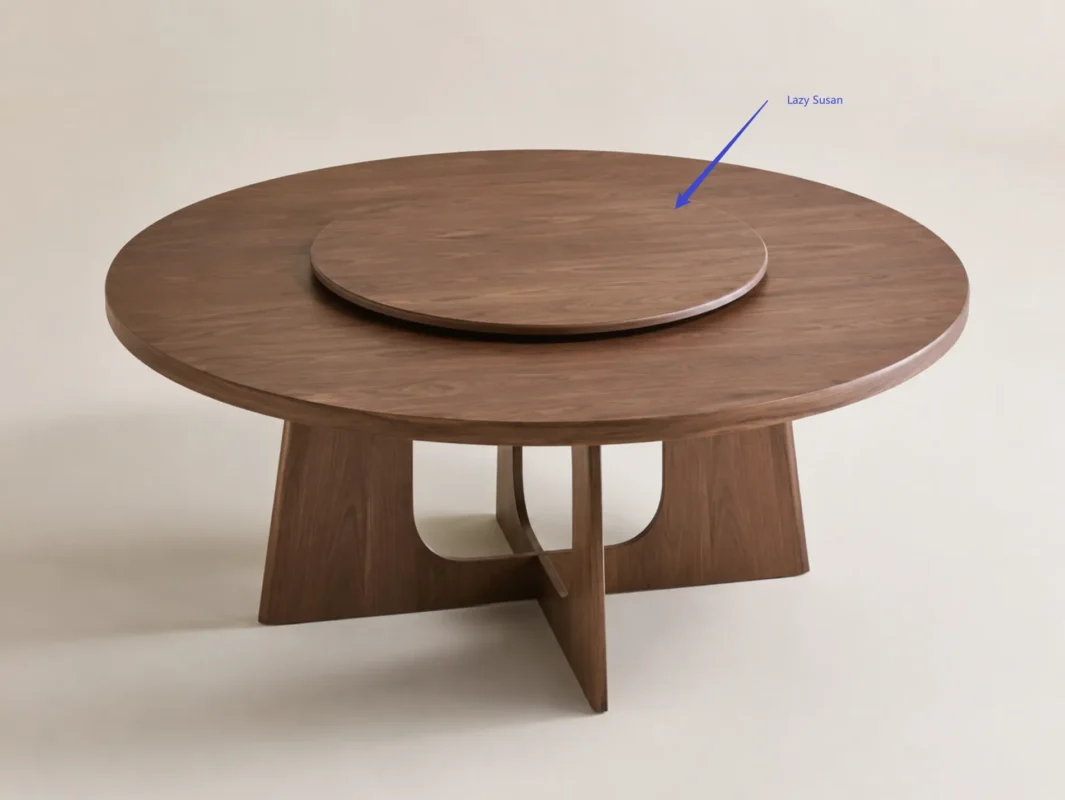
You may also wonder why this rotating tray is called a lazy Susan. In fact, the exact origin of the name is not completely clear. Some stories say it may have been named after a person called Susan, while another explanation connects the name with serving staff, because the rotating tray helps people take food by themselves and reduces the need for a server at the table. Although the true origin is uncertain, today the term lazy Susan is widely used to describe a rotating tray or turntable.
So, now it is easy to understand what a lazy Susan bearing is. A lazy Susan bearing is a bearing installed under a lazy Susan tray or rotating platform. It supports the load and allows the upper plate, tray, or tabletop to rotate smoothly over the fixed base.
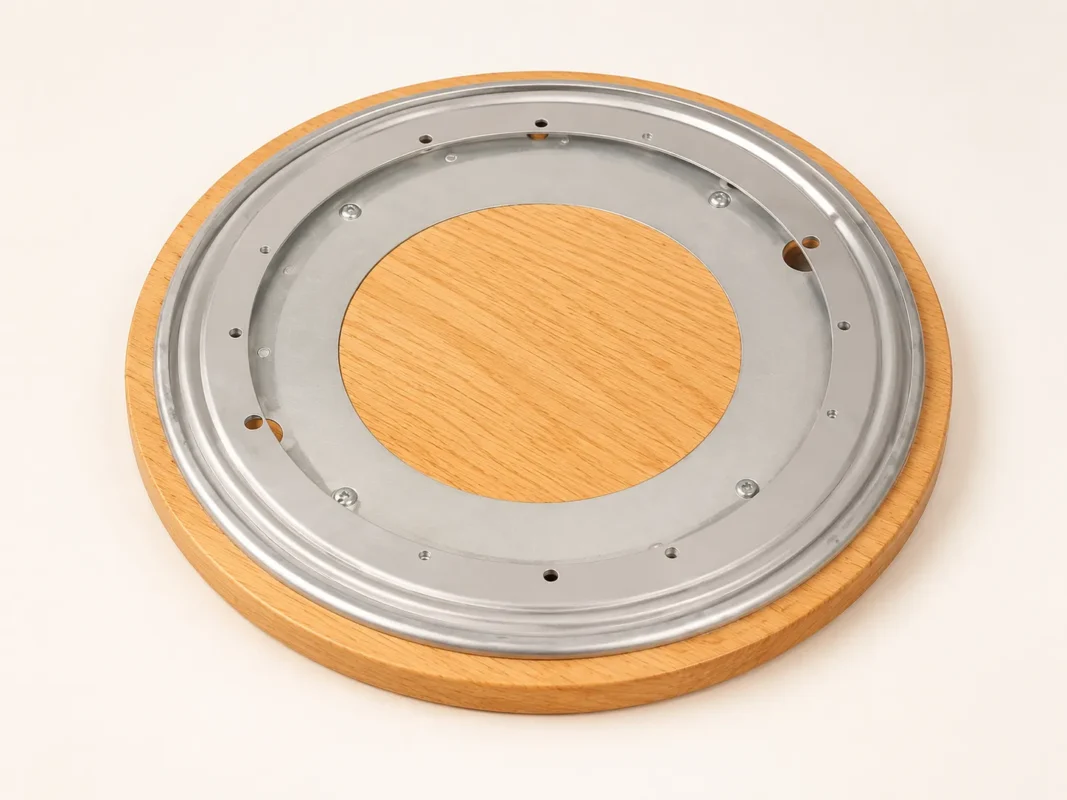
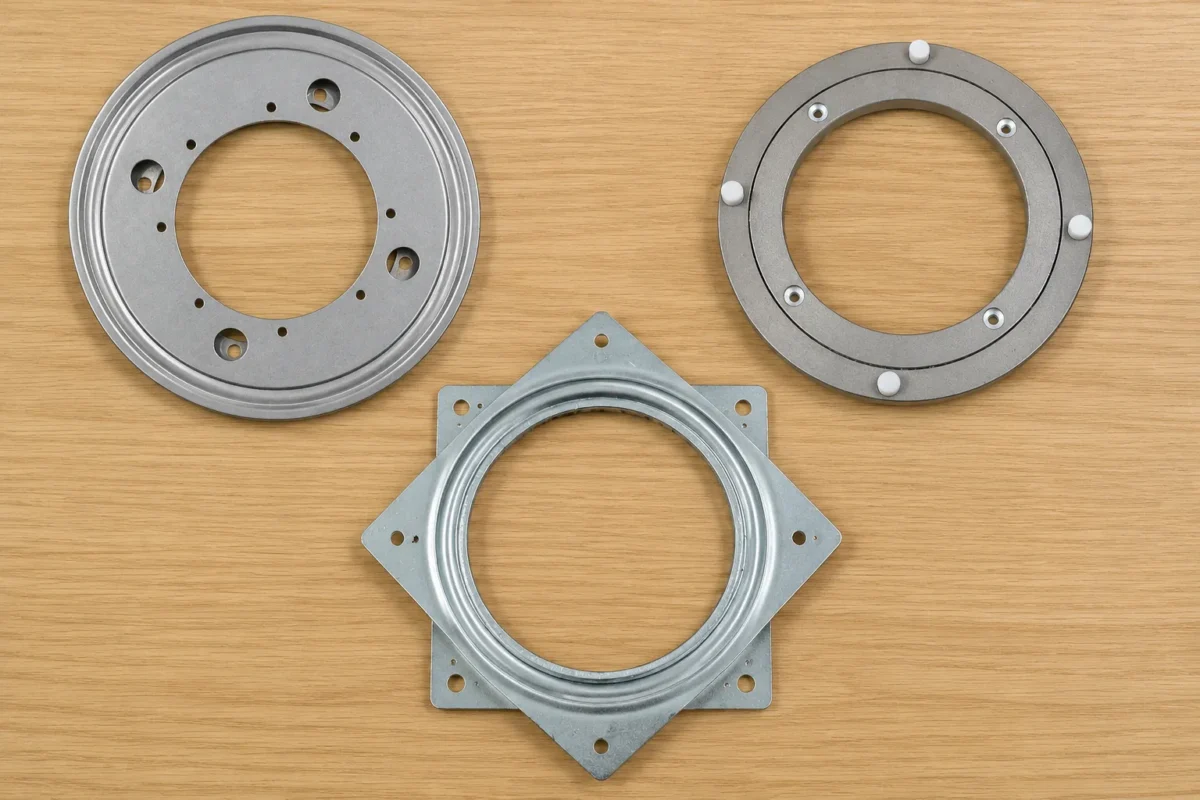
Common lazy Susan bearings are also called lazy Susan turntable bearings or turntable bearings. In common designs, they usually have two plates or rings, a circular ball race, and steel balls between the upper and lower parts. When the top plate rotates, the balls roll inside the raceway. This reduces friction and helps the tray or platform rotate smoothly.
Here are some pictures to show what lazy Susan bearings look like.
You May Also Like: What Are DU Bushings? How Do They Work?
Part 2. Lazy Susan Bearing vs Slewing Bearing: Key Differences
From the pictures above, and when you search for lazy Susan bearings online, you may also find slewing bearings in the search results. Some sellers may even describe lazy Susan bearings as slewing bearings. So, are they the same?
The answer is no.
Lazy Susan bearings and slewing bearings have a similar basic working principle. Both allow one part to rotate relative to another part by using rolling elements between two plates or rings. However, they are not the same product. Lazy Susan bearings are usually simpler, lighter, and used for low-speed furniture or display applications. Slewing bearings are usually larger, stronger, and designed for industrial equipment that needs to carry higher axial loads, radial loads, and tilting moments.
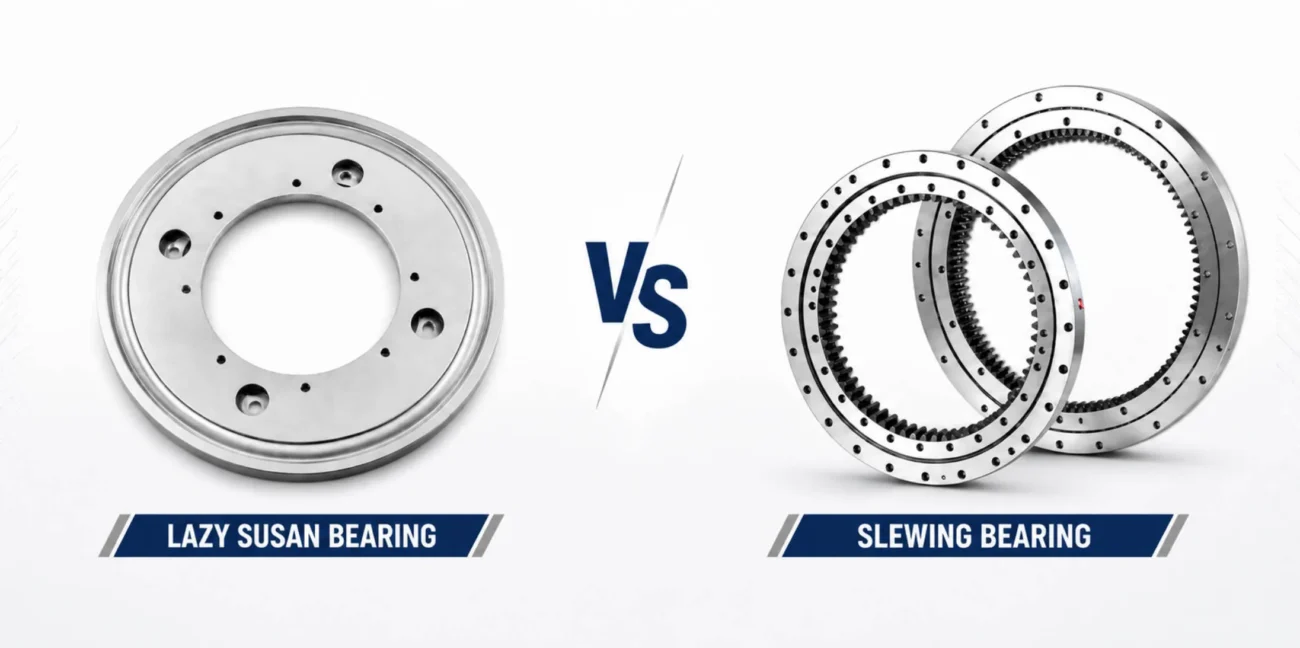
Here is a table to help you understand the key differences.
| Bearings | Lazy Susan Bearings | Slewing Bearings |
|---|---|---|
| Structure | Upper plate or ring, lower plate or ring, ball race, steel balls, and mounting holes. Some designs may also have pads or dimples. | Inner ring, outer ring, rolling elements, raceways, seals, mounting holes, and lubrication holes or grease nipples. Some slewing bearings also have internal gear, external gear, or no gear. Common designs include single-row ball, double-row ball, crossed roller, and three-row roller structures. |
| Load Capacity | Mainly used for light to medium-duty rotating loads. They are suitable for slow-speed rotation and simple support. | Designed for heavier loads. They can carry axial loads, radial loads, and tilting moments at the same time. |
| Applications | Dining tables, kitchen cabinets, storage organizers, display stands, rotating trays, and light to medium-duty rotating platforms. | Cranes, excavators, wind turbines, radar systems, industrial turntables, aerial platforms, and heavy machinery. |
| Main Difference | A simple and light-duty turntable bearing for furniture, cabinets, trays, and display products. | A heavy-duty industrial slewing ring used for large rotating equipment and higher load conditions. |
Part 3. How Does a Lazy Susan Bearing Work?
Now you have a clear understanding of what a lazy Susan bearing is. So, how does a lazy Susan bearing work? Here is the basic working principle.
A lazy Susan bearing usually has two plates or rings. One plate is fixed to the rotating tray, tabletop, or platform. The other plate is fixed to the base, table, cabinet, or another stationary section. Between these two plates, there is a ball race with steel balls.
When the tray or platform rotates, the upper plate rotates together with it and the steel balls roll inside the raceway between the two plates, while the lower plate remains fixed. This rolling motion reduces friction between the rotating part and the fixed part, supports the load, and allows the tray, tabletop, or platform to rotate smoothly 360 degrees.
Part 4. Lazy Susan Bearing Size Chart
There is no universal standard size chart for lazy Susan bearings, because different manufacturers may offer different outer diameters, materials, load capacities, mounting hole patterns, and structures. However, the following sizes are commonly used for many lazy Susan turntables, rotating trays, display tables, and tabletop applications.
When selecting a lazy Susan bearing size, a common recommendation is that the bearing outer diameter should be about half of the tabletop diameter. For example, if you have a 24-inch tabletop, a 12-inch lazy Susan bearing is commonly recommended.
However, size is not the only factor. You should also consider the load capacity, tabletop weight, rotation speed, installation space, mounting hole position, etc.
| Bearing Size | Suitable Tabletop Diameter | Suitable Tabletop Diameter in mm |
| 8 inch | 8–16 inch | 203–406 mm |
| 10 inch | 10–20 inch | 254–508 mm |
| 12 inch | 12–24 inch | 305–610 mm |
| 14 inch | 14–28 inch | 356–711 mm |
| 16 inch | 16–32 inch | 406–813 mm |
| 18 inch | 18–36 inch | 457–914 mm |
| 20 inch | 20–40 inch | 508–1016 mm |
| 24 inch | 24–48 inch | 610–1219 mm |
Also Read: Ball Bearing Size Chart: The Ultimate Guide
Part 5. Lazy Susan Bearing Uses
Lazy Susan bearings can be used in many applications. Here are the major ones:
- Dining table turntables
- Kitchen cabinets
- Display stands
- Machinery tables
- Industrial turntables
- Photography and video stands
- Craft and DIY projects
- Packaging and inspection stations
Part 6. Where to Buy Lazy Susan Bearing?
So, where can you buy lazy Susan bearings?
If you only need 1–2 pieces for a small DIY project, furniture repair, or home use, you can buy standard lazy Susan bearings from online retail platforms such as Amazon or local hardware stores.
If you need bulk orders, OEM production, or customized lazy Susan bearings, it is better to contact a lazy Susan bearing manufacturer like BKZ Industry. BKZ Industry has 15 years of bearing manufacturing experience, 2 bearing factories, and ISO 9001 quality control. We can supply standard and customized lazy Susan bearings based on your application requirements.
When contacting BKZ Industry, you can send us your requirements, such as the tabletop size, tray size, bearing diameter, load capacity, material, mounting hole design, quantity, drawings, or samples. Based on this information, BKZ Industry can check and send you a quotation.
Part 7. How to Assemble a Lazy Susan Bearing?
After receiving the lazy Susan bearing from the seller, you may need to install it. To assemble a Lazy Susan with a pre-made bearing, you can follow these general steps. However, the exact installation method may vary depending on the bearing size, bearing shape, screw hole design, and the structure of your tray, tabletop, or base.
1. Prepare the Components
First, prepare the Lazy Susan bearing, the rotating top, the fixed base, screws, drill, screwdriver, and measuring tools.
2. Mark the Center Position
Mark the center of the base and the underside of the rotating top. Correct centering is important because poor alignment may cause wobbling, uneven rotation, or unstable support.
3. Drill an Access Hole if Needed
For many wooden Lazy Susan turntables, you may need to drill an access hole in the base. This hole allows you to insert a screwdriver through the base and fasten the screws into the underside of the rotating top later.
The access hole is usually drilled in the base, not in the visible top surface. Its size should be large enough for the screwdriver and screw head to pass through, but it should not weaken the base structure.
4. Attach the Bearing to the Base
Place the bearing back on the base and align it with the center mark. Use suitable screws to fix the lower plate or ring of the bearing to the base.
Make sure the screws are tight, but do not overtighten them. Overtightening may deform the thin bearing plate and affect smooth rotation.
5. Attach the Rotating Top
Turn the base assembly over and position it on the underside of the rotating top. Align it carefully with the center marks.
Rotate the bearing until the access hole lines up with the screw holes in the upper plate or ring. Then drive screws through the access hole into the underside of the top.
Make sure the screws are shorter than the thickness of the top, so they will not go through the finished surface.
6. Check the Rotation
After installation, rotate the top by hand to check whether it turns smoothly.
7. Add Pads or Feet
To prevent the Lazy Susan from slipping or scratching the table surface, you can add felt pads, cork pads, rubber feet, or anti-slip pads to the bottom of the base.
FAQS
The bearing used in a Lazy Susan is usually a Lazy Susan turntable bearing with balls as the rolling elements. However, its design is different from deep groove ball bearings and angular contact ball bearings.
If your lazy Susan bearing does not work well, you can check the following points: whether the outside of the bearing is damaged, whether the balls inside are broken, whether the ball raceway is deformed, and whether dirt or debris has entered the bearing. If the lazy Susan bearing is damaged and cannot be fixed by cleaning, you should measure its dimensions and buy a suitable replacement.
Final Words
Now you know that lazy Susan bearings are bearings used to make a turntable, tray, or tabletop rotate smoothly. You also understand how it works. If you need to buy lazy Susan bearings in bulk, contact BKZ Industry. BKZ Industry can offer the lazy Susan bearings you need based on your size, quantity, and application requirements.