Ball bearings and roller bearings are two major categories in the bearing industry. If you are new to ball bearings and roller bearings, you may not be very clear about their differences.
So in this article, I will use simple words to explain the difference between ball bearings and roller bearings. After reading this ball bearing vs roller bearing comparison, you will have a clearer understanding of how they are different and which one may be more suitable for your application.
If you already know them clearly and want to buy ball bearings or roller bearings, you can contact BKZ Industry. BKZ Industry is a bearing manufacturer in China with 2 factories and can supply many types of bearings for industrial applications.
You can send the bearing information you have, such as the bearing number, quantity, dimensions, drawing, or application requirements, and BKZ Industry will help you check the suitable bearing solution.
Part 1. Ball Bearings vs Roller Bearings Comparison: Verdict in Advance
I understand that not everyone has time to read a long article. So, if you want to quickly understand the main differences between ball bearings and roller bearings, you can check the comparison table below.
| Category | Ball Bearings | Roller Bearings |
| Bearing Type | Rolling bearings | Rolling bearings |
| Rolling Elements | Balls | Rollers |
| Contact Type | Point contact | Line contact |
| Load Direction | Mainly radial load, and some types can carry axial load | Mainly radial load, and some types can carry axial load or combined load |
| Load Capacity | Lower load capacity compared with roller bearings of similar size | Higher load capacity, especially for radial loads |
| Major Structure | Outer ring, inner ring, balls, cage, lubricant, and sometimes seals or shields | Outer ring, inner ring, rollers, cage, lubricant, and sometimes seals |
| Major Types | Deep groove ball bearings, angular contact ball bearings, self-aligning ball bearings, thrust ball bearings | Cylindrical roller bearings, tapered roller bearings, spherical roller bearings, needle roller bearings, thrust roller bearings |
| Speed Performance | Generally suitable for higher speeds | Usually low to medium speed, depending on the roller bearing type and design |
| Friction | Lower friction because of point contact | Higher friction because of larger contact area |
| Noise | Usually lower noise, especially in high-speed and light-to-medium load applications | May generate more noise |
| Vibration | Lower vibration in high-speed and light-to-medium load applications | Better vibration resistance under heavy loads and shock-load conditions |
| Key Materials | Bearing steel, stainless steel, ceramic, plastic, and other special materials | Bearing steel, stainless steel, ceramic, and other special materials |
| Heat Generation | Usually less heat generation | Usually more heat generation under heavy loads or poor lubrication |
| Typical Applications | Electric motors, fans, pumps, bicycles, small gearboxes, medical devices, and aerospace precision parts | Construction equipment, conveyors, rolling mills, gearboxes, heavy machinery, mining equipment, and industrial transmission systems |
In short, ball bearings and roller bearings both belong to the rolling bearing family because they use rolling elements to reduce friction between moving parts.
The main difference is the shape of the rolling elements. Ball bearings use balls, so they create point contact between the rolling elements and raceways. This design helps reduce friction and allows smoother running at higher speeds. That is why ball bearings are commonly used in electric motors, fans, pumps, bicycles, and precision equipment.
Roller bearings use rollers as the rolling elements, such as cylindrical rollers, needle rollers, tapered rollers, and spherical rollers. These rollers create line contact with the raceways, which gives roller bearings a larger contact area. Because of this, roller bearings can carry higher loads, especially radial loads. They are more suitable for heavy-duty applications such as gearboxes, conveyors, construction equipment, rolling mills, and mining machinery.
So, the answer is not that one is always better than the other. Ball bearings are usually better for high-speed, low-friction, and smoother-running applications. Roller bearings are usually better for heavy loads, shock loads, and demanding industrial working conditions.
If you still want to learn more and have time to continue reading, let’s go deeper. I will explain the differences between ball bearings and roller bearings in detail.
Part 2. Roller vs Ball Bearing: What They Are?
To understand the difference between ball bearings and roller bearings, you first need to understand what they are and how they work.
Ball Bearings
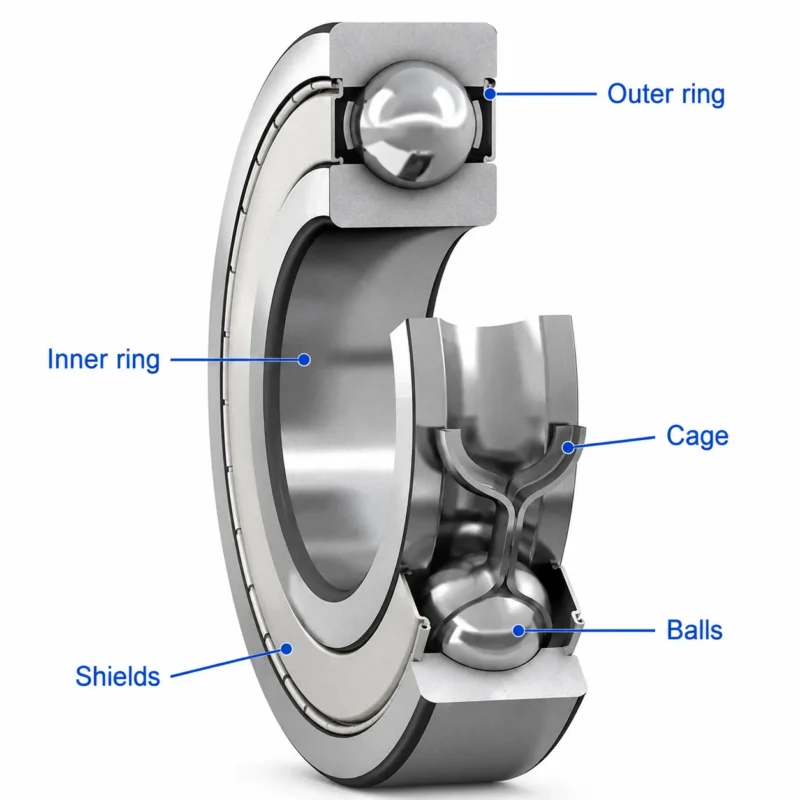
Ball bearings are rolling bearings that use balls as the rolling elements. The balls roll between the inner ring and the outer ring to reduce friction and support rotating parts.
The main feature of a ball bearing is point contact. This means the balls contact the raceways at small contact points. Because of this design, ball bearings usually have lower friction, smoother rotation, and better high-speed performance.
However, because the contact area is small, ball bearings usually carry lower loads than roller bearings of similar size.
Here is an image to help you understand.
Also Read: Ball Bearing Size Chart: The Ultimate Guide
Roller Bearings
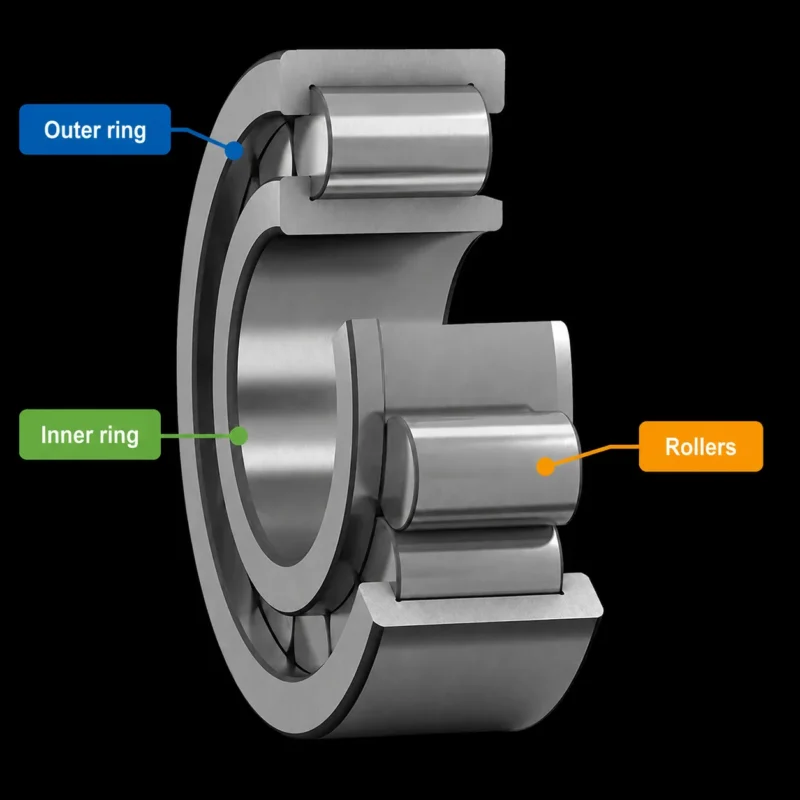
Roller bearings are rolling bearings that use rollers as the rolling elements. The rollers roll between the inner ring and the outer ring to reduce friction and support rotating parts.
Compared with ball bearings, roller bearings use line contact between the rollers and raceways. This gives them a larger contact area, so they can carry higher loads, especially radial loads.
However, because the contact area is larger, roller bearings usually generate more friction than ball bearings. They are also more sensitive to alignment, lubrication, clearance, and installation conditions.
Here is an image to help you understand.
Also Read: Tapered Roller Bearing Size Chart in mm: Single Row, Double Row, and Four Row Sizes
Part 3. Ball bearing vs Roller Bearing Pros and Cons
Except for the basic information mentioned in the table and definitions above, it is also important to understand their pros and cons. This helps you decide which bearing type is more suitable for your actual application.
Ball Bearings
Pros
Low friction: Ball bearings use point contact, so the contact area is smaller and friction is lower.
Moderate to high-speed capability: Smaller contact area creates less heat, so ball bearings are better for medium- and high-speed rotation.
Compact and lightweight: Balls and raceways usually need less space, so the bearing structure can be more compact.
Lower noise and vibration:Point contact and smooth ball rolling help reduce noise and vibration under light to medium loads.
Better for precision rotation: The ball shape, raceway accuracy, cage design, and clearance control help provide smooth and accurate rotation.
Cons:
Lower load-carrying capacity: Point contact concentrates the load in small areas, so ball bearings carry less load than roller bearings of similar size.
More sensitive to shock loads: Impact force is concentrated on the ball-to-raceway contact points, which may cause dents or raceway damage.
Lower rigidity under heavy loads: Point contact provides less stiffness, so ball bearings may deform more under heavy loads.
Limited heavy-duty performance: Their structure is designed more for speed and smooth rotation than for very heavy or continuous impact loads.
Roller Bearings
Pros:
Higher load-carrying capacity: Roller bearings use line contact, so the load is spread over a larger contact area.
Higher rigidity: The larger roller-to-raceway contact area gives the bearing better stiffness and shaft support.
Better for heavy-duty applications: The roller structure is stronger and more suitable for heavy radial loads and demanding working conditions.
Better shock-load resistance: Line contact helps distribute impact loads better than ball point contact.
Better load performance depending on type: Different roller designs handle different loads: cylindrical rollers mainly carry radial loads, tapered rollers carry combined loads, spherical rollers tolerate misalignment, and thrust rollers carry axial loads.
Some types can tolerate misalignment: This mainly applies to spherical roller bearings because their spherical outer raceway allows self-alignment.
Cons:
Higher friction: Line contact increases the contact area, so roller bearings usually create more friction than ball bearings.
Slightly lower rotational speeds: Larger contact area and heavier rolling elements create more heat at high speed.
Larger and heavier: Roller bearings usually need larger rollers, stronger rings, and a more robust structure to carry heavy loads.
More demanding installation: Their performance depends more on correct alignment, clearance, preload, and fitting accuracy.
More sensitive to lubrication under heavy loads: Larger contact areas and heavier loads require a stable lubricant film to prevent heat, wear, and surface fatigue.
May not be as quiet as ball bearings: Larger rolling elements and higher contact stiffness can create more noise if alignment, clearance, or lubrication is not correct.
Part 4. Ball and Roller Bearings Uses or Applications
Because ball bearings and roller bearings have different structures, advantages, and limitations, their applications are not always the same. Although both bearing types can be used in the same industries, they are often used in different machines, different positions, or different working conditions.
| Industry | Ball Bearings Applications | Roller Bearings Applications |
| Automotive | Electric motors, alternators, cooling fans, water pumps, air-conditioning compressors, steering systems | Gearboxes, wheel hubs, differentials, axle systems, heavy-duty transmissions |
| Electric Motors | Small and medium motors, fan motors, pump motors, servo motors, high-speed motor ends | Large industrial motors, traction motors, heavy-load motor shafts, motor drive ends under high radial load |
| Gearboxes and Transmissions | Light-duty gearboxes, auxiliary shafts, low-load rotating parts, high-speed input sections | Main shafts, output shafts, gear supports, differential gears, heavy-duty transmission systems |
| Machine Tools | High-speed spindles, precision motors, tool changers, light-duty rotary tables | Heavy-duty spindles, feed rollers, machine tool gearboxes, workpiece support systems |
| Pumps and Compressors | Small pumps, centrifugal pumps, compressor motors, high-speed rotating parts | Heavy-duty pumps, screw compressors, compressor crankshafts, high-load shaft supports |
| Fans and Blowers | Small fans, HVAC fans, motor fan bearings, low-noise blower motors | Large industrial fans, heavy-duty blowers, mining ventilation fans, high-load fan shafts |
| Mining Equipment | Electric motors, control units, auxiliary rotating parts | Crushers, vibrating screens, conveyors, grinding mills, heavy-duty gearboxes |
| Construction Machinery | Small motors, hydraulic pump motors, cab systems, auxiliary drives | Excavator swing systems, wheel loaders, cranes, bulldozers, final drives |
| Paper and Pulp Industry | Motors, pumps, fans, small guide rollers, auxiliary equipment | Dryer cylinders, press rolls, calender rolls, suction rolls, heavy conveyor rollers |
| Steel and Rolling Mills | Motors, lubrication pumps, control equipment, auxiliary drives | Rolling mill rolls, continuous casting machines, gearboxes, heavy-duty roller tables |
| Agricultural Machinery | Small motors, fans, seeders, light-duty rotating parts | Tractors, harvesters, tillage equipment, conveyor rollers, heavy-duty wheel hubs |
| Robotics and Automation | Servo motors, precision joints, small gearheads, linear motion systems | Heavy-load robot joints, reducers, rotary tables, large automation equipment |
| Railway and Transportation | Door motors, HVAC systems, auxiliary motors, control systems | Axle boxes, traction motors, gearboxes, wheelset supports |
| Marine Equipment | Pumps, motors, fans, steering control systems | Propulsion shafts, winches, deck machinery, marine gearboxes |
| Aerospace and Precision Equipment | Gyroscopes, actuators, precision motors, high-speed instruments | Landing gear systems, heavy-load actuators, gearbox supports, structural moving parts |
Part 5. Ball Bearing vs Roller Bearing Price
Many people think ball bearings are always much cheaper than roller bearings. But this is not completely true.
In general, if the bearing has the same size range, same material, similar precision grade, and similar application requirements, roller bearings are usually more expensive than ball bearings. This is because roller bearings often have larger rolling elements, stronger rings, more complex internal geometry, and higher load-carrying requirements.
But the price of a bearing is not decided only by whether it is a ball bearing or a roller bearing. It also depends on the bearing material, precision grade, size, structure, sealing design, cage material, heat treatment, manufacturing difficulty, brand, order quantity, and application requirements.
So, when comparing ball bearing and roller bearing prices, you should not only compare the bearing type. You should also check the bearing number, dimensions, material, precision, load rating, sealing structure, cage type, and working conditions.
Part 6. FAQS About Ball Bearings and Roller Bearings
In general, no. Roller bearings usually carry more load than ball bearings when they have similar size, material, and working conditions. This is because roller bearings use line contact, so the load is spread over a larger area. Ball bearings use point contact, so the load is concentrated in smaller areas.
In load capacity and rigidity, yes, roller bearings are usually stronger than ball bearings in similar size and material. Their roller structure provides a larger contact area with the raceways, so they can support heavier loads and resist deformation better. But ball bearings are still better for high speed, low friction, low noise, and compact designs.
Part 7 Conclusion: Which One is Better or How to Choose?
So, when selecting between ball bearings and roller bearings, which one is better for your application? The answer is not simply which one is better, but which one is more suitable for your working conditions. When choosing the right bearing, you should check the bearing type, shaft size, load direction, speed, working temperature, lubrication, installation space, precision requirement, and working environment.
If you are looking for a bearing manufacturer, you can contact BKZ Industry. BKZ Industry has 15 years of bearing manufacturing experience and can offer different ball bearings and roller bearings according to your application requirements.