Want to understand how a crane slewing bearing works before buying from a crane slewing bearing supplier? You have come to the right place.
First, I will explain what a crane slewing bearing is, including its definition, functions, materials, and advantages. Then, I will cover how a crane slewing bearing works, its major types, and where it is used. After covering these basics, I will introduce BKZ Industry as a crane slewing bearing supplier.
If you only want to purchase a crane slewing bearing directly from a supplier, you can skip the rest and click here to contact BKZ Industry with the information you already have.
Part 1. What Is a Slewing Bearing in a Crane?
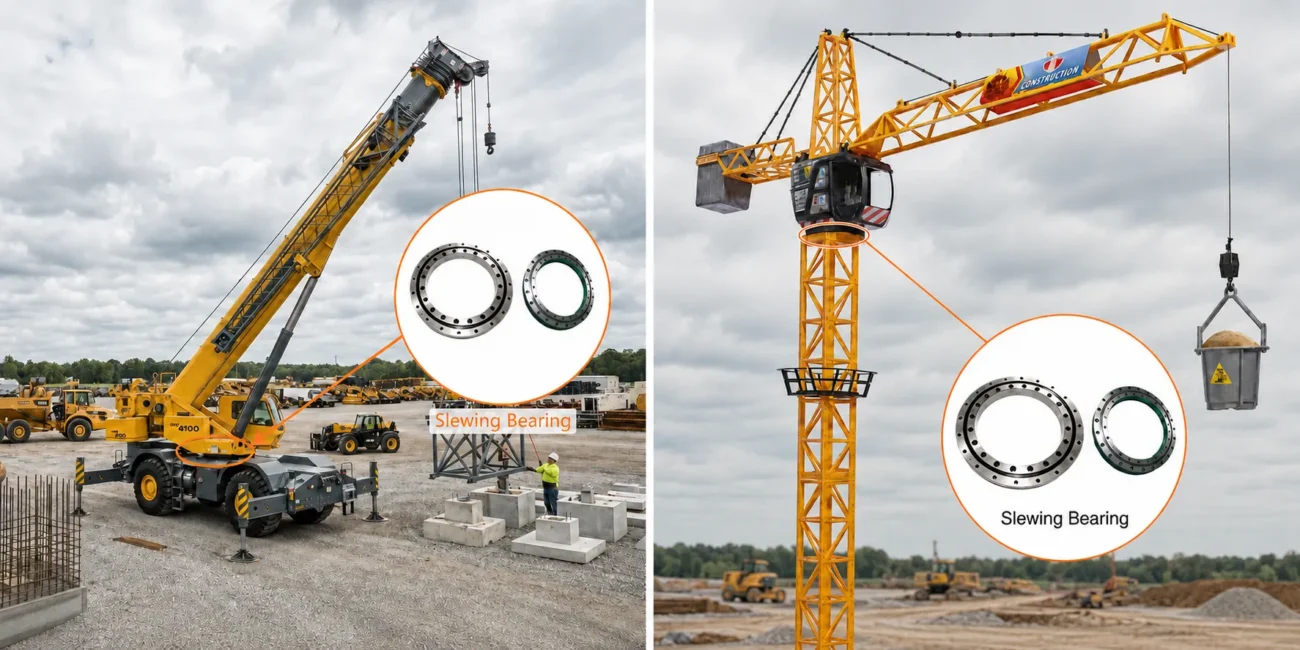
A crane slewing bearing is a large bearing installed between the crane’s upper rotating structure and lower supporting structure. It supports the upper structure, allows it to rotate relative to the base, and transmits axial loads, radial loads, and tilting moments. The following image shows the position of the slewing bearing in a crane.
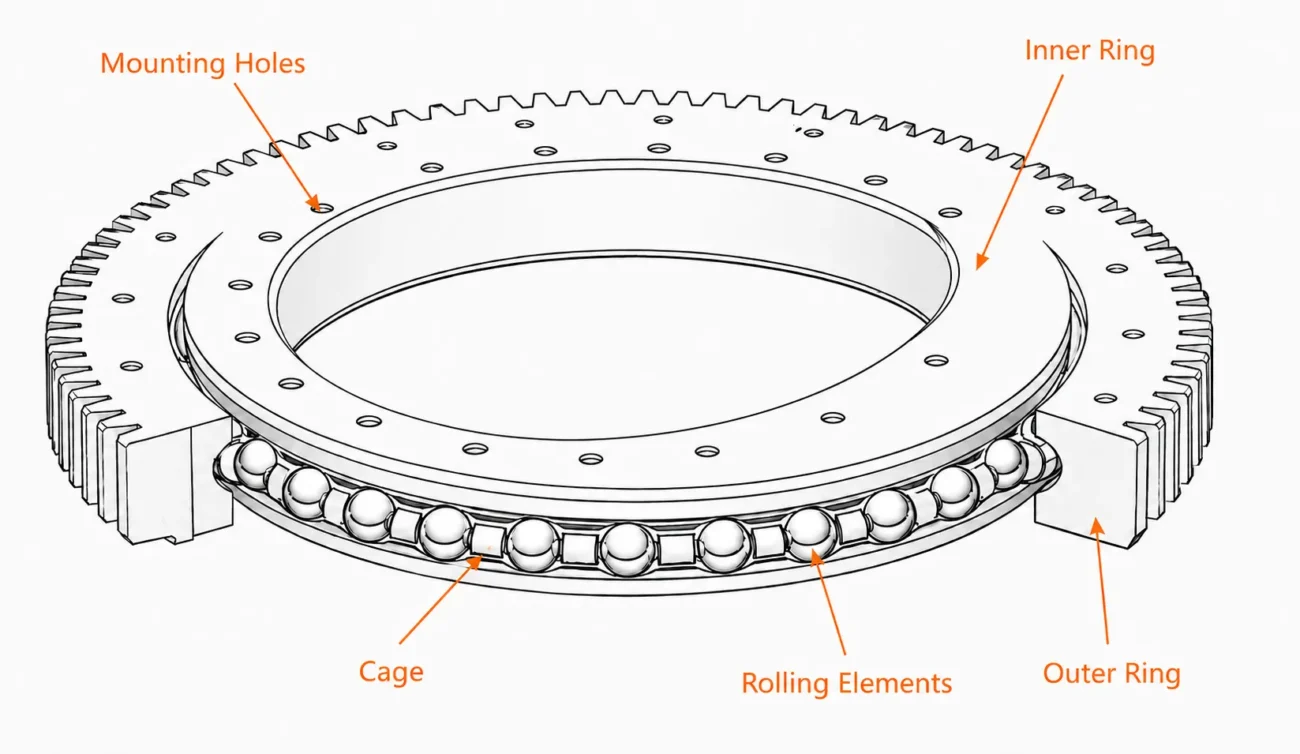
The main components of a crane slewing bearing include an inner ring, an outer ring, raceways, rolling elements, spacers or a cage, seals, and mounting holes. Depending on the design, the inner or outer ring may have gear teeth that mesh with the drive pinion to rotate the crane’s upper structure.
Major Functions of Crane Slewing Bearings
So, what are the major functions of slewing bearings in cranes? Here are the main ones:
- Support the Upper Structure: One of the major functions of a crane slewing bearing is to support the crane’s upper rotating structure and keep it properly positioned relative to the lower supporting structure.
- Connect the Upper and Lower Structures: The slewing bearing is installed between the crane’s upper rotating structure and lower supporting structure. Depending on the crane design, either the inner ring or outer ring is connected to the rotating structure, while the other ring is fixed to the supporting structure.
- Allow 360° Rotation: A crane slewing bearing allows the upper structure to rotate relative to the lower structure. Many cranes can achieve continuous 360° rotation, while some crane designs have a limited slewing range.
- Carry Axial Loads, Radial Loads, and Tilting Moments: As the slewing bearing is installed between the upper and lower structures, it carries and transmits loads between them. It mainly carries axial loads resulting from the weight of the upper structure and the lifted load. It also carries radial loads caused by wind, acceleration, and other external forces, as well as tilting moments generated by the lifted load, boom reach, and other operating conditions.
Advantages of Slewing Bearings for Crane
From the functions of crane slewing bearings, you can understand their importance in cranes. But why are slewing bearings used instead of other bearings? To answer this question, you should understand their main advantages.
- Carry Combined Loads: Slewing bearings can simultaneously carry axial loads, radial loads, and tilting moments within one compact bearing unit. In most crane applications, they mainly carry axial loads and tilting moments, together with radial loads.
- High Load-Carrying Capacity: Slewing bearings can be manufactured in large diameters. Their large raceways, multiple rolling elements, and special internal designs allow them to support the heavy loads generated by the crane’s upper structure, boom, and lifted load.
- Stable Rotation: Their large-diameter raceways and rigid structure help support the upper structure and provide stable, smooth rotation when the bearing is correctly selected, installed, and lubricated.
- Easy Installation and Drive Integration: Mounting holes in the inner and outer rings allow the slewing bearing to be bolted directly to the upper and lower structures. The bearing can also be designed with internal or external gear teeth to engage with a drive pinion and transmit slewing torque.
- Different Types for Different Applications: Slewing bearings are available in different designs, such as four-point contact ball, crossed roller, and three-row roller types. They can be selected according to the crane’s loads, required rigidity, rotation accuracy, installation space, and working conditions.
Materials of Slewing Bearings
Now, you know the advantages of slewing bearings and understand why they are used in cranes. However, when selecting a slewing bearing for your application, you should understand the materials used in its main components and determine whether they are suitable for the working conditions.
- Inner and Outer Ring Materials: The inner and outer rings are commonly made of medium-carbon steel or alloy steel, such as 50Mn, 42CrMo, or equivalent grades. The raceways are usually induction hardened to improve wear resistance and rolling-contact fatigue strength.
- Rolling Element Materials: The balls or rollers are generally made of hardened high-carbon chromium bearing steel, such as GCr15, SAE 52100, or 100Cr6.
- Cage or Spacer Materials: Slewing bearings commonly use spacers made of engineering plastic or reinforced nylon.
- Seal Materials: Seals are usually made of nitrile rubber (NBR). Polyurethane (PU) or fluoroelastomer (FKM).
Part 2. How Does a Crane Slewing Bearing Work?
Now that you have a clear idea of what a crane slewing bearing is, it is important to understand how it works. The slewing bearing is installed between the crane’s upper rotating structure and lower supporting structure. One ring is connected to the upper structure, while the other ring is connected to the lower structure.
When the crane’s slewing drive operates, the drive pinion usually engages with the internal or external gear teeth of the slewing bearing. This causes the rotating ring and the upper structure connected to it to rotate relative to the other ring. During rotation, the balls or rollers move along the raceways, allowing smooth relative movement while transmitting axial loads, radial loads, and tilting moments between the upper and lower structures.
Part 3. Types of Crane Slewing Bearings
When selecting the slewing bearings for crane, you can find different types. Here are the major types for you to understand and select the correct option after that.
- Single-Row Four-Point Contact Ball Slewing Bearing: This bearing has one row of balls running between specially designed raceways that form a four-point contact geometry. It can carry axial loads in both directions, radial loads, and tilting moments. Its compact structure makes it widely used in small- and medium-sized cranes.
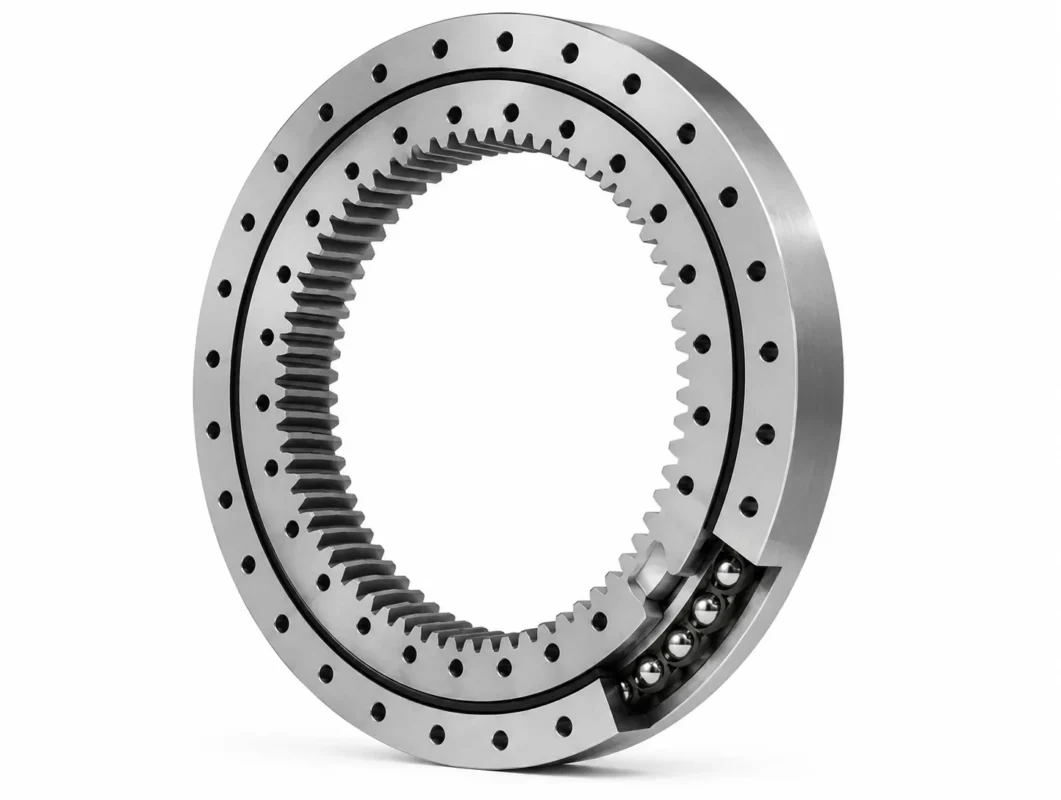
- Single-Row Crossed Roller Slewing Bearing: It has one row of cylindrical rollers, with the axes of adjacent rollers arranged alternately at approximately 90°. This design provides high rigidity and can carry axial loads, radial loads, and tilting moments. It is suitable for cranes requiring high rigidity and stable rotation.
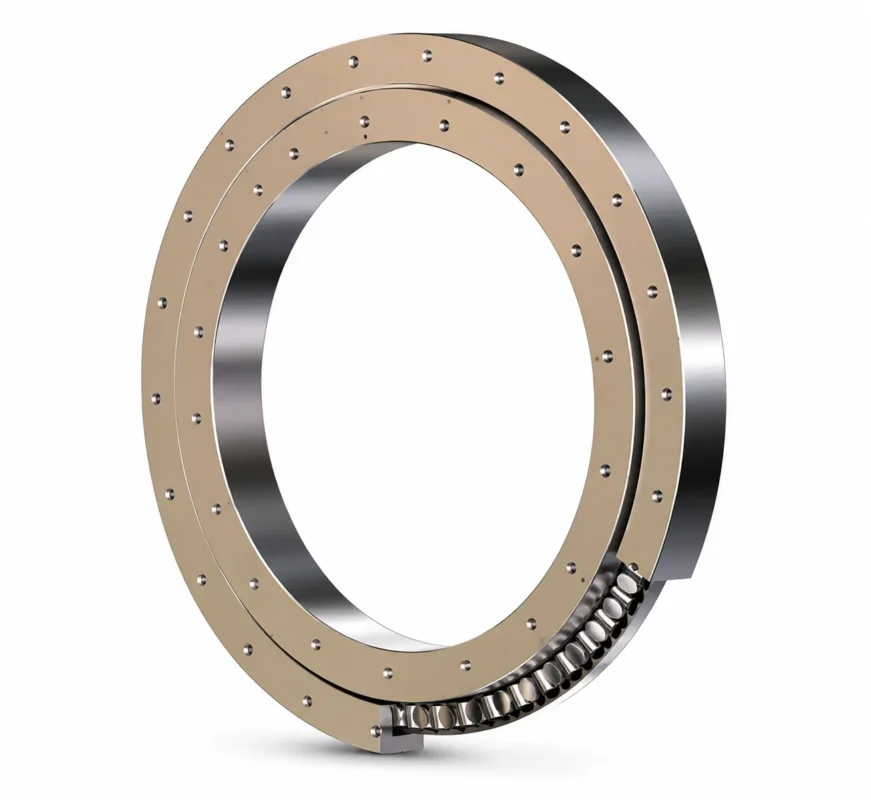
- Double-Row Ball Slewing Bearing: It has two rows of balls, which provide higher load-carrying capacity than a comparable single-row ball slewing bearing. It can carry axial loads, radial loads, and tilting moments and is suitable for cranes operating under heavier loads.
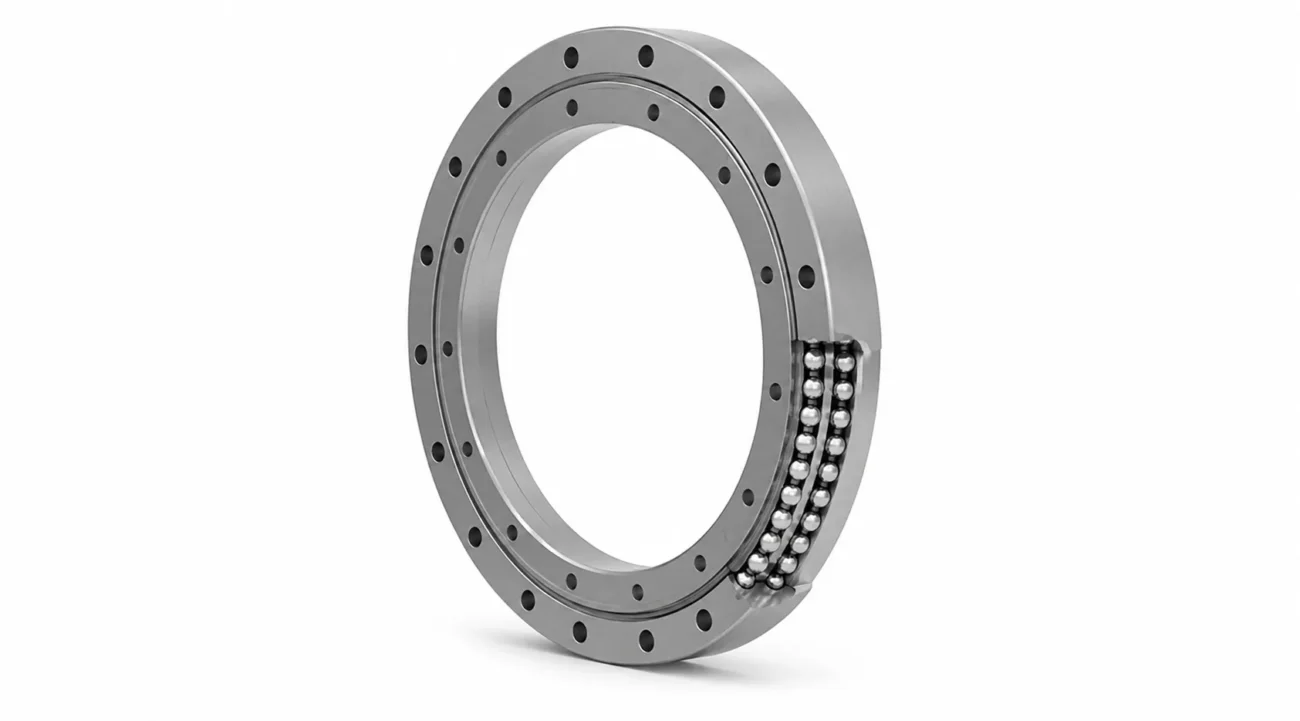
- Three-Row Roller Slewing Bearing:Three roller rows are used to separate different load components instead of requiring one row to carry all combined loads. This structure provides very high load-carrying capacity and rigidity, making it suitable for large and heavy-duty cranes.
Part 4. Crane Slewing Bearing vs. Crossed Roller Bearing
From the types of crane slewing bearings, you can see that the single-row crossed roller slewing bearing is one common type. Therefore, you may be confused about the relationship and differences between a slewing bearing and a crossed roller bearing.
Their Difference: They are classified according to different criteria. A slewing bearing is defined mainly by its function and overall structure. It is generally a large-diameter bearing installed between a rotating structure and a supporting structure to carry axial loads, radial loads, and tilting moments. A crossed roller bearing is defined by its internal rolling-element arrangement. Its cylindrical rollers are arranged alternately at 90° to one another.
Their Relationship: These two bearing categories can overlap. A crossed roller slewing bearing is both a slewing bearing and a crossed roller bearing because it combines the large-diameter, mounting-ready structure of a slewing bearing with the alternating roller arrangement of a crossed roller bearing. However, not all slewing bearings are crossed roller bearings, and not all crossed roller bearings are slewing bearings.
Part 5. Where Are Crane Slewing Bearings Used?
With these advantages, materials, functions, and types, crane slewing bearings can be used in many different types of cranes. Here are the major ones:
- Truck Crane
- Tower Crane
- Marine Crane
- Crawler Crane
- All-Terrain Crane
- Rough-Terrain Crane
- Truck-Mounted Loader Crane
- Mobile Harbor Crane
- Portal Harbor Crane
- Shipboard Deck Crane
- Floating Crane
- Railway Crane
- Telescopic Boom Crane
- Lattice Boom Crane
- Knuckle Boom Crane
- Derrick Crane
- Pedestal Crane
Part 6. Where to Buy Crane Slewing Bearings?
Now, you may have decided to buy crane slewing bearings. So, where can you buy them, and which crane slewing bearing supplier should you choose? Here, I recommend buying from BKZ Industry. Here are the reasons:
- Different Standard Crane Slewing Bearings Available: BKZ Industry supplies different types and sizes of standard crane slewing bearings based on your application requirements.
- Customized Slewing Bearings Supported: If you need customized slewing bearings, BKZ Industry can also support your requirements. You can send the drawings and technical requirements, and its team will check them and provide a quotation.
- 15+ Years of Experience: BKZ Industry has more than 15 years of experience in bearing manufacturing and exporting. It understands the requirements of bearing purchasers and can provide reliable production and delivery services.
- Strict Quality Control: BKZ Industry understands the importance of bearing quality. Material inspection reports, finished-product testing reports, and third-party inspection reports can be provided when required.
- Many Other Bearing Types Available: In addition to crane slewing bearings, BKZ Industry can supply many other types of bearings. Therefore, you can purchase different bearings from one supplier, saving time and simplifying the sourcing process.
Contact BKZ Industry now with the bearing type, dimensions or drawings, quantity, and other requirements to get a quotation.
Ending Note
Now, you know what a crane slewing bearing is, how it works, its major types, functions, and applications. If you decide to buy standard or customized crane slewing bearings, contact BKZ Industry with your drawings, dimensions, quantity, and other requirements to get a quotation.