When choosing the correct bearing, you need to consider whether the bearing will carry radial loads, axial loads, or combined loads. The load direction directly affects the bearing type, structure, and service life.
So, what are radial loads, axial loads, and combined loads? What are the differences between them? In this article, I will explain their meanings, key differences, common bearing types, and how to choose the right bearing based on load direction.
If you need bearings for radial loads, axial loads, or combined radial and axial loads, you can contact BKZ Industry. As a bearing manufacturer with 2 factories and 15 years of bearing manufacturing experience, BKZ Industry can help you choose and supply suitable bearings for your application.
Part 1. Radial Load vs Axial Load vs Combined Load: Key Differences
If you want to quickly understand the key differences between radial load, axial load, and combined before choosing bearings, you can check the comparison table below.
| Item | Axial Loads | Radial Loads | Combined Loads |
| Direction of Force | Parallel to the shaft axis | Perpendicular to the shaft axis | Both parallel and perpendicular to the shaft axis |
| Also Called | Thrust loads | Radial forces | Combined radial and axial loads |
| Main Force Direction | Pushes or pulls along the shaft | Presses down or sideways on the shaft | Acts from more than one direction |
| Major Bearing Types | Thrust ball bearings, cylindrical roller thrust bearings, needle roller thrust bearings, tapered roller thrust bearings | Cylindrical roller bearings, needle roller bearings | Angular contact ball bearings, tapered roller bearings, spherical roller bearings, deep groove ball bearings |
| Load Capacity Feature | Designed mainly to support force along the shaft direction | Designed mainly to support force at 90 degrees to the shaft axis | Designed to handle radial and axial force at the same time |
| Typical Example | Bicycle headset, screw jack, vertical shaft support | Skateboard wheel, conveyor roller, motor shaft | Gearbox shaft, car wheel hub, machine tool spindle |
From the table, you can see that the main difference between axial load, radial load, and combined load is the direction of force. Axial load acts parallel to the shaft axis, radial load acts perpendicular to the shaft axis, and combined load includes both radial and axial force components.
After reading the comparison table, if you are still not clear about the differences or do not know how to choose the right bearing, do not worry. Let’s understand radial, axial loads, and combined loads step by step.
Part 2. Radial vs Axial Load vs Combined Load: What Are They?
First, you need to understand what radial loads and axial loads are.
What is Radial Load?
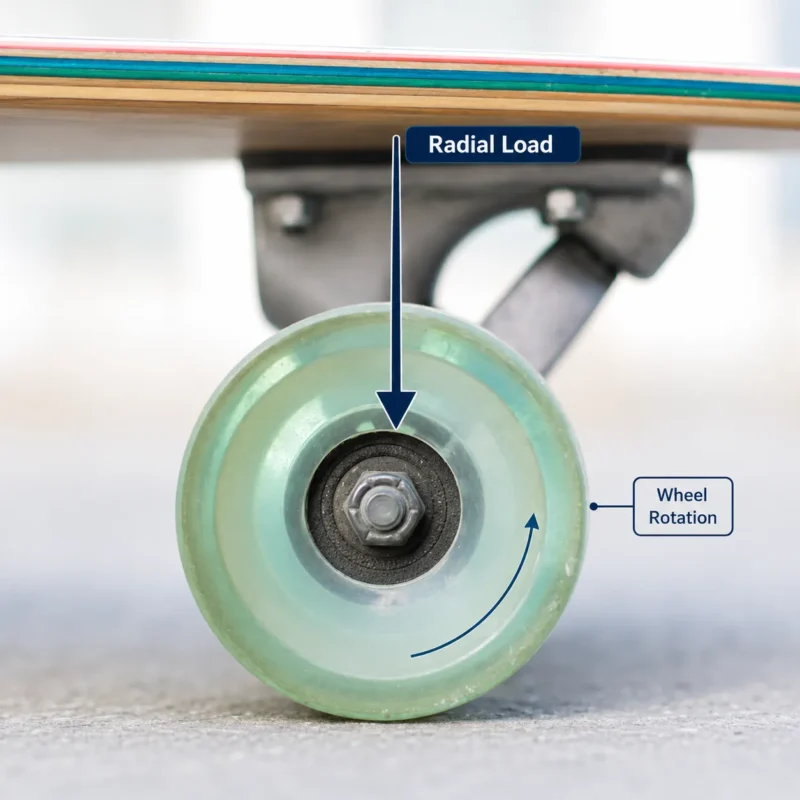
A radial load is a force acting perpendicular to the shaft axis. If the force acts at 90 degrees to the shaft axis, it is a radial load.
For example, in a skateboard wheel, when a rider stands on the skateboard, the rider’s weight is transferred to the wheel and axle. This force acts mainly perpendicular to the axle, so it creates a radial load on the bearing. The bearing must support this load while allowing the wheel to rotate smoothly.
What is Axial Load?
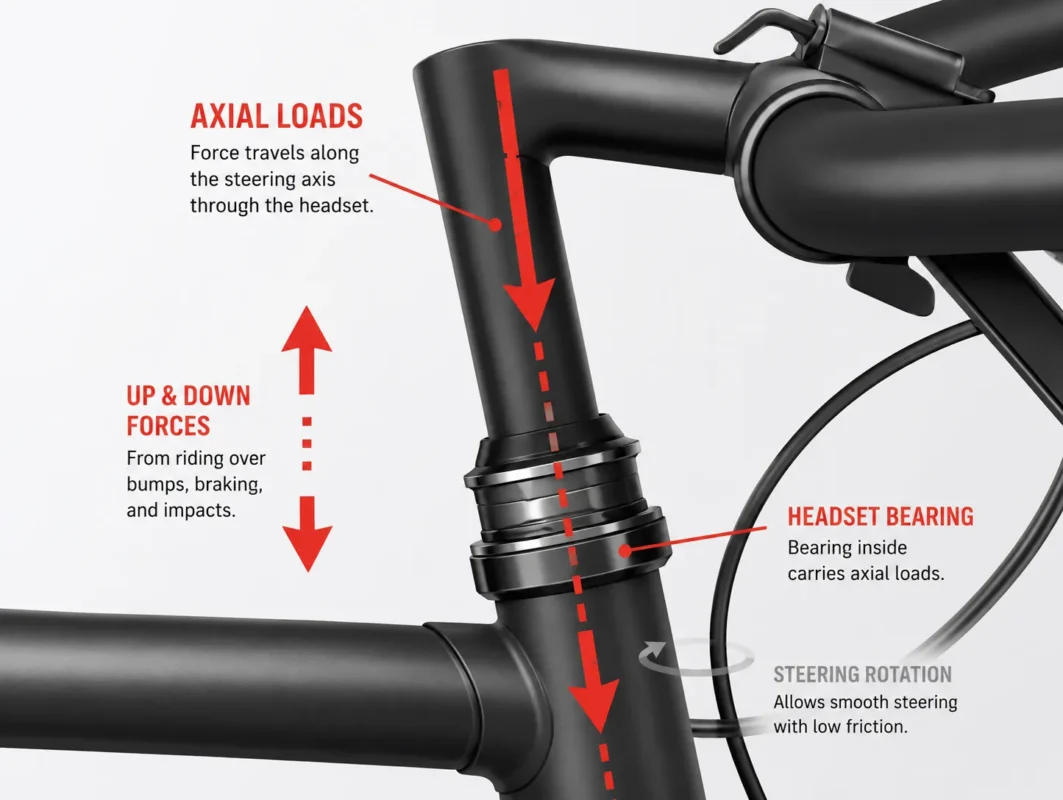
An axial load is a force acting parallel to the shaft axis. It is also called a thrust load.
Unlike radial load, which acts perpendicular to the shaft, axial load pushes or pulls along the shaft direction.
For example, the bearings in a bicycle handlebar headset can carry axial load. When the rider puts weight on the handlebar, or when the bicycle hits bumps, part of the force can be transferred along the steering axis. This creates an axial load on the headset bearings. These bearings help support the load while allowing the handlebar to turn smoothly.
What is Combined Load?
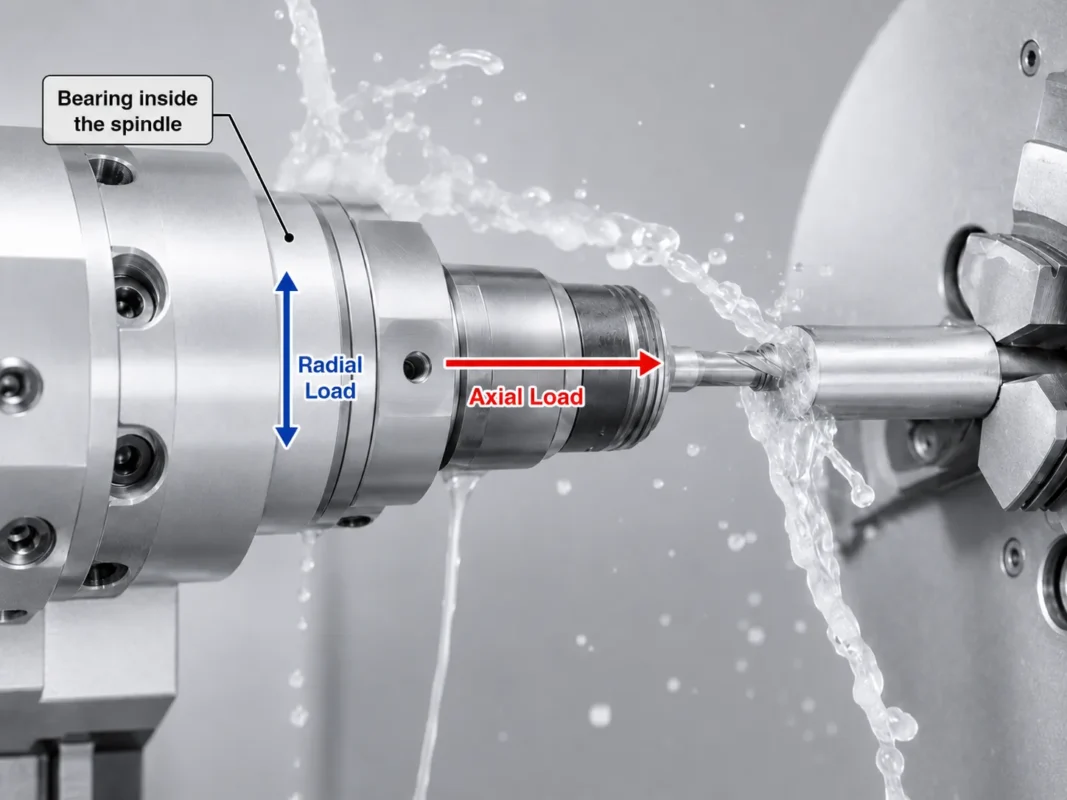
A combined load means that a bearing carries radial load and axial load at the same time. The radial load acts perpendicular to the shaft axis, while the axial load acts parallel to the shaft axis.
For example, in a machine tool spindle, the bearing may need to carry radial load from the cutting force and axial load from the thrust force during machining. In this case, the bearing is working under a combined load.
Part 3. Radial vs Axial Loads vs Combined Loads: Types of Bearings
Now that you understand radial load, axial load and combined loads, you may want to know which bearing types can carry radial loads, axial loads, or both. Here are the major types.
Bearings with Radial Load Capacity
Cylindrical Roller Bearings
Cylindrical roller bearings can carry high radial loads because their rollers contact the raceways in a line. This larger contact area helps spread the load better than point contact.
Needle Roller Bearings
Needle roller bearings use long and thin rollers. This design gives them a large contact area in a small bearing size, so they can support radial loads in limited space.
Bearings with Axial Load Capacity
Thrust Ball Bearings
Thrust ball bearings are designed to carry axial loads along the shaft direction. The balls roll between the shaft washer and housing washer, allowing the bearing to support thrust load while rotating.
Cylindrical Roller Thrust Bearings
Cylindrical roller thrust bearings carry axial loads through line contact between the rollers and washers. Because of this contact structure, they can handle higher axial loads than thrust ball bearings.
Tapered Roller Thrust Bearings
Tapered roller thrust bearings use tapered rollers and matching raceways to carry axial loads. Their geometry helps transfer thrust load more steadily through the roller contact area.
Needle Roller Thrust Bearings
Needle roller thrust bearings use needle rollers in a thrust bearing structure. The thin roller design helps them carry axial loads while keeping the bearing compact.
Besides bearings designed mainly for radial or axial loads, some bearings can carry both radial and axial loads.
Bearings That Can Carry Both Radial and Axial Loads
Deep Groove Ball Bearings
Deep groove ball bearings mainly carry radial loads. Their deep raceway grooves also allow them to carry moderate axial loads in both directions.
Angular Contact Ball Bearings
Angular contact ball bearings can carry both radial and axial loads because the balls contact the raceways at an angle. This contact angle gives the bearing better axial load capacity.
Spherical Roller Bearings
Spherical roller bearings can carry high radial loads because of their double-row roller design. Their spherical raceway also allows them to carry axial loads in both directions.
Tapered Roller Bearings
Tapered roller bearings can carry combined radial and axial loads because their rollers and raceways are tapered. A single tapered roller bearing usually carries axial load in one direction.
Part 4. How to Choose Bearings for Radial, Axial, or Combined Loads?
With so many bearing types that can carry radial loads, axial loads, or combined loads, how should you choose the right one? In most cases, you need to consider load direction, load size, speed, alignment, and installation space.
Load Direction
Radial loads and axial loads are determined by the direction of the force acting on the bearing. So, before choosing a bearing, you should first check the load direction in your application.
For example, the bearings in a forklift wheel mainly carry radial loads from the vehicle weight. Bearings in a high-speed motor spindle may need to carry radial loads, axial loads, or combined loads, depending on the spindle structure and cutting force direction.
An office chair swivel base usually needs to carry axial load from the user’s weight, and it may also carry some radial load or moment load when the chair tilts or moves. By checking the load direction first, you can know whether your application needs radial load capacity, axial load capacity, or both.
Load Size
After confirming the load direction, you need to check the load size. Different bearing types can carry the same load direction, but their load capacity is not the same.
For axial loads, thrust ball bearings are usually suitable for light to moderate axial loads. If the axial load is heavy, thrust roller bearings are usually a better choice because roller contact can carry higher loads than ball contact.
Working Speed
Load size is not the only factor. Working speed is also important.
In general, ball bearings are better for high-speed applications because they have lower friction. Roller bearings usually have higher load capacity, but their speed capability is often lower than ball bearings of similar size.
Alignment and Space
You also need to consider alignment and installation space.
If the shaft may bend or the housing alignment is not perfect, self-aligning ball bearings or spherical roller bearings may be better choices. They can tolerate a certain amount of misalignment.
If the installation space is limited, needle roller bearings or needle roller thrust bearings may be suitable because they can provide load capacity in a compact design.
So, the correct bearing choice is not based only on radial load or axial load. You need to consider load direction, load size, speed, alignment, space, lubrication, and working conditions together.
Final Words
After understanding radial loads, axial loads, and combined loads, you can better decide which bearing type may be suitable for your application. However, load direction is only one important factor in bearing selection.
To choose the correct bearing, you should also consider load size, speed, alignment, installation space, lubrication, sealing, temperature, and working conditions. If you are not sure which bearing is suitable for your application, or if you need to buy the correct bearing, you can contact BKZ Industry.
As a bearing manufacturer with 15 years of manufacturing experience, BKZ Industry can help you confirm the right bearing type based on your application and working conditions.