Spherical plain bearings are an important type of bearing within the plain bearing category. But what is a spherical plain bearing, and what does it look like? How does it differ from a standard plain bearing? What are its advantages, applications, main types, and available sizes?
In this guide, I will explain everything you need to know about spherical plain bearings, helping you understand their designs, types, and more before purchasing.
Once you understand this bearing type and are ready to buy in bulk, contact BKZ Industry. As a bearing manufacturer and one-stop sourcing supplier with 15+ years of manufacturing and export experience, BKZ Industry supplies a comprehensive range of spherical plain bearings for customers worldwide.
Contact BKZ Industry today to discuss your requirements and request a quote.
Part 1. What Is a Spherical Plain Bearing?
A spherical plain bearing, sometimes referred to as a spherical bushing, consists primarily of an inner ring and an outer ring. The outer surface of the inner ring forms a convex spherical sliding surface, while the inner surface of the outer ring forms a matching concave spherical sliding surface. These two surfaces remain in close contact and allow the inner ring to articulate relative to the outer ring.
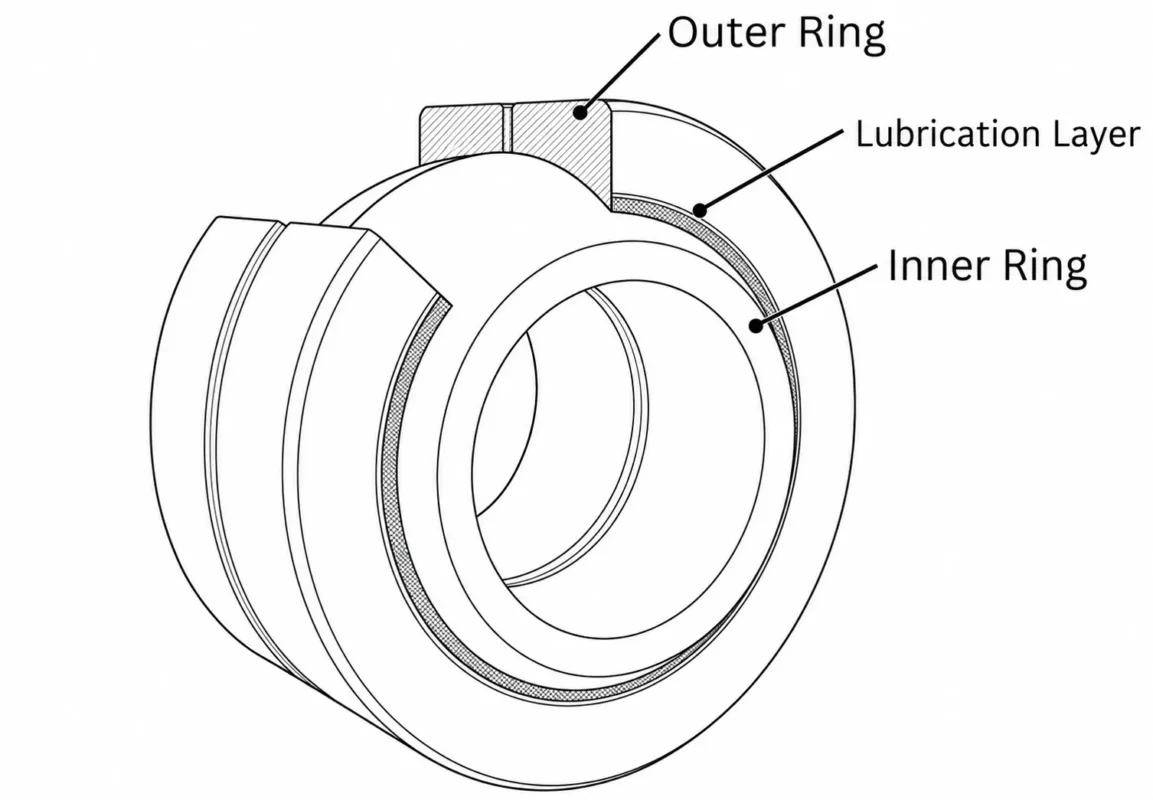
The inner and outer rings are commonly made of bearing steel, stainless steel, copper alloys, and other materials. Depending on the bearing design, the sliding surfaces may be lubricated with grease or oil, or fitted with a self-lubricating layer such as PTFE-based fabric, a metal–polymer liner, or graphite-containing material.
How Does a Spherical Plain Bearing Work?
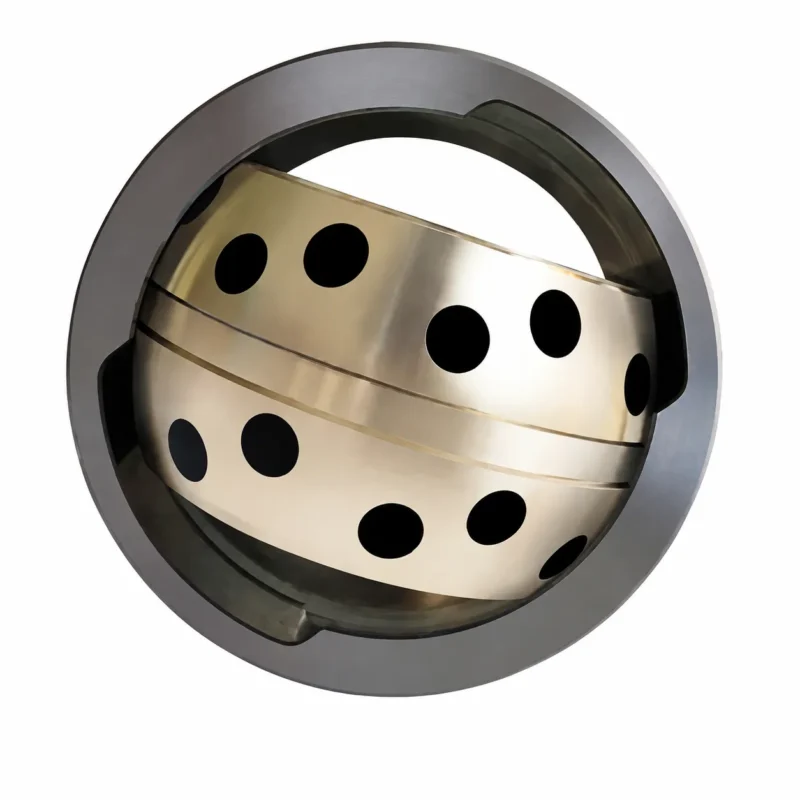
In a typical installation, the outer ring is secured in a housing, while the inner ring is mounted on a shaft. When the shaft tilts, oscillates, or becomes slightly misaligned, the inner ring articulates within the outer ring. The matching spherical surfaces allow this angular movement while continuing to support loads.
During operation, relative sliding occurs mainly between the convex outer surface of the inner ring and the concave inner surface of the outer ring. Grease, oil, or a self-lubricating liner reduces friction and wear at this interface.
Spherical Plain Bearing vs. Standard Plain Bearing
From its name and working principle, you can see that a spherical plain bearing is a type of plain bearing. However, there are significant differences between spherical plain bearings and standard plain bearings. To help you better understand spherical plain bearings, I will use the following table to compare the two types.
| Feature | Spherical Plain Bearing | Standard Plain Bearing |
| Structure | An inner ring with a convex spherical surface and an outer ring with a matching concave spherical surface | A one-piece sleeve, flanged bushing, or split bearing shell surrounding the shaft |
| Main Sliding Surface | Between the convex outer surface of the inner ring and the concave inner surface of the outer ring | Between the shaft surface and the cylindrical bore of the bearing |
| Misalignment | Accommodates angular misalignment within a specified articulation angle | Generally has little or no capacity to accommodate angular misalignment |
| Installation | The inner ring is mounted on the shaft, while the outer ring is fitted into the housing | The bearing is fitted into the housing, while its inner surface is in sliding contact with the shaft |
| Movement | The inner ring can oscillate, tilt, articulate, or rotate at low speeds with the shaft | Supports rotational or linear sliding movement between the bearing and the shaft |
As shown in the table, a spherical plain bearing differs significantly from a standard one-piece plain bearing. They have different structures, sliding surfaces, misalignment capabilities, installation methods, and types of movement. These differences make the two bearing types easy to distinguish.
Advantages of Spherical Plain Bearings
Now that you have a general idea of spherical plain bearings, you may want to know their key advantages.
- Compensate for Misalignment
One of the most important advantages of spherical plain bearings is their ability to accommodate angular misalignment. Their matching convex and concave spherical sliding surfaces allow the inner ring to tilt relative to the outer ring.
- Carry Radial and Axial Loads
Radial spherical plain bearings primarily carry radial loads and can also accommodate limited axial loads in both directions.
- Support Self-Lubrication
Spherical plain bearings can be designed with self-lubricating layers, such as PTFE-based fabric, metal–polymer liners, or graphite-containing materials. Therefore, they are suitable for applications where regular lubrication is difficult.
- Good Resistance to Vibration and Shock
Their robust construction and large sliding contact area allow spherical plain bearings to withstand vibration, shock loads, and fluctuating loads.
5. Suitable for Repeated Articulation, Slow Oscillation, and Limited-Angle Movement
With their matching convex and concave spherical sliding surfaces, spherical plain bearings are suitable for applications requiring repeated articulation, slow oscillation, and limited-angle movement.
Spherical Plain Bearing Applications
With these advantages, spherical plain bearings can be used in the following industries and equipment:
- Construction Machinery: Hydraulic excavators, wheel loaders, bulldozers, motor graders, backhoe loaders, road rollers, concrete pump trucks, crawler cranes, trenchers, and piling machines.
- Agricultural Machinery: Tractors, combine harvesters, seeders, planters, balers, ploughs, cultivators, forage harvesters, agricultural sprayers, and front-end loaders.
- Automotive Manufacturing: Vehicle assembly robots, welding fixtures, stamping presses, body-positioning systems, engine assembly equipment, chassis assembly equipment, vehicle lifts, automated guided vehicles, testing rigs, and paint-shop manipulators.
- Railway and Transit: Railway bogies, locomotive suspension systems, passenger-car suspension systems, track-maintenance machines, railway cranes, rail-grinding machines, ballast-tamping machines, turnout systems, coupling systems, and pantograph mechanisms.
- Marine and Shipbuilding: Ship steering systems, rudder mechanisms, deck cranes, hatch-cover systems, anchor-handling equipment, ship loaders, marine winches, offshore gangways, davit systems, and stabilizer mechanisms.
Part 2. What are the Different Types of Spherical Plain Bearings?
Spherical plain bearings can be classified based on two main criteria.
Based on Sliding Materials
Steel-on-Steel: The convex spherical surface of the steel inner ring slides against the matching concave spherical surface of the steel outer ring. Steel-on-steel spherical plain bearings require grease or oil to reduce friction and wear and normally need periodic relubrication.
Steel-on-PTFE: The three main options are steel/PTFE fabric, steel/PTFE FRP, and steel/PTFE sintered bronze. In these bearings, the steel inner ring slides against a PTFE-based liner. The PTFE produces a low-friction transfer film on the steel counterface, so these bearings are generally self-lubricating and maintenance-free.
Steel-on-Bronze: The convex spherical surface of the steel inner ring slides against the matching bronze sliding surface. Steel-on-bronze spherical plain bearings generally require oil or grease to reduce friction and wear.
Based on Product Form
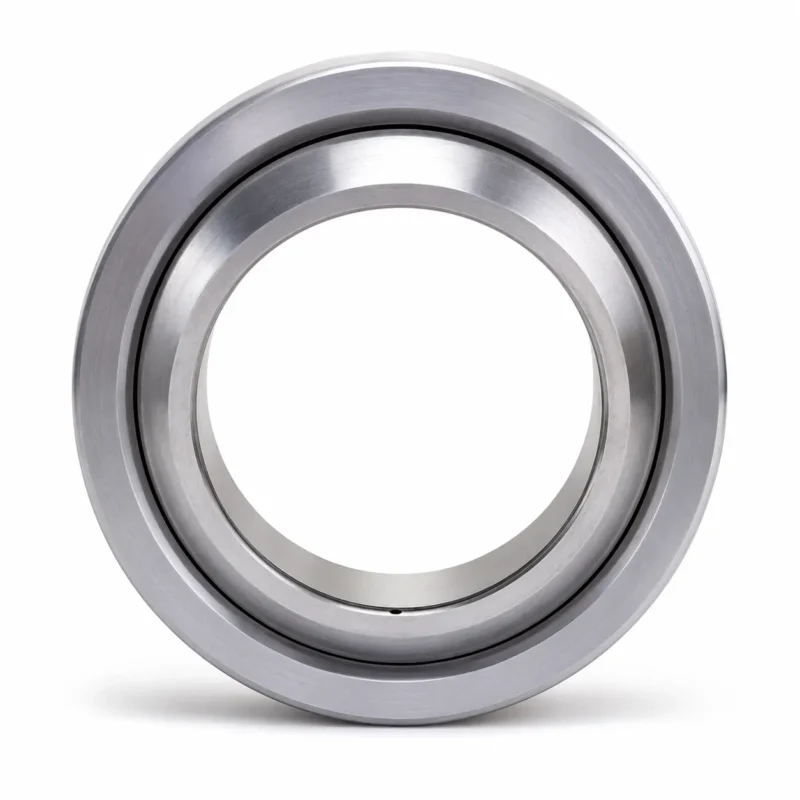
Spherical Plain Bearings: A spherical plain bearing is a separate bearing consisting mainly of an inner ring with a convex spherical surface and an outer ring with a matching concave spherical surface. It is installed directly into a machine housing or another mounting component.
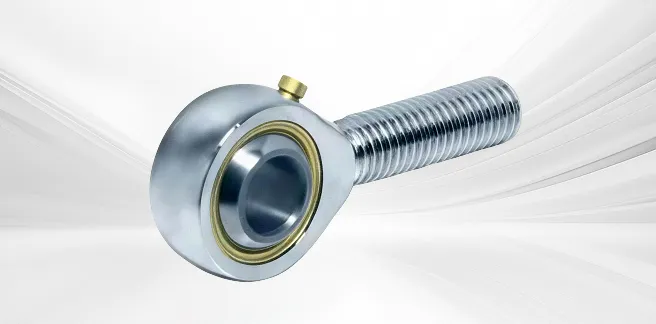
Rod End Bearings: A rod end consists of a rod-end housing with an internal or external thread and a spherical sliding joint. Depending on the design, the housing may contain a separate spherical plain bearing or incorporate the outer sliding surface directly. Rod ends are commonly used at the ends of rods, linkages, and hydraulic cylinders.
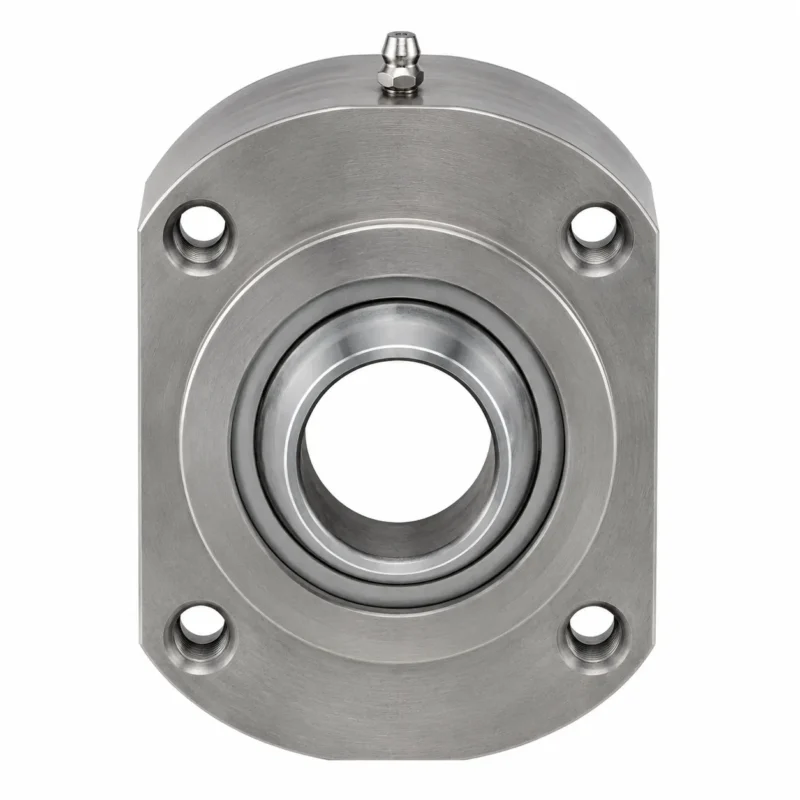
Spherical Plain Bearing Units: A spherical plain bearing unit combines a spherical plain bearing with a mounting housing or another ready-to-install arrangement. The housing makes mounting and positioning easier. Depending on the manufacturer, it may also be called a housed spherical plain bearing or spherical plain bearing assembly.
Part 3. Spherical Plain Bearing Size Chart
Spherical plain bearings are available in a wide range of sizes. The table below lists only some of the sizes offered by BKZ Industry. If your required size is not listed, contact BKZ Industry directly for availability and pricing.
| Bore Diameter, d (mm) | d Tolerance, h7 (mm) | Outside Diameter, D1 (mm) | D1 Tolerance, h6 (mm) | Inner Ring Width, B (mm) | Outer Ring Width, C (mm) | Spherical Surface Diameter, D (mm) | Allowable Alignment Angle, α (°) | Allowable Radial Load (kN) | Allowable Thrust Load (kN) |
| 15 | +0.018 / 0 | 26 | 0 / −0.013 | 12 | 9 | 22 | 8 | 6.5 | 0.5 |
| 20 | +0.021 / 0 | 32 | 0 / −0.013 | 16 | 14 | 28 | 4 | 12.6 | 1.4 |
| 25 | +0.021 / 0 | 42 | 0 / −0.016 | 21 | 18 | 36 | 5 | 21.8 | 2.5 |
| 30 | +0.021 / 0 | 50 | 0 / −0.016 | 27 | 23 | 44 | 6 | 32.0 | 3.5 |
| 35 | +0.025 / 0 | 55 | 0 / −0.019 | 30 | 26 | 49 | 5 | 43.7 | 4.8 |
| 40 | +0.025 / 0 | 62 | 0 / −0.019 | 33 | 28 | 55 | 6 | 54.7 | 5.7 |
| 45 | +0.025 / 0 | 72 | 0 / −0.019 | 36 | 31 | 62 | 5 | 69.7 | 7.2 |
| 50 | +0.025 / 0 | 80 | 0 / −0.019 | 42 | 36 | 70 | 5 | 92.4 | 10 |
| 60 | +0.030 / 0 | 100 | 0 / −0.022 | 53 | 45 | 90 | 6 | 143 | 16 |
| 70 | +0.030 / 0 | 110 | 0 / −0.022 | 58 | 50 | 99 | 5 | 181 | 20 |
| 80 | +0.030 / 0 | 130 | 0 / −0.025 | 70 | 60 | 115 | 6 | 254 | 30 |
| 90 | +0.035 / 0 | 140 | 0 / −0.025 | 76 | 65 | 125 | 6 | 313 | 36 |
| 100 | +0.035 / 0 | 160 | 0 / −0.025 | 88 | 75 | 145 | 6 | 544 | 64 |
| 110 | +0.035 / 0 | 170 | 0 / −0.025 | 93 | 80 | 155 | 5 | 642 | 73 |
| 120 | +0.035 / 0 | 190 | 0 / −0.029 | 105 | 90 | 170 | 6 | 797 | 94 |
| 130 | +0.040 / 0 | 200 | 0 / −0.029 | 110 | 95 | 180 | 5 | 880 | 105 |
| 140 | +0.040 / 0 | 210 | 0 / −0.029 | 90 | 70 | 180 | 7 | 668 | 56 |
| 150 | +0.040 / 0 | 220 | 0 / −0.029 | 120 | 105 | 200 | 5 | 1135 | 129 |
| 160 | +0.040 / 0 | 230 | 0 / −0.029 | 105 | 80 | 200 | 8 | 891 | 73 |
| 180 | +0.040 / 0 | 260 | 0 / −0.032 | 105 | 80 | 225 | 6 | 1002 | 74 |
| 200 | +0.046 / 0 | 290 | 0 / −0.032 | 130 | 100 | 250 | 7 | 1434 | 117 |
| 220 | +0.046 / 0 | 320 | 0 / −0.032 | 135 | 100 | 275 | 8 | 1577 | 118 |
| 240 | +0.046 / 0 | 340 | 0 / −0.036 | 140 | 100 | 300 | 8 | 1720 | 118 |
| 260 | +0.052 / 0 | 370 | 0 / −0.036 | 150 | 110 | 325 | 7 | 2075 | 143 |
| 280 | +0.052 / 0 | 400 | 0 / −0.040 | 155 | 120 | 350 | 6 | 2455 | 172 |
| 300 | +0.052 / 0 | 430 | 0 / −0.040 | 165 | 120 | 375 | 7 | 2630 | 172 |
Part 4. Where to Buy Spherical Plain Bearings?
Now that you have a better understanding of spherical plain bearings, you may be ready to purchase them for your application. For bulk orders, contact BKZ Industry for spherical plain bearings and other industrial bearing products. Here are several reasons to choose BKZ Industry as your bearing supplier:
- One-Stop Bearing Sourcing
BKZ Industry manufactures core bearing products in-house and has also established long-term relationships with more than 20 qualified bearing factories. This sourcing network allows purchasers to buy spherical plain bearings and many other bearing types from one supplier, reducing the time and cost involved in managing multiple manufacturers. - Quality Control
Whether bearings are manufactured in-house or sourced from qualified partner factories, BKZ Industry applies quality-control requirements throughout the sourcing and supply process. Relevant production records, inspection reports, and testing documents can also be provided according to the product and order requirements. - 15+ Years of Manufacturing and Export Experience
With more than 15 years of bearing manufacturing and export experience, BKZ Industry understands different technical, purchasing, packaging, and shipping requirements. Its export experience also helps coordinate documentation and international delivery efficiently.
Contact BKZ Industry today and provide the required bearing model, dimensions, quantity, application, and operating conditions to receive a quotation for spherical plain bearings.
Ending Note
Now, you know that a spherical plain bearing uses matching convex and concave spherical sliding surfaces to accommodate angular movement and misalignment. You also understand its structure, working principle, advantages, types, sizes, and common applications.
If you decide to purchase spherical plain bearings in bulk, contact BKZ Industry today for product availability and pricing.