Carrier bearings are commonly used in vehicles, especially in driveshaft and differential systems. But what is a carrier bearing? What does it do? What are the common types? How can you know when it needs to be replaced? And how should it be replaced?
In this article, I will explain everything you need to know about carrier bearings, including their function, types, bad signs, replacement, and where to buy them.
If you are a repair company, engineer, wholesaler, or distributor who needs to buy carrier bearings in bulk, you can contact BKZ Industry. BKZ Industry can manufacture and supply almost all types of carrier bearings you need.
Part 1. What Is a Carrier Bearing?
A carrier bearing is a bearing used to support a rotating part and keep it aligned during operation.
However, the term carrier bearing may refer to different bearings depending on the vehicle or mechanical structure.
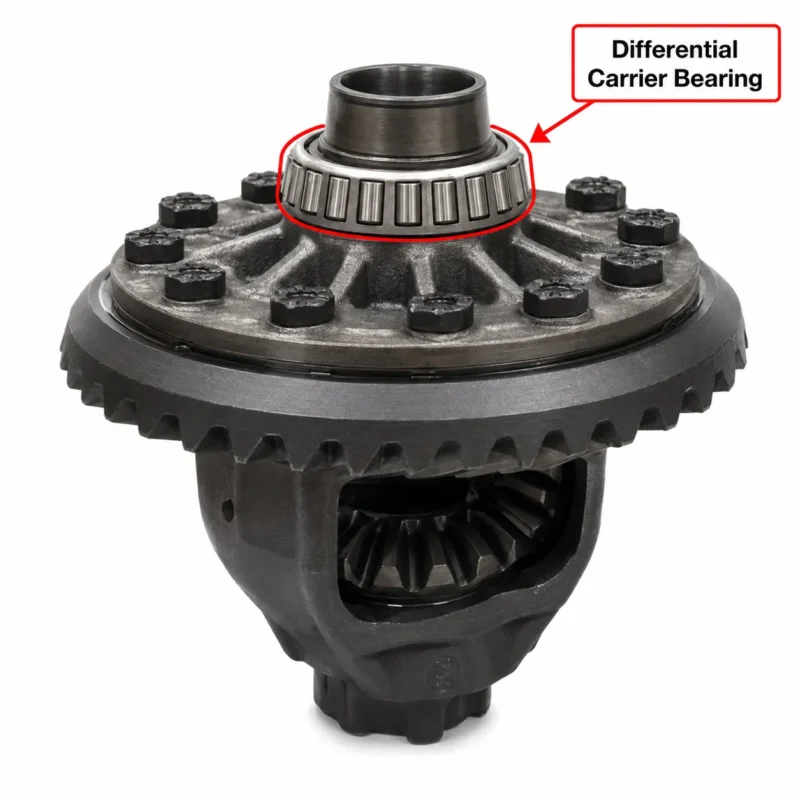
In a differential, a carrier bearing usually means the differential carrier bearing. It supports the differential carrier, also called the differential case, and helps keep the ring gear and differential assembly rotating in the correct position.
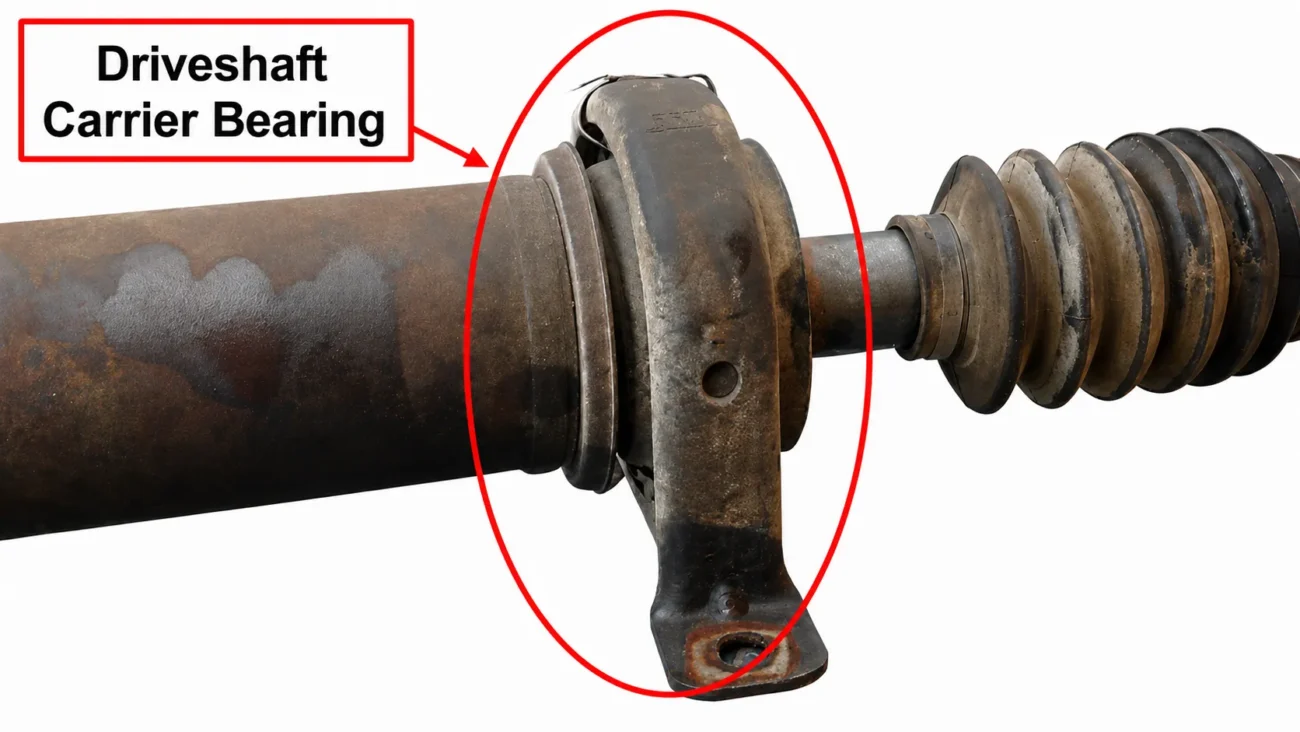
In a driveshaft system, a carrier bearing usually means the driveshaft carrier bearing or center support bearing. It supports the middle section of a long or two-piece driveshaft and helps reduce vibration, shaft movement, and misalignment.
Although differential carrier bearings and driveshaft carrier bearings can appear in similar vehicles, such as rear-wheel drive vehicles, four-wheel drive vehicles, trucks, pickups, and buses, they are not the same part.
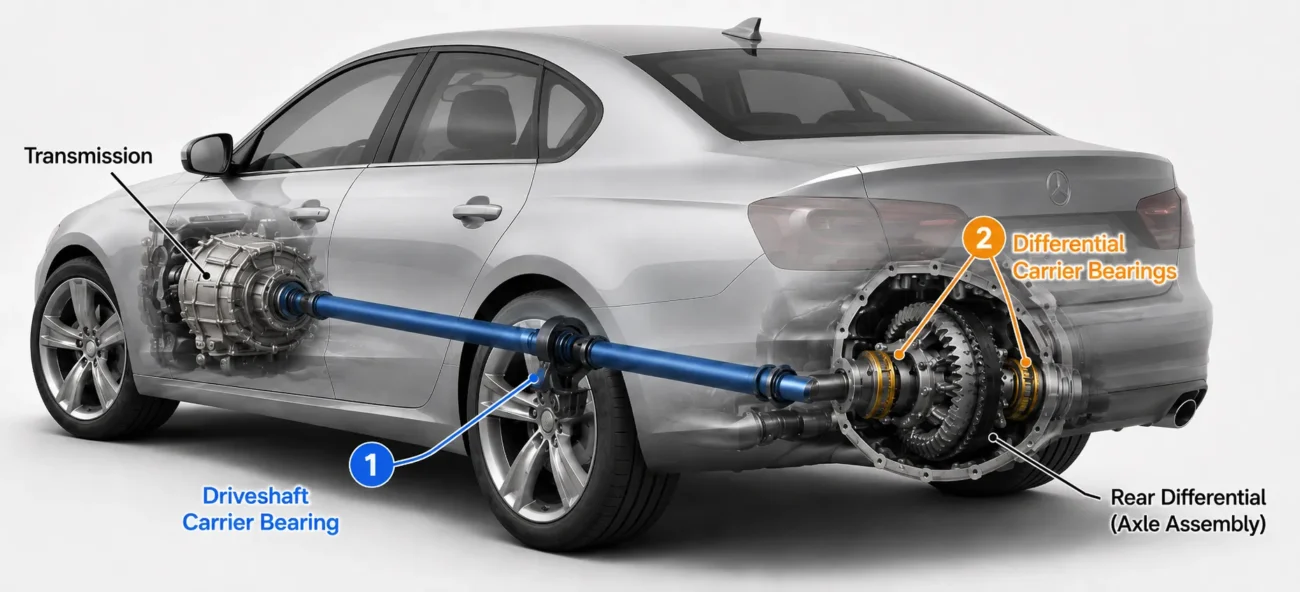
So, before replacing or buying a carrier bearing, you need to confirm its exact location first. The picture below shows where the differential carrier bearing and driveshaft carrier bearing are located, so you can recognize them more directly.
Main Functions of Carrier Bearings
Although carrier bearings can be differential carrier bearings or driveshaft carrier bearings, their major purposes and functions are similar.
Support rotating parts.
A differential carrier bearing supports the differential carrier inside the differential housing. A driveshaft carrier bearing supports the driveshaft, especially in long or multi-piece driveshaft systems.
Keep the rotating component aligned.
Carrier bearings help keep the differential carrier or driveshaft in the correct position during operation. This helps prevent excessive runout, misalignment, and unstable rotation.
Reduce friction.
The rolling elements inside the bearing reduce friction between the rotating part and the fixed housing or support bracket. This helps the drivetrain run more smoothly and reduces heat generation.
Help reduce vibration and noise.
For a differential carrier bearing, correct preload and alignment help reduce gear noise and abnormal vibration. For a driveshaft carrier bearing, the bearing supports the shaft, while the surrounding rubber mount helps absorb vibration from the driveshaft.
Maintain stable power transmission.
By supporting the carrier or driveshaft correctly, carrier bearings help the drivetrain transmit torque smoothly and prevent excessive movement under load.
Protect related parts.
A worn or loose carrier bearing can cause gear misalignment, driveshaft vibration, seal damage, uneven wear, and noise. A properly working carrier bearing helps extend the service life of the differential, driveshaft, and connected components.
Common Types of the Carrier Bearings
Carrier bearings use different bearing structures according to their installation position, load direction, speed, and support method.
For Differential Carrier Bearings
Tapered roller bearings are the most commonly used type for differential carrier bearings. They use tapered rollers and tapered raceways, so they can carry both radial loads and axial loads from gear meshing. In a differential, this helps keep the differential carrier stable and keeps the ring gear correctly aligned with the pinion gear.
For Driveshaft Carrier Bearings
Deep groove ball bearings with a rubber support bracket are the most common structure for driveshaft carrier bearings. The deep groove ball bearing supports the rotating driveshaft, while the rubber support helps absorb vibration, road shock, and shaft movement. This design is widely used in trucks, pickups, SUVs, buses, and other vehicles with long or multi-piece driveshafts.
Other Bearing Types in Industrial Support Positions
In industrial carrier or shaft support applications, other bearing types may also be used, such as pillow block bearing units, spherical roller bearings, and cylindrical roller bearings.
These bearing types are more common in industrial shafts, conveyors, gearboxes, heavy machinery, and equipment support systems. They should not be confused with standard automotive driveshaft carrier bearings.
Now, you may have a clearer picture of carrier bearing types. Next, let’s look at the common signs of a bad carrier bearing, so you can know when the bearing may need inspection or replacement.
Part 2. Bad Carrier Bearing Symptoms
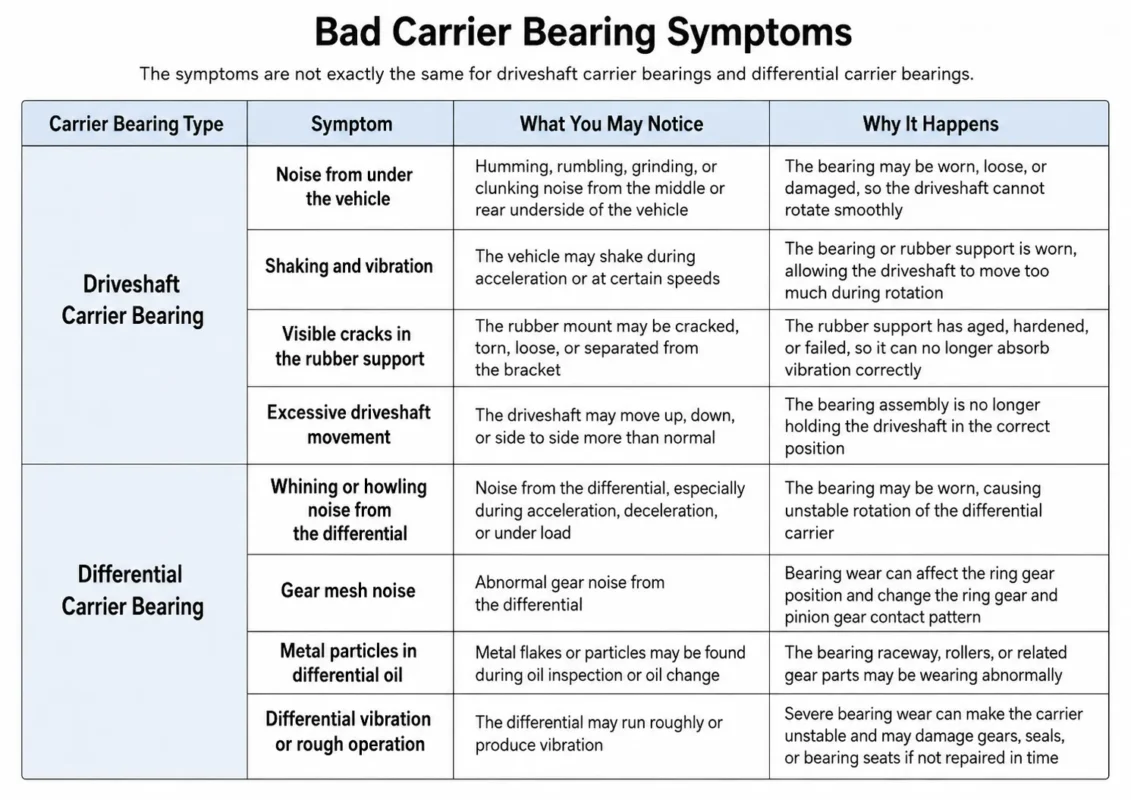
There are several symptoms that may show a carrier bearing is worn, loose, damaged, or no longer supporting the rotating part correctly.
However, the symptoms are not exactly the same for differential carrier bearings and driveshaft carrier bearings. The table below can help you recognize the difference more clearly.
Part 3. How to Replace Carrier Bearing?
When you notice the carrier bearing symptoms listed above, the first step is not to replace the bearing immediately. You should first confirm which carrier bearing has a problem and whether they are surely needed to be replaced.
Before Replacing a Carrier Bearing
Before replacing the carrier bearing, ask a professional mechanic or drivetrain engineer to inspect the vehicle.
The engineer should confirm:
| What to Check | Why It Matters |
| Whether the noise or vibration really comes from the carrier bearing | Noise and vibration may also come from other drivetrain parts. |
| Whether it is a driveshaft carrier bearing or a differential carrier bearing | These two bearings are installed in different positions and require different replacement methods. |
| Whether the bearing itself is damaged | Sometimes the problem is not the bearing itself. |
| Whether the problem comes from the rubber mount, driveshaft, U-joint, differential gear, or another related part | Replacing the wrong part will not solve the real problem. |
If the engineer confirms that the carrier bearing needs to be replaced, you can ask the engineer to replace it for you.
Note: Do not replace a carrier bearing by yourself if you do not have repair experience, proper tools, and drivetrain knowledge. Incorrect removal or installation can affect vehicle safety, shaft balance, gear alignment, and differential performance.
Replacing a Driveshaft Carrier Bearing
If it is a driveshaft carrier bearing, the general replacement process is:
- Lift and support the vehicle safely.
- Mark the driveshaft position before removal, so it can be installed back in the correct alignment.
- Remove related parts if needed, such as shields, brackets, or exhaust components.
- Remove the driveshaft assembly from the vehicle.
- Remove the old carrier bearing or center support bearing from the driveshaft.
- Inspect the driveshaft, U-joints, rubber support, splines, and related parts.
- Press or install the new carrier bearing in the correct position.
- Reinstall the driveshaft according to the original marks.
- Tighten all bolts to the correct torque.
- Test the vehicle and check for noise, vibration, or abnormal movement.For this type, the main points are correct driveshaft alignment, proper bearing installation, and avoiding driveshaft imbalance.
Replacing a Differential Carrier Bearing
If it is a differential carrier bearing, this job is more difficult than replacing a driveshaft carrier bearing. The general process may include:
- Drain the differential oil.
- Remove the differential cover or housing parts.
- Inspect the ring gear, pinion gear, carrier bearings, bearing caps, and gear contact pattern.
- Remove the differential carrier assembly.
- Remove the old carrier bearings with proper pullers or press tools.
- Press the new carrier bearings onto the differential carrier.
- Reinstall the differential carrier.
- Adjust bearing preload and backlash according to the vehicle or axle specification.
- Check the gear contact pattern.
- Refill the correct differential oil.
- Test for noise, overheating, leakage, or abnormal gear operation.
Part 4. Where and How to Buy Replacement Carrier Bearing
Repair companies, distributors, fleet maintenance teams, and engineers may need to buy replacement carrier bearings frequently. But before buying a new carrier bearing, the first step is to confirm the exact type, size, and application. Before requesting a quotation, you can prepare the following information:
| Information Needed | Purpose |
| Vehicle model or equipment model | Helps confirm the correct application and matching part. |
| Bearing number or OEM part number | Helps identify the exact bearing or replacement reference. |
| Bearing dimensions | Helps match the inner diameter, outer diameter, width, and mounting size. |
| Driveshaft or differential type | Helps confirm whether it is for a driveshaft carrier bearing or differential carrier bearing. |
| Photos or drawings | Helps check the structure, bracket style, rubber mount, and installation position. |
| Quantity needed | Helps the supplier prepare pricing, stock checking, and delivery plan. |
| Working conditions for industrial equipment | Helps select a suitable bearing according to load, speed, temperature, lubrication, and environment. |
So, where can you buy the carrier bearing after preparing this information?
Here, we recommend contacting BKZ Industry if you need carrier bearings in bulk. BKZ Industry has two factories and can supply almost all the carrier bearing types you need. Send BKZ Industry the bearing number, dimensions, photos, drawings, or application details. BKZ Industry can help check the suitable bearing type and provide a quotation.
Part 5. FAQS About Carrier Bearings
Do not remove a carrier bearing without a press if you do not have repair experience. Some mechanics may use pullers, bearing separators, or cutting tools, but these methods can damage the shaft or housing if done incorrectly. For safety and accuracy, use proper tools or ask a professional engineer to remove it.
A bad carrier bearing may create humming, rumbling, grinding, whining, or clunking noises. A driveshaft carrier bearing usually makes noise from the middle or rear underside of the vehicle. A differential carrier bearing may create whining or howling noise from the differential area.
Zero time. You should stop driving and inspect or replace the bad carrier bearing as soon as possible. A failed carrier bearing can cause vibration, shaft movement, gear misalignment, and damage to related drivetrain parts. Once you notice strong noise or vibration, do not continue driving.
A carrier bearing supports and locates a rotating component. In a driveshaft system, it supports the driveshaft and helps reduce vibration. In a differential, it supports the differential carrier and helps keep the ring gear correctly aligned with the pinion gear.
A carrier bearing may also be called a center support bearing, driveshaft center support bearing, or propeller shaft support bearing when used on a driveshaft. In a differential, it is usually called a differential carrier bearing.
The replacement cost depends on the vehicle model, bearing type, labor time, and whether it is a driveshaft carrier bearing or differential carrier bearing. A simple driveshaft carrier bearing is usually easier to replace. A differential carrier bearing usually costs more because it needs more precise adjustment and labor.
Ending Note
Now, you understand what a carrier bearing is, what it does, the common types of carrier bearings, and the signs of a bad carrier bearing.
Once you find these bad signs, you should ask a professional engineer or mechanic to inspect the vehicle first. They can confirm where the problem happens and whether the carrier bearing really needs to be replaced. If replacement is needed, let them replace it for you.
If you are a repair company, distributor, or engineer who needs to buy carrier bearings in bulk, you can contact BKZ Industry. BKZ Industry can manufacture and supply almost all types of carrier bearings you need.