When searching for bearings for linear reciprocating motion, you may come across linear sleeve bearings. To determine whether they are suitable for your application, you need to understand what they are, how they work, and their advantages, limitations, types, applications, and available sizes. This article covers all these topics and explains how to select the right linear sleeve bearing for your operating requirements.
If you decide to purchase linear sleeve bearings, BKZ Industry can supply a wide range of types, materials, and sizes. With more than 15 years of experience in the bearing industry, BKZ Industry can help you identify a suitable solution for your application. Send the required dimensions, quantity, and operating conditions to receive a quotation.
Part 1. What is Linear Sleeve Bearing?
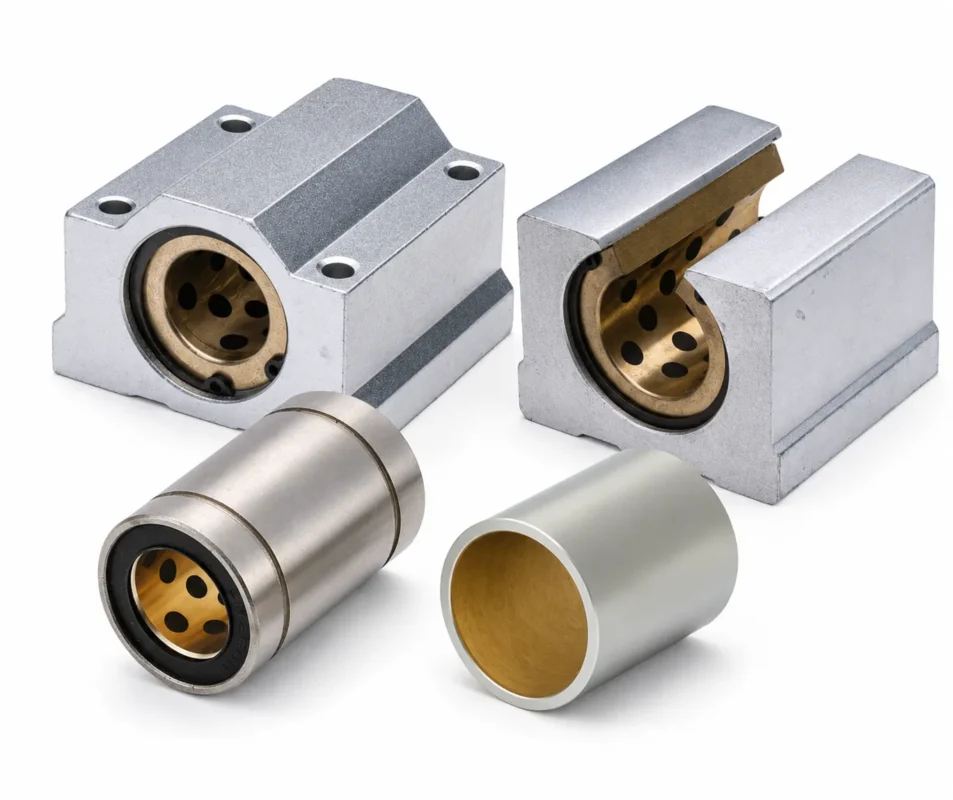
A linear sleeve bearing is a cylindrical plain bearing designed to guide a shaft in straight-line motion rather than primarily support rotation. The bearing is typically fixed in a housing, while the shaft moves back and forth through its bore. Lubricant or a self-lubricating lining between the shaft and bearing surface helps reduce friction and wear. Below is a linear sleeve bearing for reference.
Linear Sleeve Bearing vs Linear Plain Bearing vs Sleeve Bearing vs Linear Bearing vs Linear Slide Bearing
To understand a linear sleeve bearing, it is helpful to distinguish it from similar terms such as linear plain bearing, sleeve bearing, linear bearing, and linear slide bearing. Their definitions explain how these terms overlap.
Linear Plain Bearing: A linear plain bearing supports straight-line motion through sliding contact without balls or rollers. Regardless of its shape, a plain bearing designed for linear motion can be classified as a linear plain bearing. Therefore, a linear sleeve bearing is one type of linear plain bearing.
Sleeve Bearing: A sleeve bearing is a cylindrical plain bearing. Depending on its design and application, it may support rotational, oscillating, or linear motion. A linear sleeve bearing is therefore a type of sleeve bearing specifically designed for linear motion.
Linear Bearing: Linear bearing is a broad term for bearings that guide or support straight-line motion. It includes linear ball bearings, linear roller bearings, and linear plain bearings. Therefore, a linear sleeve bearing is one type of linear bearing.
Linear Slide Bearing: This term is less standardized and may refer to a plain sliding bearing, bearing block, or complete linear slide or guide assembly. A linear sleeve bearing can be considered a type of linear slide bearing only when “linear slide bearing” refers broadly to a plain bearing that supports linear sliding motion. Otherwise, the two terms describe different products.
In summary, a linear sleeve bearing can be classified as both a linear plain bearing, because it operates through sliding contact, and a sleeve bearing, because it has a cylindrical sleeve structure. It also belongs to the broader category of linear bearings.
Now, you may have a much clearer picture of linear sleeve bearings. Next, you may want to understand their advantages and limitations so that you can determine whether they are suitable for your application.
Advantages of Linear Sleeve Bearings
- Larger Load Capacity and Good Load Distribution
Linear sleeve bearings support the shaft through a relatively large sliding contact area. This helps distribute radial loads over the bearing surface and reduces concentrated contact stress. In general, linear sleeve bearings carry larger loads than ball and roller bearings.
- Stable Linear Guidance
The large contact area can provide stable support for linear reciprocating motion. Linear sleeve bearings are especially suitable for low- to moderate-speed applications involving vibration, short strokes, or repeated reciprocating movement.
- Quiet Operation
Because linear sleeve bearings use sliding contact and contain no recirculating balls or rollers, they generally operate more quietly than recirculating-ball linear bearings. Polymer and composite sliding materials can also help dampen vibration and operating noise.
- Compact and Simple Structure
A linear sleeve bearing normally has a simple cylindrical sleeve structure without balls, rollers, cages, or recirculation tracks. Its compact design requires relatively little radial installation space. During installation, the bearing is usually press-fitted so it is much easier to install.
- Good Shock and Vibration Resistance
The large sliding contact area can distribute impact loads without concentrating them on individual balls or rollers. This makes properly selected linear sleeve bearings suitable for applications involving shock or vibration.
- Self-Lubricating Options Available
Some linear sleeve bearings use PTFE-based composites, engineered plastics, sintered bronze, graphite-containing materials, or other self-lubricating sliding materials. These versions can operate with little or no additional lubrication under specified conditions.
- Suitable for High-Load, Low-Speed Applications
Linear sleeve bearings can be suitable for high radial loads at relatively low sliding speeds because of their large contact area.
- Suitable for Contaminated Environments
Linear sleeve bearings have no exposed recirculating rolling elements, so certain designs can tolerate dust and contamination better than precision linear ball bearings. Linear sleeve bearings with polymer, composite, bronze, or corrosion-resistant can work for dirty, wet, or corrosive environments.
- Potentially Cost-Effective
The simple structure and small number of components can make standard linear sleeve bearings more cost-effective than complete recirculating-ball or roller guide systems.
Limitations of Linear Sleeve Bearings
- Higher Friction Than Rolling-Element Linear Bearings
Linear sleeve bearings use sliding contact, so they generally produce more friction than linear ball or roller bearings. Starting friction may also be higher than running friction, potentially causing stick-slip during very slow movement.
- Not Suitable for Very High-Speed Applications
Higher sliding friction generates more heat and accelerates wear as speed increases. Therefore, linear sleeve bearings are generally more suitable for low- to moderate-speed linear motion.
- Sensitive to Misalignment
Standard linear sleeve bearings generally cannot compensate for angular misalignment. Improper alignment between the shaft and bearing may cause edge loading, increased friction, uneven wear, or binding.
- Not Designed to Support Axial Loads
Standard cylindrical linear sleeve bearings are designed primarily to support radial loads while guiding linear shaft movement. They do not normally support axial loads unless they incorporate a flange or are used with a separate thrust-bearing arrangement.
Applications of Linear Sleeve Bearings
After understanding the advantages and limitations of linear sleeve bearings, you may want to know where they are commonly used. Here are five major application areas.
1. Packaging Machinery
Carton erectors, case packers, labeling machines, filling machines, capping machines, sealing machines, palletizers, wrapping machines, pouch-filling machines, and pick-and-place systems use linear sleeve bearings to guide fast, repetitive movements such as pushing, lifting, filling, and sealing.
2. Food and Beverage Equipment
Meat slicers, dough-processing machines, portioning machines, beverage fillers, bottle rinsers, tray sealers, cheese cutters, vegetable processors, food sorters, and bakery machines use suitable linear sleeve bearings where quiet operation, corrosion resistance, and lubricant-free movement may be required.
3. Agricultural Machinery
Seeders, planters, combine harvesters, balers, sprayers, fertilizer spreaders, forage harvesters, cultivators, potato harvesters, and front loaders use them in sliding adjustments and reciprocating mechanisms exposed to dust, moisture, vibration, and shock.
4. Construction Machinery
Excavators, wheel loaders, bulldozers, backhoe loaders, motor graders, concrete pump trucks, road rollers, trenchers, piling machines, and drilling rigs may use linear sleeve bearings in sliding outriggers, adjustment mechanisms, access systems, and other low-speed linear assemblies.
5. Material-Handling Equipment
Conveyors, storage and retrieval systems, pallet handlers, sorting machines, scissor lifts, loading platforms, warehouse shuttles, lifting tables, transfer stations, and robotic palletizers use linear sleeve bearings to guide stops, pushers, diverters, lifting units, and positioning mechanisms.
Part 2. Types of Linear Sleeve Bearings
When selecting a linear sleeve bearing, you may find several different types. Linear sleeve bearings can be classified according to their mounting configuration, material, structural design, and lubrication requirements.
Based on Mounting Configuration
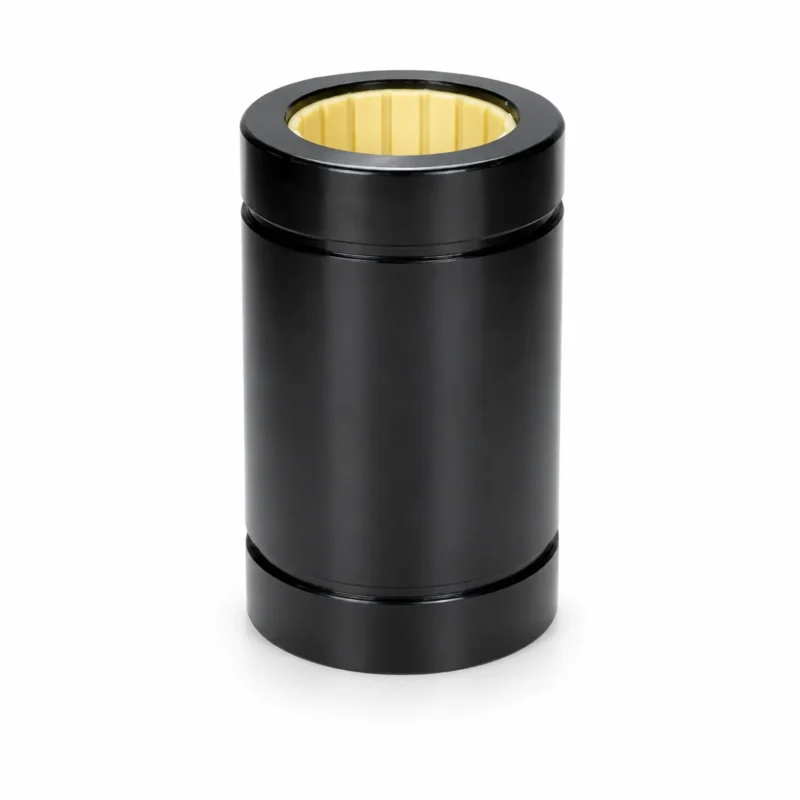
Linear Sleeve Bearing without Housing: This type is supplied as an individual sleeve bearing without a housing. It must be pressed or otherwise secured into a properly sized housing bore before supporting and guiding the shaft.
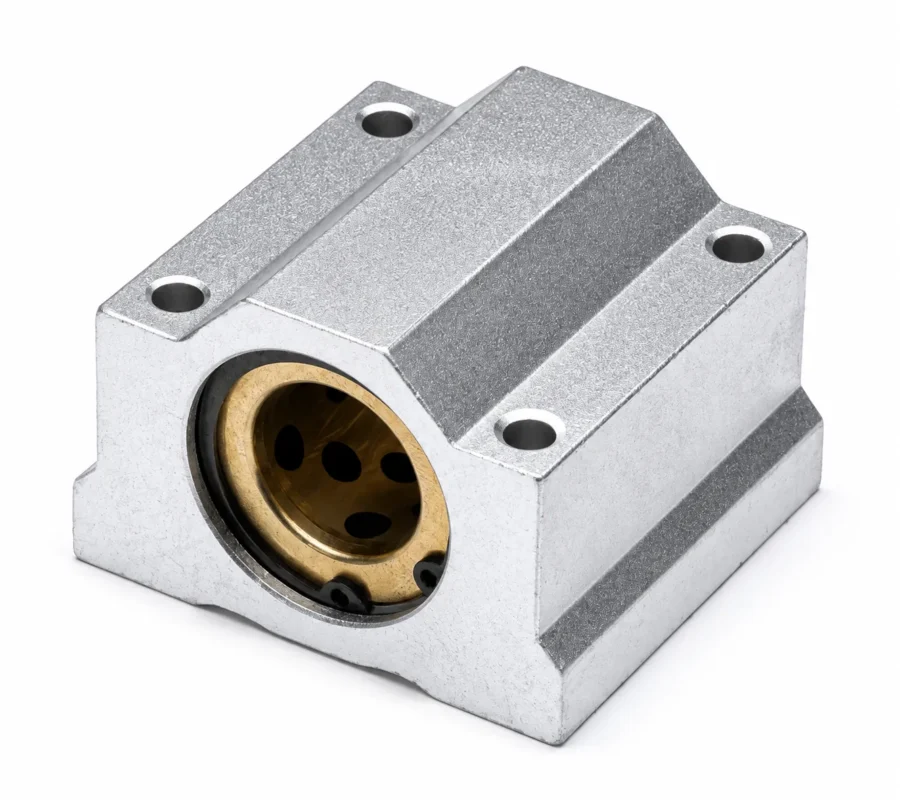
Mounted Linear Sleeve Bearing Unit: This type combines a linear sleeve bearing with a ready-to-install housing or bearing block. It simplifies mounting and can be attached directly to the machine frame using bolts.
Based on Materials
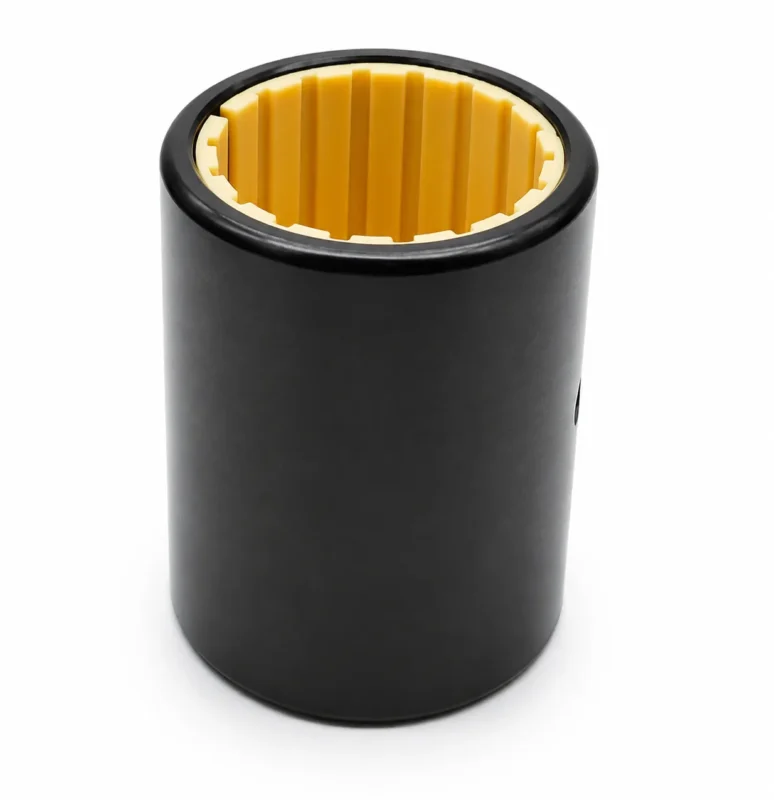
Plastic Linear Sleeve Bearing: Plastic linear sleeve bearings use engineered polymers, such as PTFE-based or other wear-resistant plastics, as their main sliding material. They are lightweight, quiet, corrosion-resistant, and often suitable for dry running.
Also Read: What Are Polymer Bearings? Types, Uses and Benefits
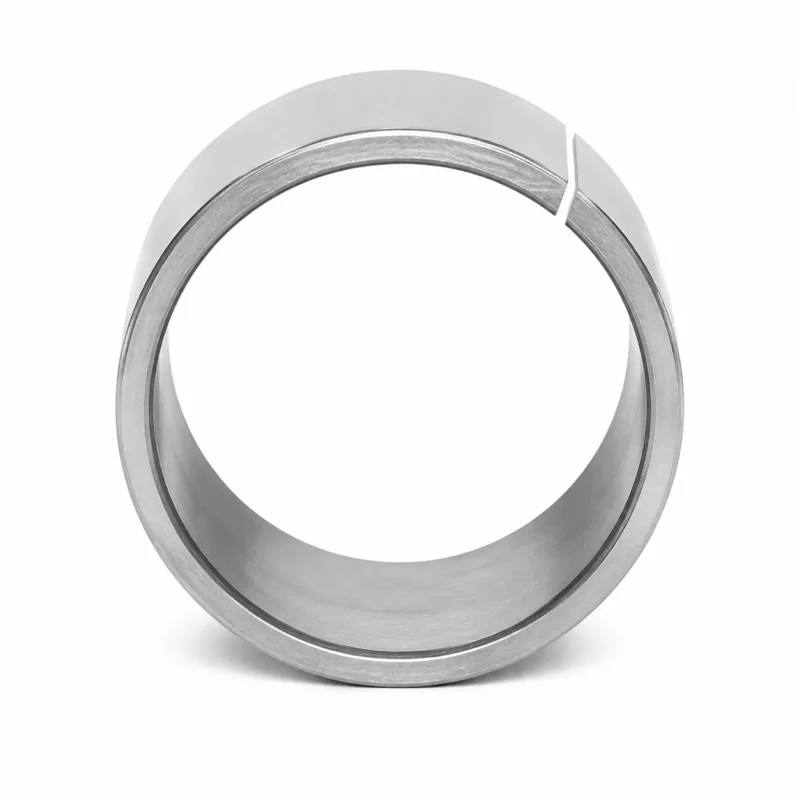
Stainless-Steel Linear Sleeve Bearing: This type uses stainless steel for the bearing body, backing, or other major structural components. It provides better corrosion resistance than standard carbon-steel versions and is suitable for wet, humid, or washdown environments.
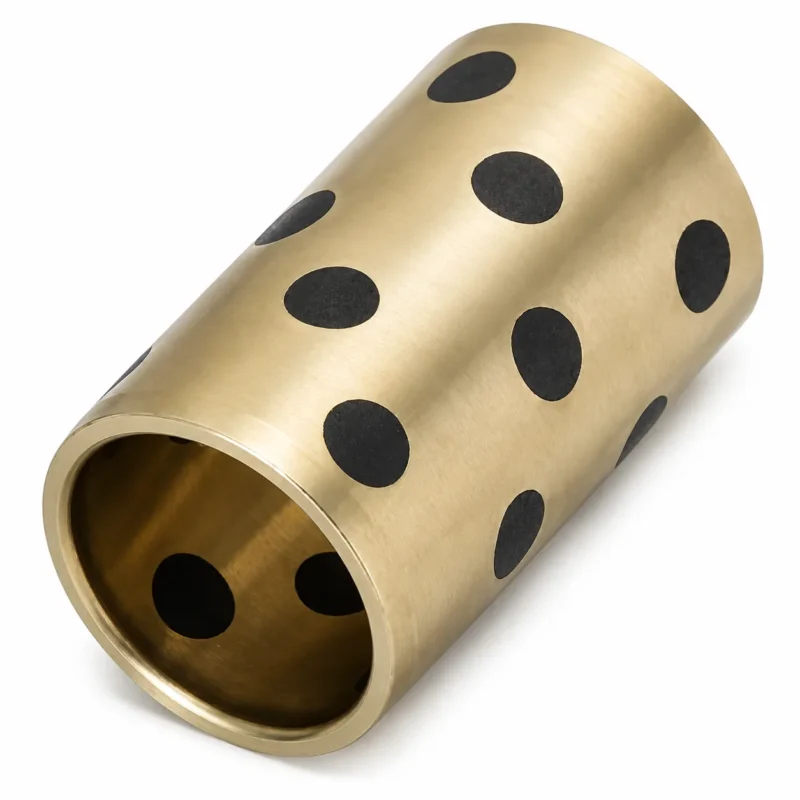
Bronze Linear Sleeve Bearing: Bronze linear sleeve bearings provide good strength, wear resistance, and load-carrying capability. Solid-bronze versions normally require oil or grease, while sintered-bronze versions can store lubricant in their porous structure. They are commonly selected for high-load, low- to moderate-speed linear motion.
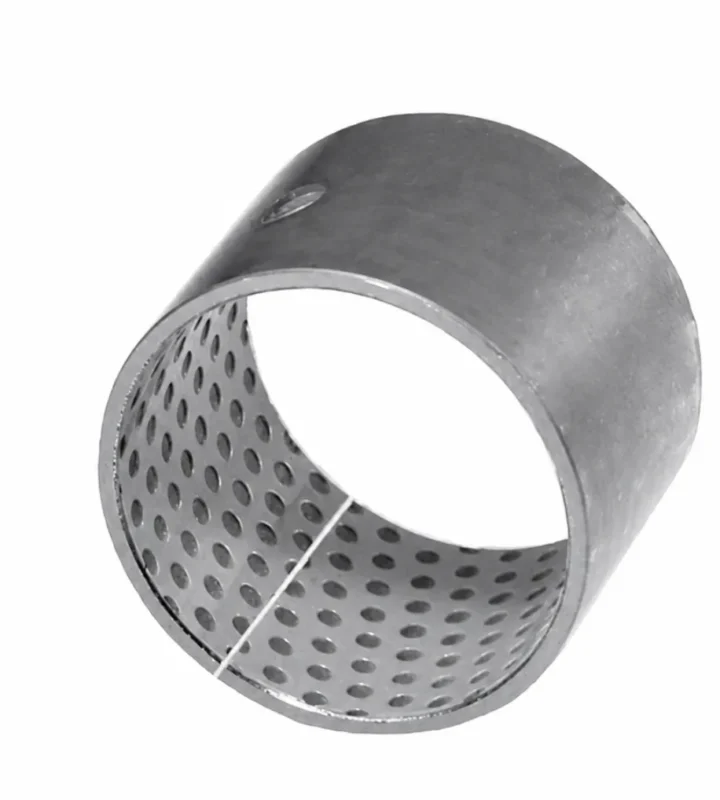
Metal-Backed Composite Linear Sleeve Bearing: This bearing usually has a steel or bronze backing combined with a porous intermediate layer and a PTFE- or POM-based sliding surface. The metal backing provides structural strength, while the composite liner reduces friction and wear.
Based on Design
Cylindrical Linear Sleeve Bearing: This is a straight, sleeve-shaped bearing without a flange. It is the most common and compact design.
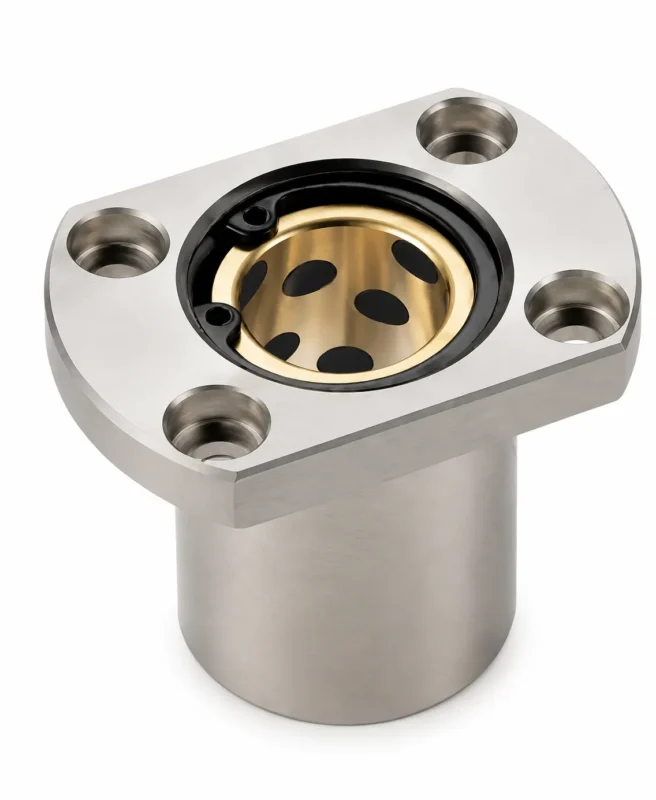
Flanged Linear Sleeve Bearing: This type has a flange at one end. The flange provides axial location, prevents the bearing from being pressed too far into the housing, and may provide a mounting surface. It is useful when reliable axial retention or simplified positioning is required.
Also Read: Flanged Bearings: What They Are, What Are Their Types, and More
Open Linear Sleeve Bearing: An open linear sleeve bearing has a continuous longitudinal opening. This opening provides clearance for the support structure beneath a fully supported shaft, allowing the bearing to travel along the shaft without contacting the shaft support.
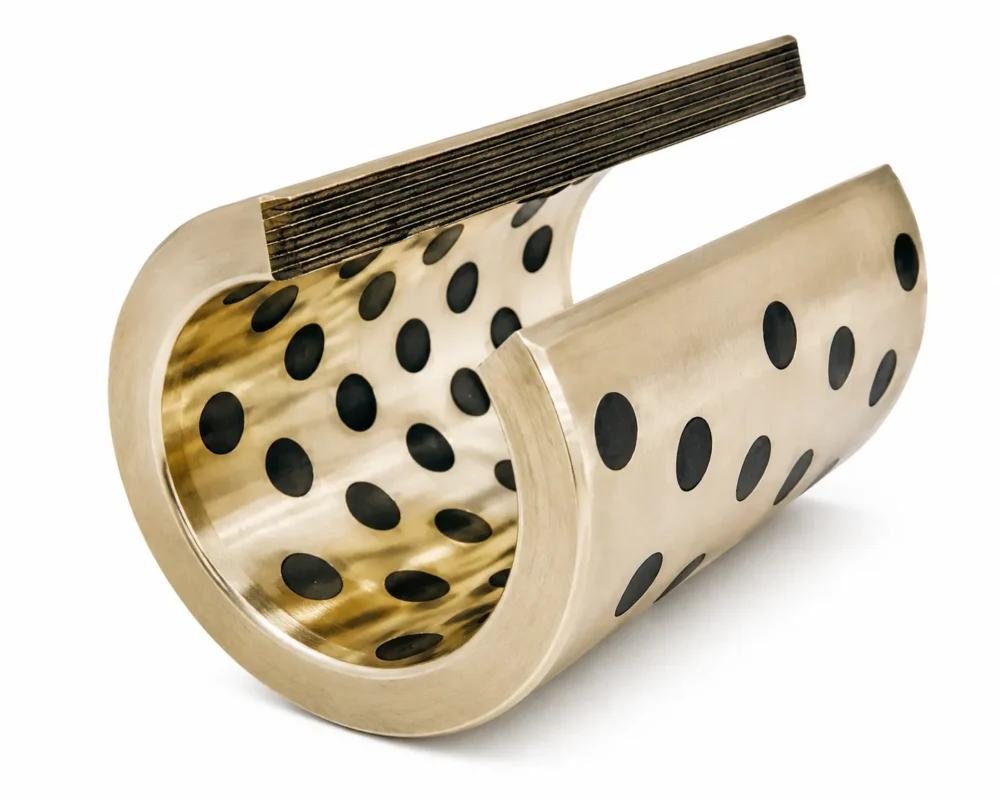
Split Linear Sleeve Bearing: A split linear sleeve bearing has a longitudinal split that allows it to open slightly during installation. It can simplify replacement around an existing shaft.
Part 3. Linear Plain Bearing Sizes
Now, let’s check the linear plain bearing size chart to find a suitable option for your application. The chart includes only some available types and sizes. If you cannot find the size you need, contact BKZ Industry with the required dimensions, quantity, and other specifications for a quotation.
1. Standard Linear Sleeve Bearing Size Chart
| Bearing Model | Bore Diameter, d (mm) | d Tolerance (mm) | Outside Diameter, D (mm) | D Tolerance (mm) | Length, L (mm) | L Tolerance (mm) | Opening Width, E (mm) | Opening Angle, θ (°) | Extended Length, L (mm) | Extended-Length Tolerance (mm) |
| LM6UU | 6 | +0.02 / +0.05 | 12 | 0 / −0.03 | 19 | 0 / −0.2 | — | — | 35 | 0 / −0.30 |
| LM8UU | 8 | +0.02 / +0.05 | 15 | 0 / −0.03 | 24 | 0 / −0.2 | — | — | 45 | 0 / −0.30 |
| LM10UU/-OP | 10 | +0.02 / +0.05 | 19 | 0 / −0.03 | 29 | 0 / −0.2 | 6.8 | 80° | 55 | 0 / −0.30 |
| LM12UU/-OP | 12 | +0.02 / +0.05 | 21 | 0 / −0.03 | 30 | 0 / −0.2 | 8 | 80° | 57 | 0 / −0.30 |
| LM13UU/-OP | 13 | +0.02 / +0.05 | 23 | 0 / −0.03 | 32 | 0 / −0.2 | 9 | 80° | 61 | 0 / −0.30 |
| LM16UU/-OP | 16 | +0.02 / +0.05 | 28 | 0 / −0.03 | 37 | 0 / −0.2 | 11 | 80° | 70 | 0 / −0.30 |
| LM20UU/-OP | 20 | +0.04 / +0.075 | 32 | 0 / −0.03 | 42 | 0 / −0.2 | 11 | 60° | 80 | 0 / −0.30 |
| LM25UU/-OP | 25 | +0.04 / +0.075 | 40 | 0 / −0.03 | 59 | 0 / −0.3 | 12 | 50° | 112 | 0 / −0.30 |
| LM30UU/-OP | 30 | +0.04 / +0.075 | 45 | 0 / −0.03 | 64 | 0 / −0.3 | 15 | 50° | 123 | 0 / −0.40 |
| LM35UU/-OP | 35 | +0.045 / +0.08 | 52 | 0 / −0.03 | 70 | 0 / −0.3 | 17 | 50° | 135 | 0 / −0.40 |
| LM40UU/-OP | 40 | +0.045 / +0.08 | 60 | 0 / −0.03 | 80 | 0 / −0.3 | 20 | 50° | 151 | 0 / −0.40 |
| LM50UU/-OP | 50 | +0.045 / +0.08 | 80 | 0 / −0.03 | 100 | 0 / −0.4 | 25 | 50° | 192 | 0 / −0.40 |
| LM60UU/-OP | 60 | +0.05 / +0.09 | 90 | 0 / −0.03 | 110 | 0 / −0.4 | 30 | 50° | 209 | 0 / −0.40 |
2. Flanged Sleeve Bearing Size Chart
| Bearing Model | Bore Diameter, d (mm) | d Tolerance (mm) | Outside Diameter, D (mm) | D Tolerance (mm) | Length, L (mm) | L Tolerance (mm) | Flange Dimension, H (mm) | H Tolerance (mm) | Extended Length, L (mm) | Extended-Length Tolerance (mm) |
| LMF/K/H6UU | 6 | +0.02 / +0.05 | 12 | 0 / −0.03 | 19 | 0 / −0.2 | 28 | 0 / −0.2 | 35 | 0 / −0.30 |
| LMF/K/H8UU | 8 | +0.02 / +0.05 | 15 | 0 / −0.03 | 24 | 0 / −0.2 | 32 | 0 / −0.2 | 45 | 0 / −0.30 |
| LMF/K/H10UU | 10 | +0.02 / +0.05 | 19 | 0 / −0.03 | 29 | 0 / −0.2 | 40 | 0 / −0.2 | 55 | 0 / −0.30 |
| LMF/K/H12UU | 12 | +0.02 / +0.05 | 21 | 0 / −0.03 | 30 | 0 / −0.2 | 42 | 0 / −0.2 | 57 | 0 / −0.30 |
| LMF/K/H13UU | 13 | +0.02 / +0.05 | 23 | 0 / −0.03 | 32 | 0 / −0.2 | 43 | 0 / −0.2 | 61 | 0 / −0.30 |
| LMF/K/H16UU | 16 | +0.02 / +0.05 | 28 | 0 / −0.03 | 37 | 0 / −0.2 | 48 | 0 / −0.2 | 70 | 0 / −0.30 |
| LMF/K/H20UU | 20 | +0.04 / +0.075 | 32 | 0 / −0.03 | 42 | 0 / −0.2 | 54 | 0 / −0.2 | 80 | 0 / −0.30 |
| LMF/K/H25UU | 25 | +0.04 / +0.075 | 40 | 0 / −0.03 | 59 | 0 / −0.3 | 62 | 0 / −0.3 | 112 | 0 / −0.30 |
| LMF/K/H30UU | 30 | +0.04 / +0.075 | 45 | 0 / −0.03 | 64 | 0 / −0.3 | 74 | 0 / −0.3 | 123 | 0 / −0.40 |
| LMF/K/H35UU | 35 | +0.045 / +0.08 | 52 | 0 / −0.03 | 70 | 0 / −0.3 | 82 | 0 / −0.3 | 135 | 0 / −0.40 |
| LMF/K/H40UU | 40 | +0.045 / +0.08 | 60 | 0 / −0.03 | 80 | 0 / −0.3 | 96 | 0 / −0.3 | 151 | 0 / −0.40 |
| LMF/K/H50UU | 50 | +0.045 / +0.08 | 80 | 0 / −0.03 | 100 | 0 / −0.3 | 116 | 0 / −0.3 | 192 | 0 / −0.40 |
| LMF/K/H60UU | 60 | +0.05 / +0.09 | 90 | 0 / −0.03 | 110 | 0 / −0.3 | 134 | 0 / −0.3 | 209 | 0 / −0.40 |
Only selected sizes of two linear sleeve bearing types are listed here. For more options, please contact BKZ Industry. This size chart is for reference only; final dimensions and specifications should be confirmed based on your detailed requirements before ordering.
Part 4. How to Select the Linear Plain Bearing for Your Application?
If you decide to buy a linear plain bearing, you should know how to select the right bearing before contacting a linear plain bearing supplier. The following information can help the supplier recommend a suitable bearing for your application.
Step 1. Confirm Sizes
First, measure the shaft diameter and the available installation space to determine the required bearing dimensions. The main dimensions include the bore diameter, outside diameter, bearing length, and flange dimensions if applicable.
Step 2. Get the Bearing Loads
You need to determine the loads that the linear plain bearing will withstand, including the static load, operating load, shock load, and moment load. You should also confirm the load direction and whether the load is evenly distributed across the bearing.
Step 3. Check the Operating Speed
Check the maximum linear speed at which the bearing will operate. You should also provide the stroke length, movement frequency, operating time, and whether the bearing moves continuously or intermittently.
Step 4. Check the Bearing Working Conditions
Check whether the bearing will operate in dusty, abrasive, wet, chemically exposed, corrosive, high-temperature, or low-temperature conditions. These operating conditions help determine the appropriate bearing material, liner, lubrication method, sealing arrangement, and shaft surface treatment.
You should also check whether the bearing can be easily accessed for lubrication. If regular lubrication is difficult or impossible, a self-lubricating linear plain bearing may be more suitable. If the bearing can be lubricated regularly, confirm the appropriate lubricant and relubrication interval with the supplier.
Finally, determine whether the bearing needs to accommodate shaft deflection or installation misalignment. Standard linear plain bearings usually have limited misalignment capability. If misalignment cannot be avoided, you may need a self-aligning design or a suitable housing to prevent edge loading and premature wear.
Part 5. The Best Linear Plain Bearing Supplier
Now, do you need a reliable linear plain bearing supplier? You can consider BKZ Industry, a bearing manufacturer and one-stop sourcing supplier established in 2011. Here is why BKZ Industry can be a suitable supplier for your linear plain bearing requirements.
- A Wide Range of Linear Plain Bearings Available: BKZ Industry can supply linear plain bearings in different sizes, structures, and configurations, including standard, flanged, and mounted versions. You can provide the required model or dimensions to confirm availability.
- Custom Options Supported: If standard bearings cannot meet your requirements, BKZ Industry can provide customized solutions based on your drawings, dimensions, samples, application, and working conditions.
- Different Material Options for Different Applications: Plastic, metal, and stainless steel linear plain bearings are available for different loads, speeds, lubrication requirements, and operating environments.
- Other Bearing Types Available: In addition to linear plain bearings, BKZ Industry can supply insert bearings, mounted ball bearing units, deep groove ball bearings, spherical roller bearings, cylindrical roller bearings, and many other bearing types. This allows you to purchase different bearings from one supplier and simplify your sourcing process.
- Over 15 Years of Bearing Manufacturing and Export Experience: With more than 15 years of experience in the bearing industry, BKZ Industry can help purchasers confirm specifications, select suitable products, manage quality, and arrange international delivery.
Contact BKZ Industry with the required bearing model or dimensions, quantity, and other technical requirements to get a quotation.
Part 6. FAQS About Linear Plain Bearings
The main difference lies in how they guide linear motion. Linear ball bearings use recirculating balls for low-friction movement, while linear sleeve bearings use sliding contact between the bearing surface and shaft.
A self-aligning linear plain bearing permits limited angular adjustment between the bearing and shaft. This helps reduce edge loading, binding, and uneven wear caused by minor installation errors or shaft misalignment.
Final Words
A linear sleeve bearing is a cylindrical plain bearing that supports linear motion through sliding contact with a shaft. After understanding its definition, advantages, limitations, applications, types, available sizes, and selection factors, you can determine which linear sleeve bearing is suitable for your application.
If you decide to buy linear sleeve bearings in bulk, contact BKZ Industry directly with your required model or dimensions, quantity, and other technical requirements.