Thrust bearings may not be as widely used as radial bearings, but they are also commonly seen in many applications. So OEMs, purchasers, manufacturers, engineers, or people who are new to bearings need to understand what thrust bearings are before trying to select them.
To help you have a clear understanding, I, with 10 years of experience in bearing engineering, would like to explain them in detail in this article.
And if you want to buy thrust bearings in bulk for your company or manufacturing needs, you can contact BKZ Industry, a bearing manufacturer from China with 2 factories and ISO 9001 certification.
Part 1. What Is a Thrust Bearing?
First of all, let’s understand what a thrust bearing is. Thrust bearings and radial bearings are two main bearing categories classified by load direction. Radial bearings are mainly designed to carry radial loads, while thrust bearings are designed to carry axial loads, help control axial movement, and keep the shaft running smoothly.
Part 2. What Does a Thrust Bearing Look Like?
A thrust bearing usually looks different from a radial bearing because it is designed to carry axial loads. The picture below shows what a thrust bearing looks like and how it compares with a radial bearing.
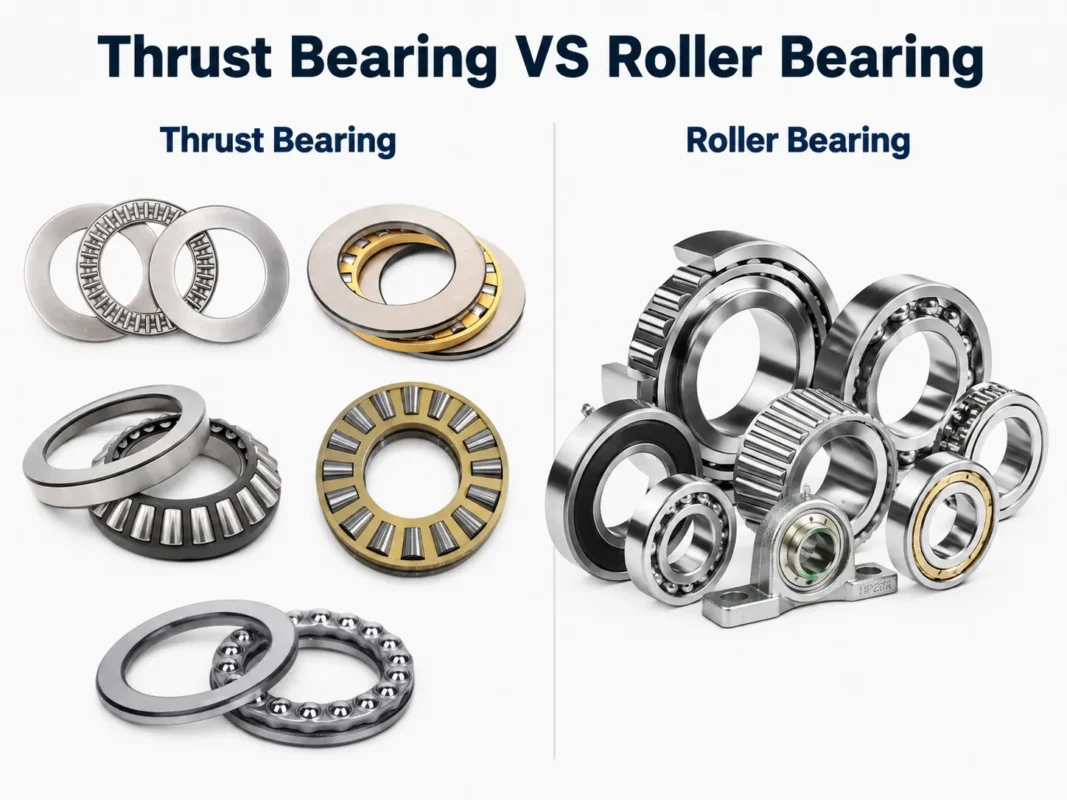
Although the picture above only shows rolling thrust bearings, there are also plain thrust bearings. Their structures vary. In general, a rolling thrust bearing usually includes rolling elements, a shaft washer, a housing washer, and a cage. A plain thrust bearing usually uses a thrust washer or sliding surface to carry axial loads.

Part 3. How Does a Thrust Bearing Work?
After understanding what a thrust bearing is and what it looks like, you may also want to know how a thrust bearing works. Here is a simple explanation.
When the shaft rotates, the shaft washer rotates with the shaft, while the housing washer usually remains fixed in the housing. The rolling elements roll between the two washers, and the cage helps separate and guide the rolling elements.
When an axial load or thrust force is applied along the shaft direction, the thrust bearing carries this load through the contact between the rolling elements and the washers. This is why thrust bearings are suitable for applications where axial loads need to be supported.
Part 4. Types of Thrust Bearing
As mentioned above, thrust bearings can be divided into rolling thrust bearings and plain thrust bearings. The major types include thrust ball bearings, thrust roller bearings, and plain thrust bearings.
Here is a table to show the common types and their main structural differences.
| Main Type | Common Type | Structural Difference |
| Thrust Ball Bearing | Single direction thrust ball bearing | The simplest thrust ball bearing structure. It has one shaft washer, one housing washer, and one ball-and-cage assembly, so it supports axial load in one direction only. |
| Double direction thrust ball bearing | Built for axial loads from both directions. It normally has one central shaft washer, two housing washers, and two ball-and-cage assemblies. | |
| Thrust Roller Bearing | Cylindrical roller thrust bearing | The balls are replaced by cylindrical rollers. Because the rollers create line contact with the washers, this type can carry higher axial loads than a thrust ball bearing of similar size. |
| Tapered roller thrust bearing | The rollers and raceways are tapered instead of flat or cylindrical. This geometry makes it suitable for heavy thrust loads, and some designs can also carry combined loads. | |
| Spherical roller thrust bearing | Its main feature is the spherical raceway and barrel-shaped rollers. This structure allows high axial load capacity, some radial load capacity, and limited misalignment compensation. | |
| Needle roller thrust bearing | A compact thrust bearing with long, thin rollers. It provides axial load capacity in a very small axial space. | |
| Plain Thrust Bearing | Thrust washer | No rolling elements are used. It is basically a flat washer-shaped sliding surface for carrying axial load between two parts. |
| Flanged thrust washer | Compared with a flat thrust washer, it has a flange or locating shape to help position the component while carrying axial load. | |
| Thrust sliding plate / thrust pad | Instead of a washer-shaped ring, it uses sliding pads or plates. This type is more common in heavy-duty, low-speed, or special lubrication applications. | |
| Spherical plain thrust bearing | A plain thrust bearing with spherical sliding contact surfaces. It can carry axial loads and allow angular misalignment or tilting movement between connected parts. |
Part 5. How to Select a Thrust Bearing?
To fully understand thrust bearings, you also need to know how to select the right thrust bearing and what factors you should consider.
In general, you need to check the following points.
Size. You need to confirm the shaft size, housing size, and available mounting space. If you are replacing an old bearing, you can check the bearing number or bearing dimensions with the thrust bearing size chart.
Load direction and load capacity. Thrust bearings are mainly designed to carry axial loads, but you still need to confirm whether the load acts in one direction or both directions. You also need to check the axial load value and whether any radial load is also present.
Speed. Different thrust bearing types have different speed limits. Thrust ball bearings are usually suitable for lighter axial loads and higher speeds, while thrust roller bearings are more suitable for heavier axial loads and lower or medium speeds.
Working conditions. You need to know whether the bearing will work in moisture, water, dust, contamination, high temperature, heavy load, vibration, or corrosive conditions. If the working environment is harsh, you need to choose a suitable material, sealing design, lubrication method, or surface treatment to protect the bearing.
Lubrication. You also need to confirm whether the bearing will use grease, oil, or self-lubricating material. Proper lubrication helps reduce friction, heat, and wear.
After you collect this information, you can choose a manufacturer that can produce or supply the thrust bearing you need. Here, I recommend contacting BKZ Industry, a bearing manufacturer with 2 factories, ISO 9001 certification, and 15 years of bearing manufacturing experience.
You can send your bearing number, size, drawing, load, speed, application, and working conditions to ask for a quotation. The manufacturer can help check the suitable bearing type, confirm the bearing number, and offer the price.
After that, you can buy samples for testing first. If the samples work well, you can place a bulk order.
Part 6. Where Are Thrust Bearings Used?
Thrust bearings can be used in many industries and types of equipment. Here, I will list five major applications.
| Application | Common Equipments with Thrust Bearings |
|---|---|
| Automotive | Clutch systems, transmissions, gearboxes, and differential assemblies |
| Marine | Propeller shafts, marine thrust blocks, reduction gearboxes, and ship propulsion systems |
| Pumps and Compressors | Vertical pumps, centrifugal pumps, hydraulic pumps, screw compressors, and centrifugal compressors |
| Machine Tools | CNC spindles, rotary tables, ball screws, lead screws, and indexing tables |
| Heavy Industrial Machinery | Steel rolling mills, mining crushers, conveyors, hoists, cranes, and heavy-duty gear drives |
Part 7. What Causes Thrust Bearing Failure?
Like other bearings, thrust bearings can also fail if they are not used, installed, or maintained correctly. To extend the service life as much as possible, it is important to understand what causes thrust bearing failure and try to avoid these problems.
Misalignment: If the thrust bearing is not installed correctly or has serious misalignment during operation, it may cause uneven load distribution and lead to bearing failure.
Contamination: If the bearing works in a contaminated environment without proper protection, shields, or seals, contaminants may enter the bearing and cause wear, noise, heat, or early failure.
Lack of Lubrication: Most bearings need proper and correct lubrication to work normally and last longer. So, you should check the bearing specification carefully before use and follow the correct lubrication requirements.
Overload: Thrust bearings should work within their designed load range. If the axial load is too high or there is an unexpected impact load, the bearing may be damaged or fail earlier.
Part 8. FAQS About Thrust Bearing
The biggest difference is the load direction. A thrust bearing is designed to carry axial loads, while a radial bearing is mainly designed to carry radial loads.
A thrust bearing may also be called an axial bearing.
A guide bearing is mainly used to guide or support movement direction, while a thrust bearing is used to carry axial loads. Their functions are different.
Common signs include abnormal noise, vibration, overheating, rough rotation, increased axial movement, or metal particles in the lubricant. In severe cases, the shaft may move too much in the axial direction.
When a thrust bearing fails, it can no longer control or support axial load properly. This may cause shaft movement, overheating, equipment vibration, wear of nearby parts, or serious machine damage.
Final Words
Now you should have a clearer understanding of what a thrust bearing is, how it works, what it looks like, and where it is used.
If you need to buy thrust bearings in bulk, you can contact BKZ Industry with your bearing number, size, drawing, or application details. As an ISO 9001 certified bearing manufacturer from China with 2 factories, BKZ Industry can help you confirm the suitable thrust bearing and offer reliable bulk supply.