Thrust washers are commonly used in axial load applications. But what is a thrust washer? What is it made of? How does it work? What are its advantages and types? Where is it used? What are the differences between a thrust washer, a flat washer, and a thrust bearing? And where to find a thrust washer size chart?
In this article, I will explain everything you need to know about thrust washers.
After understanding thrust washers, if you need to buy thrust washers, you can contact BKZ Industry. With 15 years of bearing manufacturing experience, BKZ Industry can offer the thrust washers you need.
Part 1. What is a Thrust Washer?
A thrust washer is a washer-shaped plain bearing used to support axial loads and reduce friction between rotating and stationary parts. It is usually made as a flat circular disc, but some designs can also be supplied as split half washers for easier installation.
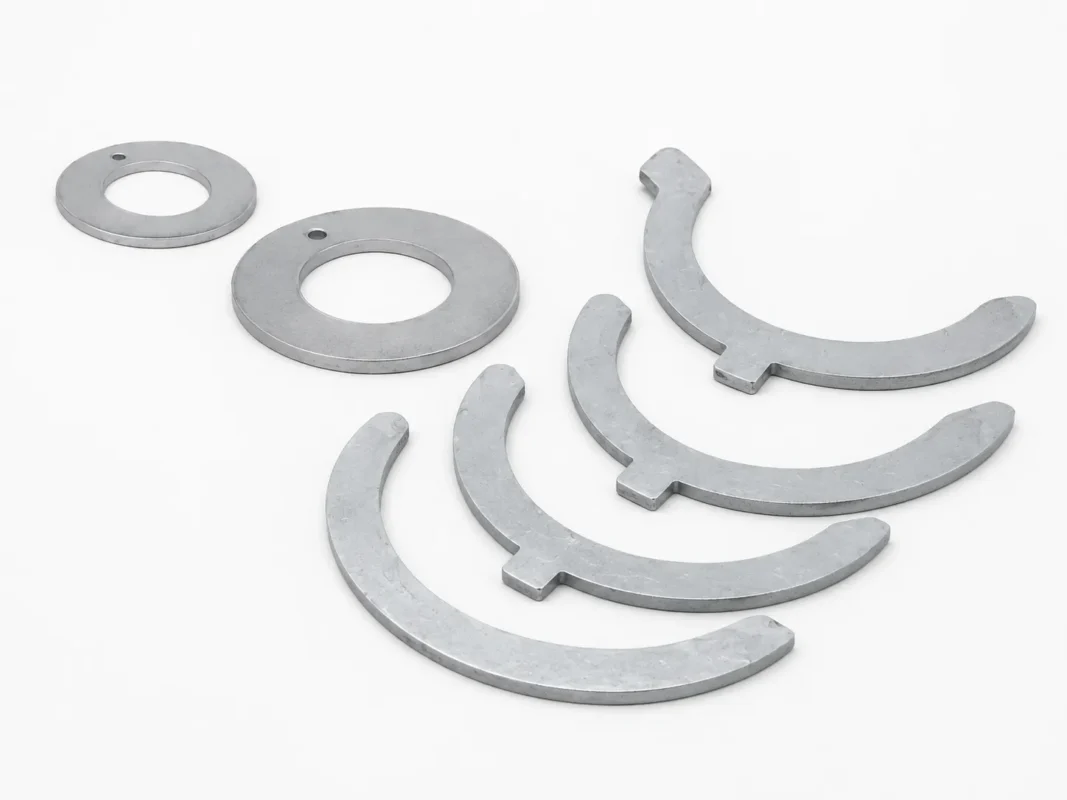
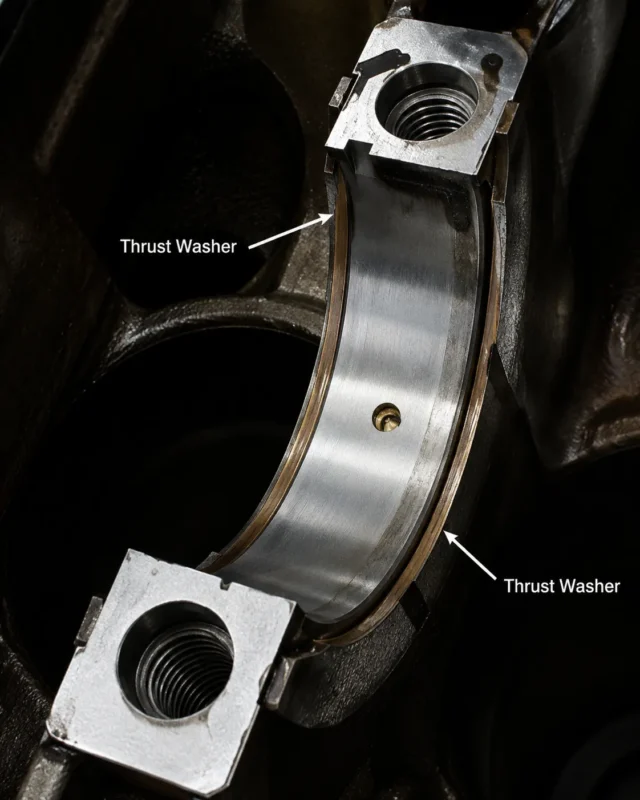
One common application of thrust washers is in engine crankshafts. In this application, split half thrust washers are usually installed on both sides of one main bearing journal, between the crankshaft thrust faces and the engine block or main bearing cap. Their function is to control crankshaft end play and prevent excessive axial movement of the crankshaft.
What Are Thrust Washers Made of?
Thrust washers can be made from different materials. Common materials include steel, bronze, brass, plastic, PTFE composite, POM composite, graphite bronze, and steel-backed bronze.
Some thrust washers are made from a single material, such as bronze, steel, or plastic. Others use a composite structure, such as a steel backing with a bronze layer and a PTFE or POM sliding surface. These composite thrust washers can provide lower friction and better self-lubricating performance.
How Do Thrust Washers Work?
When a shaft, crankshaft, gear, or other rotating part rotates, its thrust face slides on the surface of the thrust washer. With lubricating oil, grease, or self-lubricating materials, friction and wear on the thrust washer surface can be reduced.
As the thrust washer works between the fixed section and the rotating element, it can separate them and protect them from direct contact.
Moreover, during rotation, the shaft may receive axial force and try to move along its axis. The thrust washer carries this axial force, helps keep the shaft in the correct position, and allows the machine to work stably.
Advantages of Thrust Washers:
From the working principle of thrust washers, you can understand some of their advantages. However, these are not complete. Here I will list the main advantages of thrust washers.
- Support heavy axial loads.
- Good wear resistance and low friction when properly lubricated or made with suitable self-lubricating materials.
- Good shock resistance.
- Some thrust washers can provide self-lubricating performance, such as PTFE composite, POM composite, graphite bronze, or oil-impregnated bronze thrust washers
- Long service life.
- Simple structure and easy installation.
- Cost-effective compared with many complex thrust bearing designs.
Types of Thrust Washers
Thrust washers can be divided into different types based on different criteria.
Based on structure, common thrust washer types include:
- Flat thrust washers
- Split half thrust washers
Based on sliding surface material and lubrication design, common thrust washer types include:
- PTFE composite thrust washers
- POM composite thrust washers
- Graphite plugged bronze thrust washers
Based on base material or main body material, common thrust washer types include:
- Bronze thrust washers
- Steel thrust washers
- Plastic thrust washers
Where Are Thrust Washers Used?
With many advantages and different material options, thrust washers are commonly used in different mechanical applications and assemblies. Common applications of thrust washers include:
- Engine crankshafts
- Gearboxes
- Gear assemblies
- Pulley assemblies
- Kingpins and steering pivots
- Valve actuator linkages
- Pumps
- Electric motors
- Crane pivot joints and boom linkages
Now, you have a clear picture of what a thrust washer is. However, this is not enough when choosing between a thrust washer and other washer or bearing products. So here, I will compare thrust washers with regular washers, also called flat washers, and thrust bearings to help you understand their differences and make the correct selection.
Part 2. What is the Difference Between a Thrust Washer and a Regular Washer or Flat Washer?
A regular washer, also called a flat washer or plain washer, is not a bearing. It is a thin flat ring used with bolts, nuts, or screws to distribute the clamping load, protect the contact surface, and increase the bearing area of the fastener.
Although a regular washer and a thrust washer may look similar in shape, they are completely different in function, material design, and application. A thrust washer is used as a plain bearing to carry axial loads and reduce friction between moving parts, while a regular washer is mainly used as a fastening accessory.
To understand their differences more clearly, you can check the comparison table below.
| Item | Thrust Washer | Flat Washer / Regular Washer |
| Category | Plain bearing / sliding bearing | Fastener accessory |
| Main purpose | Carry axial loads, reduce friction, and control axial movement | Distribute the clamping load of bolts, nuts, or screws |
| Working position | Between rotating and stationary parts | Under a bolt head, nut, or screw |
| Structure | Washer-shaped disc or split half washer with a sliding surface | Simple flat ring with a center hole |
| Material | Bronze, steel-backed bronze, PTFE composite, POM composite, graphite bronze, plastic, etc. | Carbon steel, stainless steel, brass, plastic, etc. |
| Lubrication | May need oil or grease, or may use self-lubricating materials | Usually does not need lubrication |
| Application | Crankshafts, gearboxes, pumps, motors, machinery shafts, and other axial load positions | Bolted joints, screws, nuts, and general fastening assemblies |
Part 3. Thrust Washer vs Thrust Bearing
Besides flat washers, thrust bearings are also often confused with thrust washers. Many people call a thrust washer a thrust bearing. However, they are not exactly the same item.
A thrust washer is usually a washer-shaped plain bearing used to support axial loads. A thrust bearing is a broader category. It can include plain thrust bearings, such as thrust washers and thrust pads, as well as rolling thrust bearings, such as thrust ball bearings and thrust roller bearings.
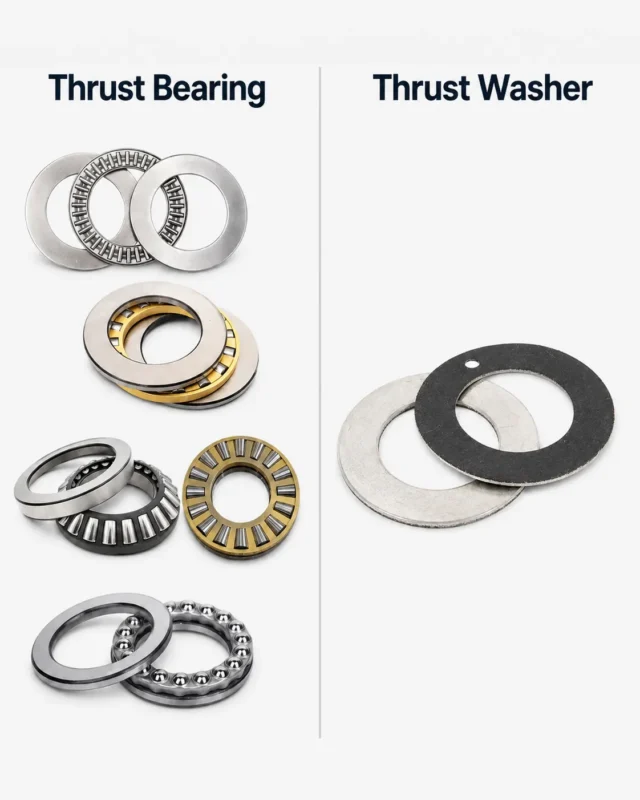
You can check the comparison table below to understand their differences.
| Item | Thrust Washer | Thrust Bearing |
| Category | Plain bearing / sliding bearing | A broad bearing category for axial loads |
| Bearing type | Plain thrust bearing | Can be plain bearing or rolling bearing |
| Structure | Flat circular disc or split half washer | Different structures depending on the bearing type |
| Common types | Flat thrust washer, split half thrust washer, PTFE composite thrust washer, POM composite thrust washer, graphite plugged bronze thrust washer | Thrust washer, thrust pad, thrust ball bearing, thrust roller bearing, spherical plain thrust bearing |
| Rolling elements | No balls or rollers | May have balls, rollers, or no rolling elements |
| Working principle | Sliding contact on the washer face | Sliding contact or rolling contact, depending on the type |
| Main function | Carry axial load, reduce friction, and control axial movement in a compact space | Carry axial load in different machines and working conditions |
| Typical applications | Crankshafts, gearboxes, pumps, motors, pulley assemblies, and machinery shafts | Gearboxes, automotive systems, machine tools, heavy machinery, pumps, and rotating equipment |
Part 4. Thrust Washer Size Chart
Now, with the detailed comparison, if you need to buy thrust washers, you can first check your application details, including size, working conditions, and material requirements. Then, you can check the thrust washer size chart and find the one that meets your requirements.
Here is the thrust washer size chart from BKZ Industry for your reference. Please note that it only includes some common sizes. If you do not find the size you need, or if you want to customize thrust washers for your application, you can contact BKZ Industry by email at sales@bkzindustry.com or contact us on WhatsApp at +86 18901426056.
| Backing Material | Intermediate Layer | Sliding Layer | Surface Treatment | Heat Resistance | t | t Tolerance | d | d Tolerance | D | D Tolerance | Locating Pin Hole d1 | d1 Tolerance | P.C.D. | P.C.D. Tolerance |
| SPCC | Bronze Powder | PTFE | Tin Plating | -200 to 280°C | 1.5 | -0.03 / -0.08 | 8 | +0.25 / 0 | 16 | 0 / -0.25 | 1.0 | +0.30 / +0.10 | 12 | ±0.12 |
| SPCC | Bronze Powder | PTFE | Tin Plating | -200 to 280°C | 1.5 | -0.03 / -0.08 | 10 | +0.25 / 0 | 18 | 0 / -0.25 | 1.0 | +0.30 / +0.10 | 14 | ±0.12 |
| SPCC | Bronze Powder | PTFE | Tin Plating | -200 to 280°C | 1.5 | -0.03 / -0.08 | 12 | +0.25 / 0 | 24 | 0 / -0.25 | 1.5 | +0.30 / +0.10 | 18 | ±0.12 |
| SPCC | Bronze Powder | PTFE | Tin Plating | -200 to 280°C | 1.5 | -0.03 / -0.08 | 14 | +0.25 / 0 | 26 | 0 / -0.25 | 1.5 | +0.30 / +0.10 | 20 | ±0.12 |
| SPCC | Bronze Powder | PTFE | Tin Plating | -200 to 280°C | 1.5 | -0.03 / -0.08 | 16 | +0.25 / 0 | 30 | 0 / -0.25 | 2.0 | +0.30 / +0.10 | 23 | ±0.12 |
| SPCC | Bronze Powder | PTFE | Tin Plating | -200 to 280°C | 1.5 | -0.03 / -0.08 | 18 | +0.25 / 0 | 32 | 0 / -0.25 | 2.0 | +0.30 / +0.10 | 25 | ±0.12 |
| SPCC | Bronze Powder | PTFE | Tin Plating | -200 to 280°C | 1.5 | -0.03 / -0.08 | 20 | +0.25 / 0 | 36 | 0 / -0.25 | 2.0 | +0.30 / +0.10 | 28 | ±0.12 |
| SPCC | Bronze Powder | PTFE | Tin Plating | -200 to 280°C | 1.5 | -0.03 / -0.08 | 22 | +0.25 / 0 | 38 | 0 / -0.25 | 3.0 | +0.375 / +0.125 | 30 | ±0.12 |
| SPCC | Bronze Powder | PTFE | Tin Plating | -200 to 280°C | 1.5 | -0.03 / -0.08 | 24 | +0.25 / 0 | 42 | 0 / -0.25 | 3.0 | +0.375 / +0.125 | 33 | ±0.12 |
| SPCC | Bronze Powder | PTFE | Tin Plating | -200 to 280°C | 1.5 | -0.03 / -0.08 | 28 | +0.25 / 0 | 48 | 0 / -0.25 | 3.0 | +0.375 / +0.125 | 38 | ±0.12 |
| SPCC | Bronze Powder | PTFE | Tin Plating | -200 to 280°C | 1.5 | -0.03 / -0.08 | 32 | +0.25 / 0 | 54 | 0 / -0.25 | 3.0 | +0.375 / +0.125 | 43 | ±0.12 |
| SPCC | Bronze Powder | PTFE | Tin Plating | -200 to 280°C | 1.5 | -0.03 / -0.08 | 38 | +0.25 / 0 | 62 | 0 / -0.25 | 4.0 | +0.375 / +0.125 | 50 | ±0.12 |
| SPCC | Bronze Powder | PTFE | Tin Plating | -200 to 280°C | 1.5 | -0.03 / -0.08 | 42 | +0.25 / 0 | 66 | 0 / -0.25 | 4.0 | +0.375 / +0.125 | 54 | ±0.12 |
| SPCC | Bronze Powder | PTFE | Tin Plating | -200 to 280°C | 2.0 | -0.03 / -0.08 | 52 | +0.25 / 0 | 78 | 0 / -0.25 | 4.0 | +0.375 / +0.125 | 65 | ±0.12 |
Final Words
Now, you know what a thrust washer is and have a clear understanding of the differences between a thrust washer, a flat washer, and a thrust bearing. I also provided a thrust washer size chart from BKZ Industry for your reference.
If you decide to buy thrust washers, I recommend contacting BKZ Industry. With ISO 9001 certification and two factories, BKZ Industry can produce thrust washers according to your requirements.
You can send the bearing number, quantity, drawing, working conditions, or any other information you have. BKZ Industry will reply to you with a quotation as soon as possible.