When selecting a bearing based on its material, you may come across hybrid ceramic bearings. Then, you may feel confused about what a hybrid ceramic bearing is, how it is constructed, what advantages and limitations it has, and whether you should choose it for your application. You may also want to know the key differences between hybrid ceramic bearings, full ceramic bearings, and conventional steel bearings.
In this guide, I will explain everything you want to know about hybrid ceramic bearings, including their structure, materials, advantages, limitations, applications, and differences from other types of bearings.
After understanding these points, if you decide to use hybrid ceramic bearings for your application and want to purchase them in bulk, you can contact BKZ Industry. As a bearing manufacturer with 15 years of experience and two factories, BKZ Industry can manufacture and supply hybrid ceramic bearings in bulk according to your application requirements.
Part 1. What Is a Hybrid Ceramic Bearing?
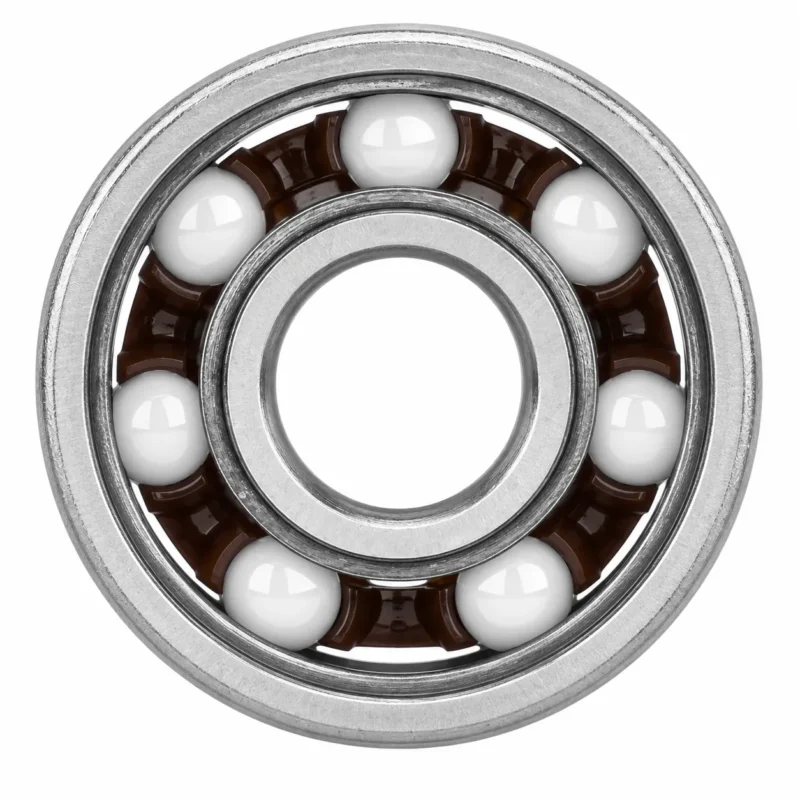
A hybrid ceramic bearing is a bearing that combines ceramic rolling elements with metal inner and outer rings. The rolling elements are usually made of silicon nitride. The rings are generally made of bearing steel or stainless steel.
Unlike a full ceramic bearing, a hybrid ceramic bearing is not made entirely of ceramic. It combines the advantages of ceramic rolling elements with the strength and toughness of metal rings.
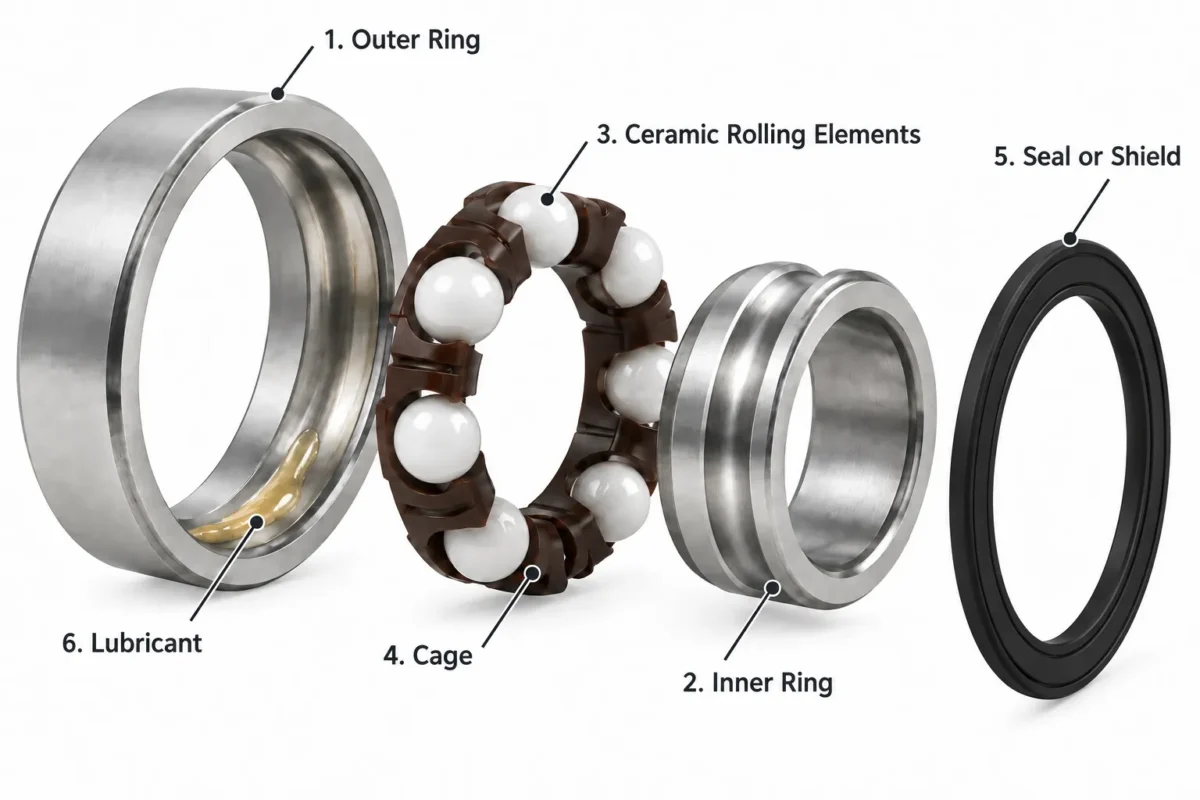
Structure of a Hybrid Ceramic Bearing
A hybrid ceramic bearing generally consists of the following parts:
- Outer Ring: The outer ring is generally made of bearing steel or stainless steel.
- Inner Ring: Like the outer ring, the inner ring is generally made of bearing steel or stainless steel.
- Ceramic Rolling Elements: The rolling elements can be balls or rollers. They are usually made of silicon nitride.
- Cage: The cage keeps the rolling elements correctly spaced and guides their movement. It can be made of steel, brass, nylon, PEEK, or other engineered materials.
- Seals or Shields: Seals or shields help prevent dust, water, and other contaminants from entering the bearing. They also help retain the lubricant inside the bearing.
- Lubricant: Grease or lubricating oil is selected according to the bearing speed, temperature, load, and operating environment.
Now that you have a general idea of what a hybrid ceramic bearing is, you may want to know why you should use one in your application. To decide whether it is suitable, you need to understand its advantages and limitations.
Advantages of Hybrid Ceramic Bearings
- Protection Against Electrical Erosion: Silicon nitride rolling elements have electrically insulating properties. They can interrupt the current path between the inner and outer rings, helping prevent electrical erosion of the raceways.
- Higher Speed Capability: Ceramic rolling elements are lighter than steel rolling elements. Therefore, they generate lower centrifugal forces and less heat, allowing hybrid ceramic bearings to operate at higher speeds.
- Better High-Temperature Performance: Ceramic rolling elements have lower thermal expansion and can maintain their properties at higher temperatures. However, the maximum operating temperature of the complete bearing is still limited by the rings, cage, seals, and lubricant.
- Potentially Longer Service Life: Silicon nitride is harder and more wear-resistant than bearing steel. Its lower friction and reduced heat generation may extend bearing service life under suitable operating and lubrication conditions.
Limitations of Hybrid Ceramic Bearings
- Higher Price: Compared with conventional steel bearings, hybrid ceramic bearings are generally more expensive because ceramic rolling elements require more complex materials and manufacturing processes.
- Risk of Cracking or Fracture: Silicon nitride has high hardness and compressive strength, but it is still a brittle material. The ceramic rolling elements may be damaged by severe impact, improper installation, or excessive edge loading.
- Risk of Corrosion: Although the rolling elements are ceramic, the inner and outer rings are still made of metal. Bearing-steel rings can therefore corrode when exposed to water, moisture, or corrosive chemicals. Stainless-steel rings provide better corrosion resistance, but they are not completely corrosion-proof.
With these advantages and limitations, you can understand why hybrid ceramic bearings are used in certain applications. Next, if you want to choose one for your application, you will find that many different types are available. Therefore, understanding these types is important when selecting a suitable hybrid ceramic bearing.
Types of Hybrid Ceramic Bearings
Hybrid ceramic bearings can be divided into different types based on the shape of their rolling elements.
- Hybrid Ceramic Ball Bearings: Their rolling elements are ceramic balls, while the inner and outer rings are usually made of bearing steel or stainless steel. Compared with roller bearings, they generally produce less friction and are more suitable for high-speed applications. Based on their design, they include hybrid ceramic deep-groove ball bearings, angular-contact ball bearings, thrust ball bearings, and more.
- Hybrid Ceramic Roller Bearings: Their rolling elements are ceramic rollers, while the inner and outer rings are generally made of metal. Compared with ball bearings of a similar size, roller bearings generally have a higher radial load capacity because of their larger contact area. However, they usually generate more friction and are less suitable for extremely high-speed applications. They can include cylindrical, tapered, spherical, and needle roller bearings. However, hybrid ceramic roller bearings are less common than hybrid ceramic ball bearings.
Based on whether they come with a housing, hybrid ceramic bearings can also be divided into the following two types:
- Housed Hybrid Ceramic Bearing Units: These consist of a hybrid ceramic bearing insert and a bearing housing. The housing can be made of cast iron, pressed steel, stainless steel, or another suitable material. Compared with purchasing and installing the bearing and housing separately, a complete bearing unit is generally easier to mount and align. However, housed hybrid ceramic bearing units are less common and are often produced for special applications.
- Unhoused Hybrid Ceramic Bearings: These are individual hybrid ceramic bearings supplied without a housing. They need to be installed in a separate machine housing or bearing seat. This is the most common form of hybrid ceramic bearing.
Part 2. Hybrid Ceramic Bearings vs Full Ceramic vs Steel Bearings: Key Differences
Understanding hybrid ceramic bearings alone is not enough to determine whether they are suitable for your application. You also need to understand their differences from full ceramic bearings and steel bearings. The table below compares their materials, performance, limitations, and other important characteristics.
| Comparison | Hybrid Ceramic Bearings | Full Ceramic Bearings | Steel Bearings |
| Materials | Ceramic rolling elements with steel or stainless-steel inner and outer rings; cages and seals may be made of other materials | Ceramic rolling elements with ceramic inner and outer rings; cages and seals may be made of other materials | Main bearing components are made of steel; cages, seals, liners, and lubricants may use other materials |
| Common Types | Ball bearings and roller bearings | Ball bearings and roller bearings | Ball bearings, roller bearings, and plain bearings |
| Electrical Insulation | Generally excellent because the ceramic rolling elements interrupt the electrical-current path between the inner and outer rings | Excellent | Generally poor unless an electrically insulated design is used |
| Corrosion Resistance | The ceramic rolling elements resist corrosion, but the metal rings may still corrode | Generally excellent, depending on the ceramic material | Limited unless stainless steel, coatings, or other corrosion-protection methods are used |
| Speed Capability | Generally the highest because the ceramic rolling elements are lighter and generate less centrifugal force | Can be high, depending on the ceramic material, accuracy, and bearing design | Moderate to high, depending on the bearing type and design |
| Temperature Capability | Can be better than standard steel bearings, but is still limited by the metal rings, cage, seals, and lubricant | Generally suitable for higher temperatures, depending on the ceramic material, cage, seals, and design | Depends on the steel, heat treatment, cage, seals, and lubricant |
| Thermal Expansion | Lower than comparable all-steel rolling bearings | Generally very low, depending on the ceramic material | Generally higher than ceramic-bearing designs |
| Impact Resistance | Better than full ceramic bearings but generally lower than all-steel bearings | Generally the lowest because ceramic materials are brittle | Generally the highest |
| Stiffness | Generally high because ceramic rolling elements have high elastic stiffness | Generally high, but varies with the ceramic material and bearing design | Moderate to high |
| Wear Resistance | High | Generally very high | Moderate to high, depending on the steel, surface treatment, and lubrication |
| Lubrication Requirement | Proper lubrication is normally required | Some designs can operate with limited or no lubrication, but this does not apply to all full ceramic bearings | Proper lubrication is normally required, although some plain bearings are self-lubricating |
| Load and Shock Capability | Provides good load capacity but is less suitable for severe shock loads than all-steel bearings | Can support many normal loads but is generally not suitable for heavy impact or shock loads | Generally the most suitable for heavy loads and shock-loading conditions |
| Weight | Lighter than comparable all-steel rolling bearings when silicon nitride rolling elements are used | Can be very light when made of silicon nitride, but the weight varies according to the ceramic material | Generally heavier than silicon-nitride bearing designs |
| Magnetic Properties | Partially non-magnetic, but the metal rings may still be magnetic | Generally non-magnetic | Usually magnetic, except for certain stainless-steel grades |
| Price | Higher than conventional steel bearings | Generally the highest | Generally the lowest |
From this comparison, you can see that hybrid ceramic bearings provide a balance between the high-speed and electrical-insulation performance of ceramic materials and the toughness of steel rings.
Part 3. Where to Buy Hybrid Ceramic Bearings?
If you decide to buy hybrid ceramic bearings, you can contact BKZ Industry. As an experienced bearing manufacturer, BKZ Industry can manufacture and supply hybrid ceramic bearings in bulk for your application.
So, why should you buy hybrid ceramic bearings from BKZ Industry? Here are the reasons:
- 15 Years of Bearing Manufacturing and Export Experience: BKZ Industry has 15 years of experience in bearing manufacturing and has exported bearings to many countries. It can manufacture hybrid ceramic bearings according to your drawings and application requirements.
- Support from Two Factories: With two bearing factories, BKZ Industry can support the bulk production of hybrid ceramic bearings for your application.
- Strict Quality Control: BKZ Industry controls product quality throughout the process, from material sourcing to manufacturing and final inspection.
- OEM and Custom Options: BKZ Industry provides OEM services and can customize hybrid ceramic bearings according to your drawings, samples, or technical requirements.
Contact BKZ Industry to get a quotation for your hybrid ceramic bearings.
Part 4. FAQS
Q1. Can Hybrid Ceramic Bearings Replace Steel Bearings?
In some applications, yes. A hybrid ceramic bearing may replace an all-steel rolling bearing when its dimensions, bearing type, internal clearance, load capacity, speed rating, accuracy, and operating conditions are suitable.
Q2. Do Hybrid Ceramic Bearings Require Lubrication?
Yes. Most hybrid ceramic bearings still require proper lubrication because their inner and outer rings are generally made of metal and rolling contact still occurs inside the bearing.
Q3. Can Hybrid Ceramic Bearings Replace SKF, NSK, or FAG Models?
In many cases, BKZ Industry can provide a hybrid ceramic bearing with dimensions and specifications equivalent to an SKF, NSK, or FAG model. You can send BKZ Industry the original bearing model, dimensions, drawings, quantity, and operating conditions. BKZ Industry will check the requirements and provide a suitable quotation.
Ending Note
Hybrid ceramic bearings combine ceramic rolling elements with metal rings, providing electrical insulation, higher speed capability, lower thermal expansion and improved wear resistance.
If you need hybrid ceramic bearings in bulk, contact BKZ Industry with your required model, dimensions, quantity, drawings and operating conditions. With 15 years of bearing manufacturing experience and support from two factories, BKZ Industry can provide standard, OEM and custom hybrid ceramic bearings for your application.