When you try to find information about hanger bearings, you may come across different descriptions. Some articles describe a hanger bearing as a type of plain bearing, while others say it uses a ball bearing. This may leave you wondering what exactly a hanger bearing is and which explanation you should trust.
No worries. Based on nearly 10 years of experience in the bearing industry, I will explain what a hanger bearing is and provide the key information you need to know.
After reading this guide, if you are planning to purchase hanger bearings, you can contact BKZ Industry. As a bearing manufacturer established in 2011, BKZ Industry specializes in bearing units, including hanger bearings. With its own factory, BKZ Industry can also offer cost-effective prices based on your requirements.
Part 1. What is a Hanger Bearing?
Now, let’s see what a hanger bearing is. A hanger bearing is not simply a type of plain bearing or ball bearing. Instead, it is a complete bearing assembly installed by hanging it from an overhead supporting structure. It is mainly used to support an intermediate section of a long rotating shaft.
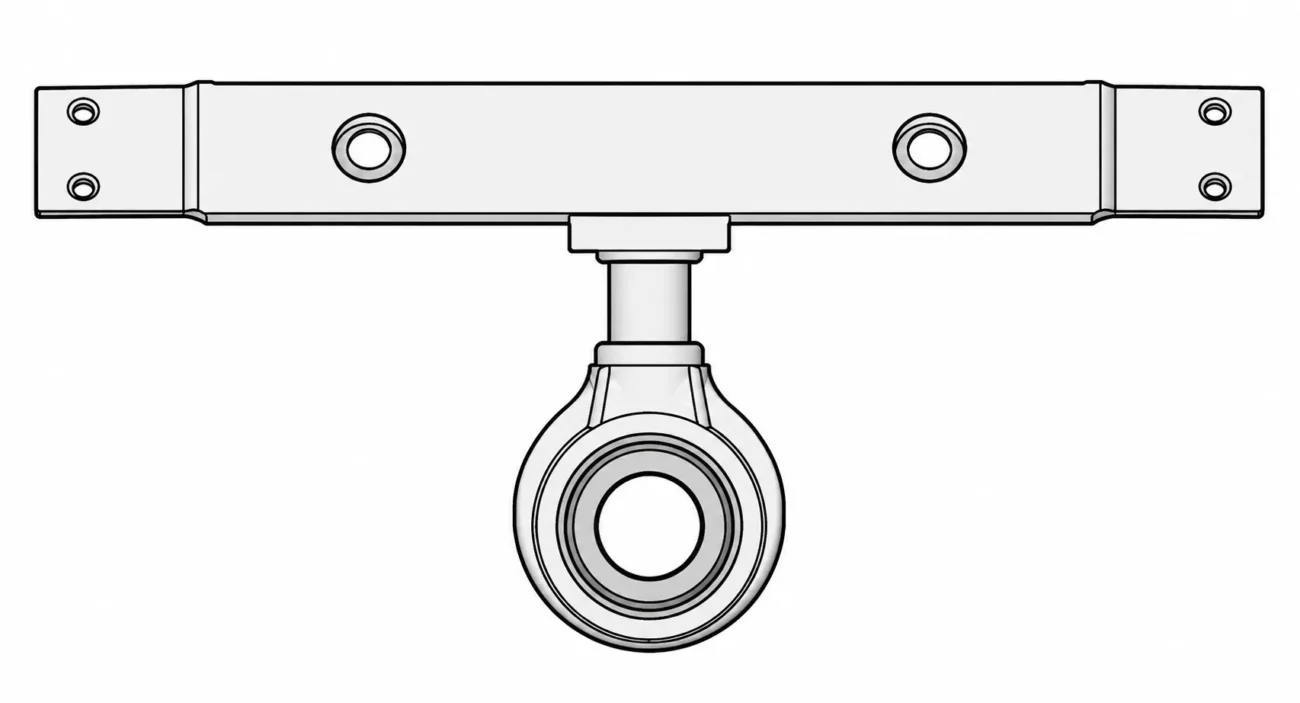
Depending on the design and operating conditions, a hanger bearing may use a plain bearing, bushing, ball bearing or roller bearing. Therefore, the term “hanger bearing” describes how the bearing assembly is mounted and used rather than one specific type of bearing.
To help you understand it more easily, the picture below shows what a typical hanger bearing looks like.
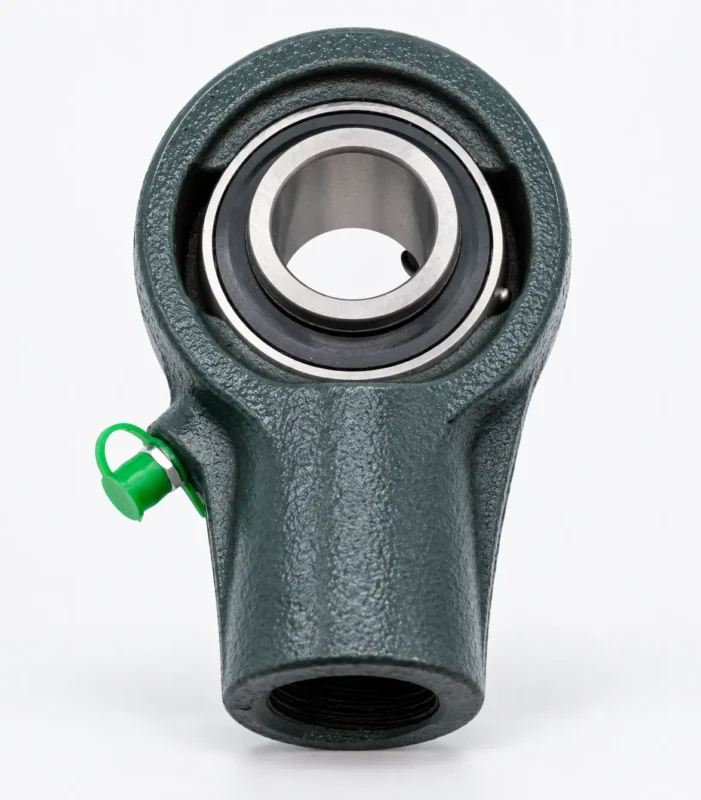
So, what are the main functions of a hanger bearing? Like other bearings, it supports the rotating shaft and reduces friction between the shaft and its stationary support. It also helps keep the shaft aligned and prevents excessive bending or sagging. Hanger bearings are commonly used to support the intermediate shafts of screw conveyors and other long shaft systems.
The exact structure varies according to the design and application. A typical hanger bearing assembly may include the following parts:
- Hanger Housing or Support
The hanger housing suspends the bearing from an overhead structure and contains a bore or bearing seat for holding the bearing element. Depending on its design, the upper mounting section may use a threaded connection, bolts or other mounting methods. - Bearing Element
The bearing element supports the rotating shaft and reduces friction. Depending on the hanger-bearing design, it may be a plain bearing, a replaceable bushing, a ball-bearing insert or a roller bearing. Some ball-bearing inserts have an extended inner ring for shaft mounting and locking, but this feature is not found in every hanger bearing. - Mounting and Retaining Components
Bolts, collars, seals and other retaining components may also be used to secure the bearing element, connect the assembly to the supporting structure and protect the bearing from dust or contaminants.
Types of Hanger Bearings
Now, you already know what a hanger bearing is and its structure. You may want to know what types of hanger bearings are available. Hanger bearings can be divided into different types based on their bearing elements, construction and housing materials. Here, I will explain the main types to help you understand their differences.
Based on the Bearing Element
Plain Hanger Bearings: The bearing element inside the hanger housing is a plain bearing or replaceable bushing. It supports the shaft through sliding contact without using balls or rollers. This type is commonly used in low-speed, dusty or abrasive applications, such as screw conveyors.
Ball-Bearing Hanger Units: The bearing element inside the housing is a ball-bearing insert. It uses balls to reduce friction and can generally operate at higher speeds than a plain hanger bearing. Some designs, such as UCHA hanger bearing units, have an extended inner ring and set screws to secure the bearing to the shaft.
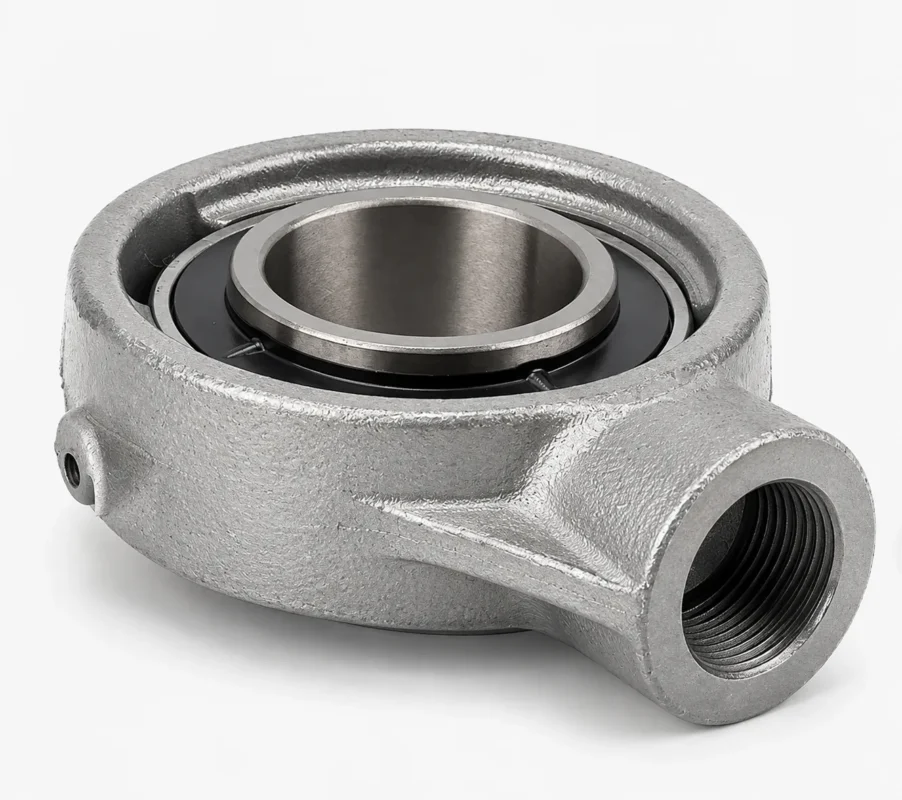
Roller Hanger Bearings: The bearing element inside the housing is a roller bearing. The rollers have line contact with the raceways, allowing the bearing to support relatively heavy radial loads. This type can be used in heavy-duty conveyors and other industrial machinery.
Based on the Construction
Hanger bearings can also be divided into split and solid types based on their construction.
Split Hanger Bearings: The bearing element, housing or both are divided into two sections. This design makes installation, inspection and replacement easier because you may not need to remove the entire shaft. Depending on the design and application, a split hanger bearing may use a plain bearing or roller bearing.
Solid Hanger Bearings: The bearing element, housing or both have a one-piece construction. This design is generally simple and rigid. However, you may need to remove the shaft or nearby components when installing or replacing the bearing.
Based on the Housing Material
The housing of a hanger bearing can also be made from different materials. The suitable material depends on the load, working environment, corrosion conditions and other application requirements.
Cast-Iron Hanger Bearings: The housing is made of cast iron. It offers good rigidity, vibration damping and cost efficiency, making it suitable for many general industrial applications.
Ductile-Iron Hanger Bearings: The housing is made of ductile iron. Compared with standard gray cast iron, it provides higher strength and better resistance to impact loads.
Cast-Steel Hanger Bearings: The housing is made of cast steel. It offers high strength and is suitable for heavy loads, shock loads and demanding industrial applications.
Pressed-Steel Hanger Bearings: The housing is made of pressed steel. It is lightweight and cost-effective, making it more suitable for relatively light-duty applications.
Stainless-Steel Hanger Bearings: The housing is made of stainless steel. It provides better corrosion resistance and is suitable for wet, corrosive or frequently washed-down environments.
Applications of Hanger Bearings
From the types above, you can see that hanger bearings are mainly used in screw conveyors. These conveyors are widely used to transport bulk materials in different industries. The main applications include:
- Agriculture: Grain, animal feed, seeds and fertilizer.
- Food Processing: Flour, sugar, starch, salt, grains and other powdered or granular food materials.
- Cement and Construction Materials: Cement, sand, lime, gypsum, fly ash and dry mortar.
- Mining and Mineral Processing: Coal, ore, mineral powder and other abrasive bulk materials.
- Chemical Processing: Chemical powders, granules, additives and corrosive materials.
- Plastics and Rubber: Plastic pellets, resins, additives and rubber-processing materials.
- Wastewater Treatment: Sludge, screenings, dewatered solids and other waste materials.
- Biomass and Energy: Wood chips, sawdust, ash, biomass fuel and agricultural residues.
- Pulp and Paper: Wood fibers, pulp, bark and other paper-processing materials.
- General Manufacturing: Powders, granules, components and other bulk materials transported by screw conveyors.
Part 2. Hanger Bearing vs Rod End Bearing: Are They the Same Bearing?
You may find that some hanger bearings and rod end bearings have a similar appearance because both can have an extended or threaded section. Therefore, you may wonder whether they are the same type of bearing. The answer is no.
Here, I will use a table to help you compare them and understand their key differences.
| Comparison | Hanger Bearing | Rod End Bearing |
| Main purpose | Supports a rotating shaft and reduces friction during rotation | Connects mechanical components, transfers loads and allows angular movement |
| Bearing element | May use a plain bearing, ball-bearing insert or roller bearing | Usually uses a spherical plain bearing; some designs use rolling bearings |
| Housing structure | Hanger-style housing or frame with an upper mounting stem or mounting point | Eye-shaped housing with an integral male or female threaded shank |
| Main movement | Supports continuous or intermittent shaft rotation | Mainly allows oscillating, tilting or articulating movement; limited rotation may also occur |
| Misalignment | Misalignment capability depends on the bearing element and design | Designed to accommodate angular movement and misalignment between connected components |
| Threaded section | An upper threaded stem may be used to suspend and position the housing | A male or female thread is used to connect the bearing to a rod or linkage |
| Common applications | Screw conveyors, material-handling equipment and long shaft systems | Hydraulic cylinders, steering systems, control linkages and suspension systems |
From the comparison, you can see that hanger bearings and rod end bearings are two different types of bearing units. A hanger bearing is mainly used to support a rotating shaft from an overhead structure. In comparison, a rod end bearing is mainly used to connect mechanical components, transfer loads and allow angular movement.
Therefore, although some of their structures may look similar, their purposes, designs and movement types are different.
Part 3. Hanger Bearing vs Pillow Block Bearing vs Flange Bearing vs Take-Up Bearing
A hanger bearing with a ball-bearing insert is also a type of mounted bearing unit. Therefore, you may want to know how it differs from other common bearing units, such as pillow block bearings, flange bearing units and take-up bearing units.
Here, I will use a table to help you understand their main differences.
| Comparison | Hanger Bearing with Ball-Bearing Insert | Pillow Block Bearing | Flange Bearing Unit | Take-Up Bearing Unit |
| Main purpose | Supports a shaft from an overhead supporting structure | Supports a shaft above a mounting base | Supports a shaft through or beside a machine wall or mounting plate | Supports a shaft while allowing its position to be adjusted |
| Mounting position | Suspended from above | Mounted on a base or horizontal surface | Mounted on the face of a machine wall or plate | Installed inside a take-up frame or guide |
| Housing structure | Hanger-style housing with an upper threaded stem or mounting point | Pedestal-style housing with two mounting feet | Flanged housing with two, three or four mounting-bolt holes | Sliding housing designed to move within a take-up frame |
| Adjustment function | The mounting height may be adjusted in some designs | Usually installed in a fixed position | Usually installed in a fixed position | Designed for shaft-position and belt- or chain-tension adjustment |
| Common applications | Screw conveyors, material-handling equipment and suspended shaft systems | Conveyors, fans, agricultural machinery and general industrial equipment | Machine frames, conveyors and equipment with vertical mounting surfaces | Belt conveyors, chain conveyors and other tensioning systems |
From the table, you can see that the main differences between these bearing units are their mounting methods, housing structures and functions.
A hanger bearing supports the shaft from above, while a pillow block bearing supports it from a mounting base. A flange bearing unit is installed on the face of a wall or plate. In comparison, a take-up bearing unit can move within a frame to adjust the shaft position and maintain the required belt or chain tension.
Part 4. How to Select a Hanger Bearing
With a clear understanding of hanger bearings, you may now need to select a suitable hanger bearing for your application. So, what should you consider during selection? Here are the main steps you should follow.
Step 1. Check the Required Dimensions
First, you need to confirm the dimensions of the hanger bearing. The main dimensions you should check include:
- Shaft diameter or bearing bore
- Overall height
- Shaft center height
- Housing width
- Bearing width
- Mounting-stem diameter
- Thread size and thread length
- Available installation space
You should compare these dimensions with the product drawing to ensure that the hanger bearing fits both the shaft and the supporting structure.
Step 2. Check the Working Conditions
Next, you need to consider the actual working conditions. These conditions determine which bearing element, material, seal and lubrication method are suitable.
The main factors include:
- Load: For heavy radial loads, you may need a heavy-duty plain or roller hanger bearing.
- Speed: Plain hanger bearings are commonly used in low-speed applications such as screw conveyors. For relatively higher speeds, ball-bearing or suitable roller-bearing hanger units are generally more appropriate.
- Contamination: In dusty or abrasive environments, you should consider wear-resistant bearing materials, suitable seals and an appropriate lubrication method.
- Temperature: For high-temperature applications, you need to check the temperature limits of the bearing element, housing, seals and lubricant.
- Corrosion and moisture: For wet, corrosive or frequently washed-down environments, stainless steel, engineering plastics, composite materials or corrosion-resistant coatings may be required.
- Conveyed material: For screw conveyors, consider the abrasiveness, corrosiveness, temperature and hygiene requirements of the conveyed material.
- Misalignment: If shaft or mounting misalignment may occur, select a design that can accommodate the expected misalignment within the manufacturer’s limits.
Step 3. Consider Maintenance and Cost
Finally, you need to consider maintenance requirements and the total operating cost of the hanger bearing.
The main factors include:
- Lubrication requirements and intervals
- Access to the lubrication point
- Ease of installation and replacement
- Availability of replacement bearings or bushings
- Expected service life
- Equipment downtime
- Initial purchase price
- Long-term maintenance and replacement costs
You should select a hanger bearing that provides a suitable balance between performance, service life, maintenance and price.
Part 5. Where to Buy Standard or Custom Hanger Bearings
Now, you may decide to buy hanger bearings but do not know which manufacturer or supplier to choose. In this case, you can contact BKZ Industry. BKZ Industry manufactures hanger bearing units with ball-bearing inserts and works with long-term suppliers to provide other types of hanger bearings based on your requirements.
Here are the main reasons to choose BKZ Industry:
- Over 15 Years of Bearing Manufacturing Experience: BKZ Industry has been manufacturing bearings since 2011. With its manufacturing experience and long-term supplier network, it can provide different types of standard and custom hanger bearings according to your requirements.
- Support from Two Bearing Factories: With two bearing factories, BKZ Industry can support both small orders and bulk production while helping customers meet their required quantities and delivery schedules.
- Standard and Custom Hanger Bearings Available: In addition to standard hanger bearing models, BKZ Industry can also manufacture custom hanger bearings based on your drawings, dimensions, materials, loads and working conditions.
- Experienced Bearing Exporter: BKZ Industry has exported bearings to customers in different countries. Its team can assist with quotations, technical confirmation, packaging, shipping and the required export documents.
- Strict Bearing Quality Control: BKZ Industry controls bearing quality throughout material inspection, production, assembly and final inspection. The dimensions, appearance, rotation and other required items can be checked before shipment.
If you need standard or custom hanger bearings, you can send your model, dimensions, drawings, quantity and working conditions to BKZ Industry. The team will check your requirements and provide a suitable solution and quotation.
Part 6. Hanger Bearing Size Chart
For your reference, I have listed some sizes of hanger bearings manufactured by BKZ Industry in the table below. If the model or size you need is not listed, you can contact BKZ Industry directly for more options or a custom solution.
| Hanger Bearing Unit Designation | Shaft Diameter (mm) | Overall Unit Height (mm) | Overall Housing Width (mm) | Housing Offset (mm) | Mounting Face-to-Shaft Center Height (mm) | Housing Thickness (mm) | Threaded Hole Depth (mm) | Mounting Thread Size | Insert Bearing Inner Ring Width (mm) | Set-Screw Center Distance (mm) | Insert Bearing Designation | Housing Designation | Weight (kg) |
| UCHA201S | 12 | 88.5 | 57 | 0 | 60 | 38 | 19 | G3/4 | 27.4 | 11.5 | UC201S | HA203 | 0.60 |
| UCHA202S | 15 | 88.5 | 57 | 0 | 60 | 38 | 19 | G3/4 | 27.4 | 11.5 | UC202S | HA203 | 0.60 |
| UCHA203S | 17 | 88.5 | 57 | 0 | 60 | 38 | 19 | G3/4 | 27.4 | 11.5 | UC203S | HA203 | 0.60 |
| UCHA201 | 12 | 96 | 64 | 0 | 64 | 40 | 19 | G3/4 | 31 | 12.7 | UC201 | HA204 | 0.73 |
| UCHA202 | 15 | 96 | 64 | 0 | 64 | 40 | 19 | G3/4 | 31 | 12.7 | UC202 | HA204 | 0.73 |
| UCHA203 | 17 | 96 | 64 | 0 | 64 | 40 | 19 | G3/4 | 31 | 12.7 | UC203 | HA204 | 0.73 |
| UCHA204 | 20 | 96 | 64 | 0 | 64 | 40 | 19 | G3/4 | 31 | 12.7 | UC204 | HA204 | 0.73 |
| UCHA205 | 25 | 103 | 78 | 0 | 64 | 40 | 19 | G3/4 | 34 | 14.3 | UC205 | HA205 | 0.88 |
| UCHA206 | 30 | 103 | 78 | 0 | 64 | 40 | 19 | G3/4 | 38.1 | 15.9 | UC206 | HA206 | 1.00 |
| UCHA207 | 35 | 116 | 92 | 0 | 70 | 40 | 19 | G3/4 | 42.9 | 17.5 | UC207 | HA207 | 1.20 |
| UCHA208 | 40 | 121 | 96 | 2 | 73 | 40 | 19 | G3/4 | 49.2 | 19 | UC208 | HA208 | 1.30 |
| UCHA209 | 45 | 136 | 108 | 5 | 82 | 48 | 21 | G1 | 49.2 | 19 | UC209 | HA209 | 1.80 |
| UCHA210 | 50 | 140.5 | 115 | 5 | 83 | 48 | 21 | G1 | 51.6 | 19 | UC210 | HA210 | 2.10 |
| UCHA211 | 55 | 150 | 126 | 7 | 87 | 60 | 24 | G1-1/4 | 55.6 | 22.2 | UC211 | HA211 | 2.80 |
| UCHA212 | 60 | 173 | 142 | 9 | 102 | 60 | 28 | G1-1/4 | 65.1 | 25.4 | UC212 | HA212 | 3.90 |
| UCHA213 | 65 | 200 | 166 | 9.5 | 117 | 70 | 32 | G1-1/2 | 65.1 | 25.4 | UC213 | HA213 | 5.90 |
| UCHA214 | 70 | 200 | 166 | 9.5 | 117 | 70 | 32 | G1-1/2 | 74.6 | 30.2 | UC214 | HA214 | 5.90 |
| UCHA215 | 75 | 200 | 166 | 9.5 | 117 | 70 | 32 | G1-1/2 | 77.8 | 33.2 | UC215 | HA215 | 5.90 |
Final Words
From this guide, you now know that a hanger bearing is a complete bearing assembly suspended from an overhead supporting structure to support a rotating shaft. Depending on its design and application, it may use a plain bearing, ball-bearing insert or roller bearing as its bearing element. Hanger bearings are commonly used in screw conveyors and other material-handling equipment.
If you need standard or custom hanger bearings, you can contact BKZ Industry and send your model, dimensions, drawings, quantity and working conditions for a suitable solution and quotation.