Sleeve bearings are an important type of bearing, but many of you may not fully understand what they are, what they look like, how they work, what their structure is, and where they are used.
In this article, I will explain sleeve bearings in a clear way, including their purpose, working principle, structure, advantages and disadvantages, common applications, major types, and how to choose the right sleeve bearing. I will also explain the differences between sleeve bearings, bushings, and journal bearings, because these terms are often used together and can easily cause confusion.
After understanding sleeve bearings, if you need to buy them for your application, it is important to choose a reliable bearing manufacturer. BKZ Industry is one option you can consider, especially if you are looking for self-lubricating sleeve bearings. Since 2018, BKZ Industry has been producing bearings and supplying bearing solutions for industrial buyers. With manufacturing experience and product knowledge, BKZ Industry can help you select and supply the sleeve bearings you need. Contact BKZ Industry now.
Part 1. What is a Sleeve Bearing?
OK. First of all, let’s understand what a sleeve bearing actually is. A sleeve bearing is a type of plain bearing. Bearings that work by sliding contact instead of rolling elements are generally called plain bearings, and sleeve bearings are usually cylindrical plain bearings.
Its structure is usually a hollow cylinder with an inner sliding surface. This surface may work with oil or grease lubrication, or it may use low-friction or self-lubricating materials such as PTFE or graphite to reduce friction. Here are some pictures to show what they look like, so that you can have a better understanding of them.
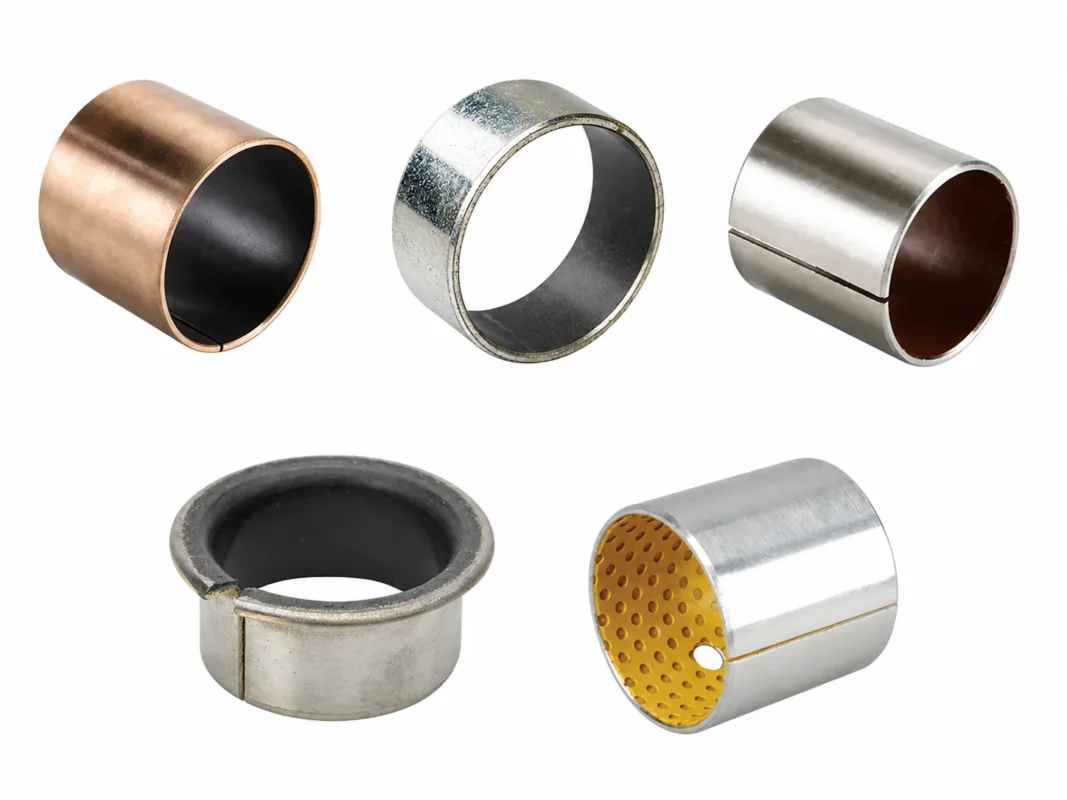
So how does it work? In most applications, the sleeve bearing is fixed in the housing, and the shaft rotates or slides inside its inner bore. The sleeve bearing supports the shaft, while the lubrication film or self-lubricating material helps reduce direct contact between the shaft and the bearing surface. This reduces friction and wear and allows the shaft to rotate or slide smoothly.
So why should you use sleeve bearings instead of other bearings? What are their advantages and disadvantages? Here are the advantages and disadvantages of sleeve bearings.
Advantages:
- Simple structure
- Low cost in many applications
- Quiet operation
- Good shock load resistance
- Easy installation
- Compact design
- Can provide low maintenance or self-lubricating performance when made with self-lubricating materials
Disadvantages:
- Usually higher friction than rolling bearings, especially during start-up or under boundary lubrication
- More sensitive to lubrication condition, material selection, and shaft surface quality
- Not suitable for all high-speed applications, especially when heat dissipation and lubrication are not well controlled
With these advantages and disadvantages, sleeve bearings can be used in many applications, especially where simple structure, low noise, low cost, compact design, or self-lubricating performance is required. Common application examples include:
| Industry | Devices / Equipment Where Sleeve Bearings May Be Used |
| Automotive | Starters, alternators, pedals, suspension components, steering systems, wiper motors, pumps |
| Electric motors | Small motors, fan motors, blower motors, household appliance motors |
| Pumps | Water pumps, chemical pumps, oil pumps, centrifugal pumps, submersible pumps |
| Compressors | Reciprocating compressors, air compressors, refrigeration compressors |
| Agricultural machinery | Tractors, harvesters, seeders, tillage equipment, linkage joints |
| Construction machinery | Excavators, loaders, cranes, hydraulic cylinders, boom pivots |
| Mining machinery | Crushers, conveyors, screens, feeders, heavy pivot points |
| Marine | Propeller shafts, rudder systems, deck equipment, pumps |
| Food & beverage equipment | Conveyors, mixers, packaging machines, filling machines |
| Textile machinery | Spinning machines, weaving machines, rollers, guide mechanisms |
| Printing & packaging | Rollers, guide shafts, folding machines, labeling machines |
| Home appliances | Fans, washing machines, vacuum cleaners, mixers, small motors |
| Office equipment | Printers, scanners, copiers, paper feed rollers |
| Aerospace | Control linkages, hinges, actuator systems, light-duty rotating or oscillating parts |
| Railway | Door systems, brake linkages, suspension components, sliding joints |
| Robotics & automation | Linear motion joints, pivot arms, small rotary mechanisms, grippers |
Part 2. Sleeve Bearing vs Bushing
Now, you may already have a clear picture of what a sleeve bearing is. But how is it different from a bushing? When you search for sleeve bearings, the term often appears together with bushing. So what are their differences? To make the key differences clear, I will use a table to compare them.
| Item | Sleeve Bearing | Bushing |
| Category | A type of plain bearing. | A broader term. In the bearing category, it can refer to a type of plain bearing, such as bronze bushings, sleeve bushings, flanged bushings, and self-lubricating bushings. |
| Meaning | Usually refers to a cylindrical plain bearing used to support a rotating or sliding shaft. | Can refer to a bearing component, but it can also mean a locating bushing, spacer sleeve, protective sleeve, rubber bushing, or structural connecting component, depending on the application. |
| Relationship | A sleeve bearing can also be called a sleeve bushing in many applications. | A sleeve bushing is often used as a sleeve bearing, but not every bushing is a sleeve bearing. |
So now, you can understand that a sleeve bearing is a type of plain bearing. However, a bushing is a broader term. In bearing applications, a bushing can be a type of plain bearing, but in other applications, it may refer to other components.
Part 3. Sleeve Bearing vs Journal Bearing
Knowing the difference between a sleeve bearing and a bushing is not enough, because you will often see sleeve bearings mentioned together with journal bearings. To help you understand sleeve bearings more clearly and know the difference between sleeve bearings and journal bearings, I will also use a table to compare them.
| Item | Sleeve Bearing | Journal Bearing |
| Category | A type of plain bearing. | A type of plain bearing. |
| Focus | Focus on its shape | Focus on its function to support the rotating journal part of a shaft. |
| Structure | Usually a hollow cylindrical bearing installed in a housing. | Can be a sleeve-type structure, split bearing, or other plain bearing structure used around a journal. |
| Lubrication | May use oil, grease, PTFE, graphite, bronze, or composite self-lubricating materials. | Often relies on oil lubrication, especially in hydrodynamic journal bearings. |
From the table, you can see that both sleeve bearings and journal bearings belong to plain bearings, but their names come from different focuses. A sleeve bearing usually describes a cylindrical sleeve-shaped bearing structure, while a journal bearing describes a bearing used to support the rotating journal part of a shaft.
So, when a sleeve bearing supports the rotating journal of a shaft, it can work as a journal bearing. When a journal bearing uses a cylindrical sleeve structure, it can also be called a sleeve bearing. However, a sleeve bearing may also be used for sliding or oscillating motion, not only for supporting a rotating journal. A journal bearing may also have other structures, such as a split bearing or a tilting pad bearing.
Part 4. Sleeve Bearing Types
Sleeve bearings have many different types based on their structure, material, lubrication method, and size standard.
Sleeve Bearing Types by Structure
- Plain sleeve bearings
- Flanged sleeve bearings
- Thrust sleeve bearings
- Split sleeve bearings
- Self-aligning sleeve bearings
Sleeve Bearing Types by Material
- Bronze sleeve bearings
- Steel-backed composite sleeve bearings
- Plastic sleeve bearings
- PTFE-lined sleeve bearings
- Graphite-plugged bronze sleeve bearings
- Bimetal sleeve bearings
Sleeve Bearing Types by Motion
- Rotary sleeve bearings
- Linear sleeve bearings
Sleeve Bearing Types by Size Standard
- Metric sleeve bearings
- Inch sleeve bearings
Part 5. How to Choose a Sleeve Bearing?
With so many types of sleeve bearings, how do you choose a suitable sleeve bearing for your application? Here are the main elements you need to consider when choosing a sleeve bearing.
Load, Speed, and Working Conditions
First, you should check the load, speed, temperature, and working environment of the application. Sleeve bearings work through sliding contact, so load and speed directly affect friction, heat, wear, and service life.
You should also consider the PV value. “P” means the pressure on the bearing surface, and “V” means the sliding speed. If the PV value is too high for the bearing material, the sleeve bearing may overheat, wear quickly, or fail early.
The working temperature, dust, moisture, chemicals, and lubrication condition should also be checked before choosing the bearing material and lubrication method.
Shaft and Housing Dimensions
Next, you need to choose a sleeve bearing that fits the shaft and housing. You should confirm the shaft diameter, housing bore, bearing inner diameter, outer diameter, length, wall thickness, and required running clearance.
You should also check the shaft material, shaft hardness, surface finish, tolerance, and possible misalignment. These factors affect friction, wear, running clearance, and bearing service life.
Bearing Material and Lubrication Method
Then, you need to choose the right bearing material and lubrication method. Some sleeve bearings use oil or grease lubrication, while others use self-lubricating materials such as PTFE, graphite, or solid lubricant plugs.
The choice depends on the load, speed, temperature, working environment, maintenance conditions, and whether regular lubrication is possible. For example, if the application is difficult to lubricate regularly, a self-lubricating sleeve bearing may be more suitable. If the application has higher speed or continuous rotation, oil lubrication or a suitable lubricated plain bearing design may be required.
Bearing Structure
Finally, you need to choose the correct sleeve bearing structure according to the installation and working condition. Common structures include straight sleeve bearings, flanged sleeve bearings, split sleeve bearings, thrust washers, and self-aligning plain bearings.
If the shaft is large, difficult to remove, or the bearing position is hard to access, a split sleeve bearing may be a good option. If the bearing needs axial location or easier positioning during installation, a flanged sleeve bearing may be suitable. If the application needs to carry axial load, a thrust washer or thrust plain bearing should be considered. If the shaft has alignment problems, a self-aligning plain bearing may be needed.
Part 6. What Information to Provide Before Buying
Now, after understanding how to choose a sleeve bearing and what key factors to consider, you can contact a bearing manufacturer to buy the right sleeve bearing for your application.
If you need sleeve bearings, BKZ Industry can be an option to consider. Here are some reasons to choose BKZ Industry:
- ISO 9001 certification
- 2 bearing factories
- 15 years of bearing manufacturing experience
- Sleeve bearing production experience since 2018
- 21-step quality control process
- Experience in exporting bearings to global customers
When contacting BKZ Industry, you should provide the following information:
- Bearing size or shaft and housing dimensions
- Quantity
- Load, speed, temperature, and working conditions
- Application or equipment type
- Material or lubrication requirements, if any
- Drawing, sample, or part number, if available
Ending Note
With this guide to sleeve bearings, you can have a clearer understanding of what sleeve bearings are and how to choose the right one for your application.
If you are still not sure how to choose a suitable sleeve bearing, don’t worry. You can provide information such as the bearing size, shaft and housing dimensions, quantity, working conditions, application, drawing, or sample. BKZ Industry can help you choose the correct sleeve bearing option for your needs.