Pinion bearings are important bearings used in automotive differentials, steering racks, gearboxes, reducers, and other gear transmission systems.
If you are new to pinion bearings, you may have some questions:
What is a pinion bearing? Where is it located? Is it part of the pinion gear? What types of bearings are used as pinion bearings? What are the signs of a bad pinion bearing? Is it hard to replace?
In this article, we will explain pinion bearings in detail.
If you are a repair company, distributor, or wholesale buyer who needs pinion bearings, you can contact BKZ Industry. BKZ Industry is a bearing manufacturer with two factories and 15+ production lines. You can send us the bearing number, size, application, or other information you have, together with the quantity you need. Our team will send you a quotation as soon as possible.
Part 1. What is a Pinion Bearing?
A pinion bearing is a bearing used to support the pinion shaft in a gear transmission system.
The pinion gear may be mounted on the shaft, fixed to the shaft, or machined together with the shaft as one part. When the pinion shaft rotates, the pinion gear rotates with it and transfers torque to another gear, such as a ring gear in a differential or a rack in a steering system.
So, a pinion bearing does not directly support the gear teeth. It supports the shaft that carries the pinion gear.
By supporting the shaft, the bearing keeps the pinion gear in the correct position and helps it mesh properly with the mating gear.
In simple words:
- The pinion gear transmits power.
- The pinion shaft carries the gear.
- The pinion bearing supports the shaft and keeps the gear aligned.
This is why pinion bearings are important. If the pinion bearing is worn or damaged, the pinion shaft may become loose or misaligned. Then the gear mesh will become poor and cause noise, vibration, abnormal gear wear, oil leakage, or even gear system failure.
Here is a picture to help you understand what a pinion bearing is.
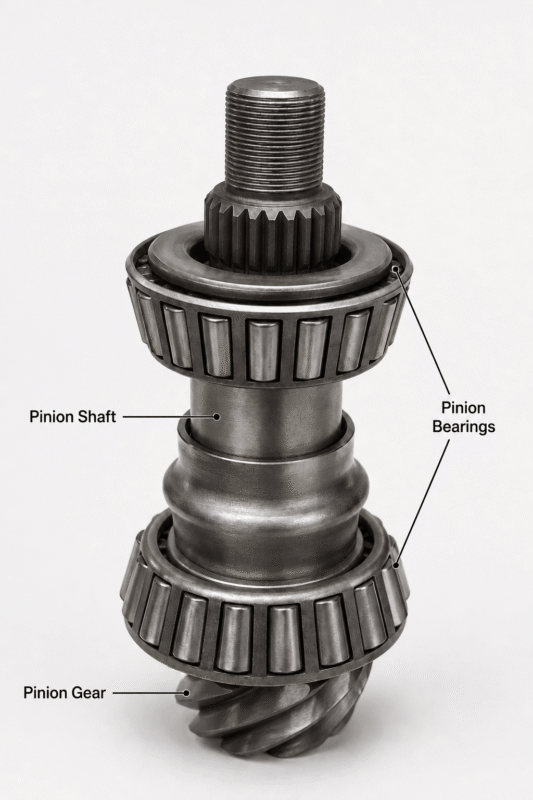
After understanding what pinion bearing is and where it is installed, you may want to know what their functions are.
Main Functions of Pinion Bearings
The main functions of pinion bearings include:
| Function | Explanation |
| Support the pinion shaft | The bearing holds the pinion shaft in the correct position during rotation. |
| Reduce friction | It reduces friction between the rotating shaft and the housing, but it does not remove friction completely. |
| Carry radial loads | It supports loads acting perpendicular to the shaft. |
| Carry axial loads | Depending on the bearing type and arrangement, it can also support thrust loads along the shaft direction. |
| Keep gear alignment | It helps the pinion gear mesh correctly with the ring gear, rack, or other mating gear. |
| Improve smooth rotation | It helps reduce vibration, noise, and unstable shaft movement. |
Types of Pinion Bearings
The bearing type used as a pinion bearing depends on the load, speed, shaft size, available space, gear design, and precision requirements.
But these five ones are the most common pinion bearing types:
| Pinion Bearing Type | Common Applications | Main Reason for Use |
| Tapered roller bearings | Automotive differentials, heavy-duty gear drives, reducers | Carry combined radial and axial loads |
| Deep groove ball bearings | Light-duty gearboxes, compact gear mechanisms, electric tools | High speed, low friction, moderate load |
| Angular contact ball bearings | Precision gear systems, high-speed gear drives | Carry combined radial and axial loads with better axial positioning |
| Cylindrical roller bearings | Industrial gearboxes, heavy radial load applications | High radial load capacity |
| Needle roller bearings | Compact gearboxes, steering systems, small pinion shafts | High radial load capacity in limited space |
Applications of Pinion Bearings
Pinion bearings are used in many gear transmission systems where a pinion shaft needs support. Here are the common applications.
| Application | Role of the Pinion Bearing |
| Automotive differential | Supports the drive pinion shaft and keeps the pinion gear correctly meshed with the ring gear. |
| Steering rack system | Supports the pinion shaft that meshes with the steering rack. |
| Gearbox | Supports pinion shafts or small gear shafts inside the transmission system. |
| Industrial gear reducer | Supports pinion shafts under radial and axial loads. |
| Electric tools | Supports compact pinion gears in high-speed gear mechanisms. |
| Agricultural machinery | Supports gear shafts in transmission and drive systems. |
| Construction machinery | Supports pinion shafts in heavy-duty gearboxes and reducers. |
Part 2. How to Tell the Difference Between Rear Wheel Bearing, Carrier Bearing, and Pinion Bearing?
Now you should have a clear idea of what a pinion bearing is.
But when you search for pinion bearing problems, you may also see other terms, such as rear wheel bearing and carrier bearing. These bearings may all be related to the rear axle, differential, or drivetrain system, so they are easy to confuse.
However, they are not the same bearing.
Here is a simple table to help you understand the difference.
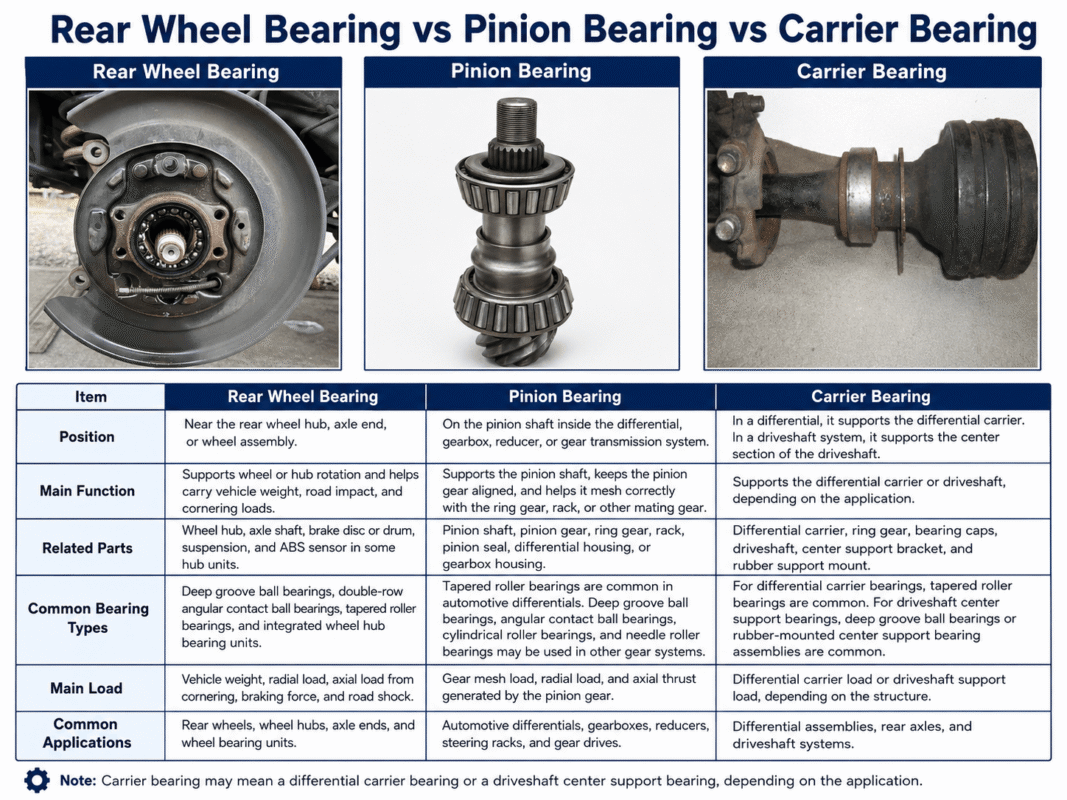
The easiest way to understand the difference is this:
A rear wheel bearing supports the wheel or hub.
A pinion bearing supports the pinion shaft inside the differential, gearbox, reducer, or gear transmission system.
A carrier bearing may support the differential carrier inside the differential. In some drivetrain systems, it can also mean the center support bearing that supports the driveshaft.
So before replacing any bearing, you need to confirm its exact position and function.
After reading this part, you should not only understand the differences between rear wheel bearings, carrier bearings, and pinion bearings. You should also have a much clearer picture of what a pinion bearing does and where it is used.
Part 3. Bad Pinion Bearing Symptoms
Now, let’s look at the common signs of bad pinion bearings. These symptoms can help you know whether the pinion bearing needs to be inspected or replaced. Here are the common bad pinion bearing symptoms.
| Symptom | What You May Notice | What It Usually Means | Technical Reason |
| Whining or howling noise | Noise from the rear differential or gearbox, especially during acceleration, deceleration, or speed changes | The pinion bearing may be worn, or the pinion gear may not mesh correctly with the ring gear | Worn raceways, rollers, or excessive bearing clearance can make the pinion shaft unstable |
| Growling noise | Low and rough noise from the differential area | The bearing surface may already have wear or damage | Damaged rolling elements or raceways cause rough rotation |
| Grinding noise | Harsh grinding sound, usually more serious than whining | The bearing may be badly damaged | The pinion shaft may move out of position and create rough gear contact |
| Drivetrain vibration | Vibration through the vehicle body, floor, driveshaft area, or sometimes the steering wheel | The pinion shaft may have excessive play or unstable rotation | Bearing wear allows shaft runout and disturbs gear alignment |
| Oil leakage near pinion seal | Gear oil leaking around the differential input yoke or pinion seal | The pinion seal may be damaged, or the shaft may be moving too much | Excessive shaft movement can damage the seal and cause oil leakage |
| Metal particles in gear oil | Metal debris found during oil inspection or oil change | Bearing or gear wear may already be happening | Damaged bearing surfaces or gear teeth can release metal particles into the oil |
| Excessive pinion shaft play | The pinion shaft or input yoke feels loose | The bearing may no longer hold the shaft correctly | Excessive clearance changes the gear contact pattern |
| Abnormal gear wear | Ring gear or pinion gear teeth show uneven wear | Gear mesh may be incorrect | Poor bearing support causes wrong gear alignment |
| Tire damage | Uneven tire wear or tire scrubbing | Usually not a direct symptom of pinion bearing failure | More commonly related to wheel alignment, suspension, tire pressure, wheel bearings, or other differential problems |
So if you hear or find these signs, you should suspect whether your pinion bearings are bad or not. As you cannot decide by yourself, you can go to a repair company or ask other engineers for help. Describe the signs you find and let them check whether the pinion bearing needs to be replaced or not.
Part 4. How Hard Is It to Change a Pinion Bearing?
difficult to replace. Some people may even want to replace it by themselves.
However, if you do not have experience in bearing removal, differential repair, gearbox repair, or shaft alignment, it is not recommended to replace a pinion bearing on your own.
The reason is that a pinion bearing is not just a simple bearing replacement job. In many applications, especially in an automotive differential, the pinion bearing affects the position of the pinion shaft, the bearing preload, and the gear mesh between the pinion gear and the ring gear.
If the bearing is installed incorrectly, it may cause:
- differential whining noise
- overheating
- oil leakage
- abnormal gear wear
- excessive vibration
- early bearing failure
- damage to the ring and pinion gears
In serious cases, poor installation can affect drivetrain safety and equipment operation.
The difficulty also depends on the application. In a small gearbox, replacing a pinion bearing may be easier if the structure is simple. But in an automotive differential, it is usually a precision repair job. You may need special tools, such as a bearing puller, hydraulic press, bearing separator, pinion flange holding tool, torque wrench, dial indicator, and gear marking compound.
So, changing a pinion bearing is not only about removing the old bearing and installing a new one. You also need to check or adjust the bearing preload, backlash, shaft position, seal condition, and gear contact pattern.
If you are not familiar with these steps, it is better to ask a professional repair technician or engineer to do the job.
Part 5. FAQS About Pinion Bearing
Pinion bearing preload is checked by measuring the rotating torque of the pinion shaft with an inch-pound torque wrench. It is adjusted by a crush sleeve, shim, or spacer system. Correct preload is important because loose preload causes noise, while excessive preload causes heat and early bearing failure.
You should not keep driving with a bad pinion bearing. The vehicle may still move, but the damaged bearing can make the pinion shaft loose, affect gear mesh, cause oil leakage, and damage the ring and pinion gears. Stop driving safely and replace it as soon as possible.
The cost depends on the vehicle type, bearing size, labor rate, and whether other parts are damaged. Pinion bearing replacement is usually not cheap because the technician must remove parts, replace the bearing and race, set preload, check backlash, and confirm the ring and pinion contact pattern.
Pinion bearing preload is measured by rotating the pinion shaft and checking the required turning torque with an inch-pound torque wrench. The bearing should rotate smoothly with controlled resistance. If the torque is too low or too high, the preload must be adjusted according to the correct repair specification.
Final Words
Now, you understand what a pinion bearing is, its types, functions, applications, the differences between a pinion bearing, rear wheel bearing, and carrier bearing, the signs of a bad pinion bearing, and whether it is hard to replace a pinion bearing.
For the pinion bearing and machine safety, if you do not have enough knowledge of pinion bearings, you should not replace the pinion bearing on your own. You should find a professional pinion bearing engineer or repair technician to help you check and replace it.
If you want to buy pinion bearings, you can contact BKZ Industry. BKZ Industry is a bearing factory that can supply the pinion bearings you need.