Magnetic bearings are often mentioned in the bearing industry and in many bearing application industries. But if you are new to magnetic bearings, you may still feel confused.
What are magnetic bearings? How do magnetic bearings work? What is their working principle? What types are available? Where are they used? And how are magnetic bearings different from other bearings?
No worry.
I am a bearing engineer with about 10 years of experience, and I understand magnetic bearings well. To help you get a clear picture, I will explain magnetic bearings in detail, including their definition, working principle, main types, applications, advantages, limitations, and differences from other common bearings.
Note: If you are a purchaser, wholesaler, repair company, or industrial customer who needs to buy common bearings such as ball bearings, roller bearings, or journal bearings from a manufacturer, you can contact BKZ Industry. BKZ Industry can offer almost all the bearings you need.
Part 1. What Are Magnetic Bearings?
Magnetic bearings are different from ball bearings and roller bearings, which use balls or rollers as rolling elements to support a rotating shaft. They are also different from journal bearings or plain bearings, which use a sliding surface, oil film, or other contact surface to support rotation.
Magnetic bearings use magnetic force to support and control the rotating shaft without direct mechanical contact between the shaft and the bearing surface. Because there is no physical contact during normal operation, magnetic bearings can reduce friction, wear, lubrication needs, and heat generation.
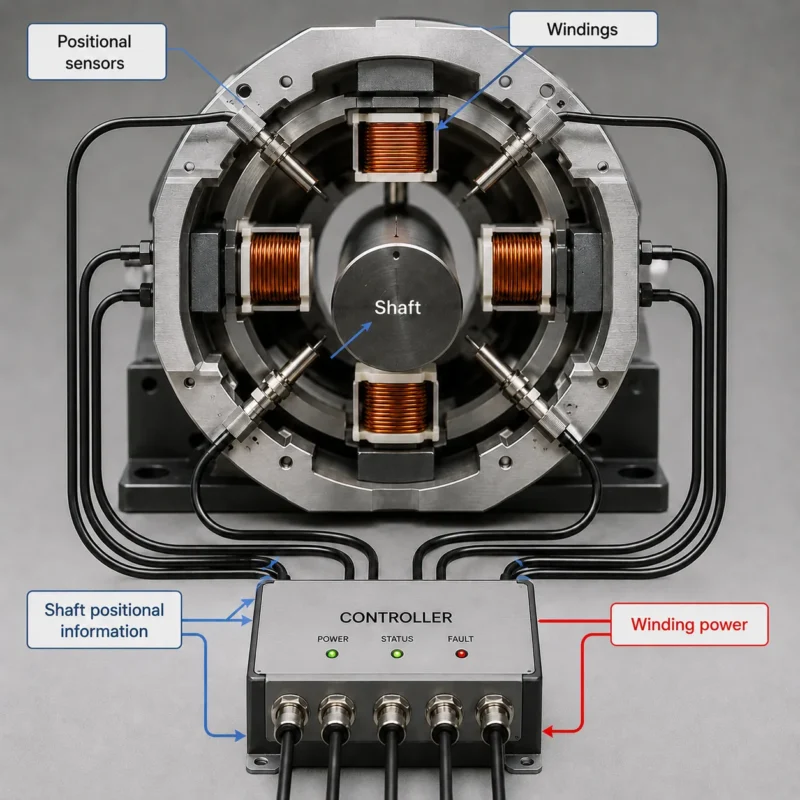
Structures of Magnetic Bearings
So, what do magnetic bearings look like? Here is the basic structure to help you understand them better.
Electromagnets: These elements are used to generate magnetic forces. In active magnetic bearings, electromagnets create controlled magnetic fields to keep the rotor in the correct position.
Position Sensors: These sensors are used to detect the position of the rotating shaft or rotor. They do not control the bearing directly, but they send position signals to the control system.
Control System: The control system tracks the rotor position through the position sensors. Then it adjusts the current supplied to the electromagnets, so the magnetic force can keep the shaft stable and centered.
Supporter: The support structure is used to fix the position of the electromagnets, position sensors, and other bearing components. It helps keep the whole magnetic bearing system aligned and stable.
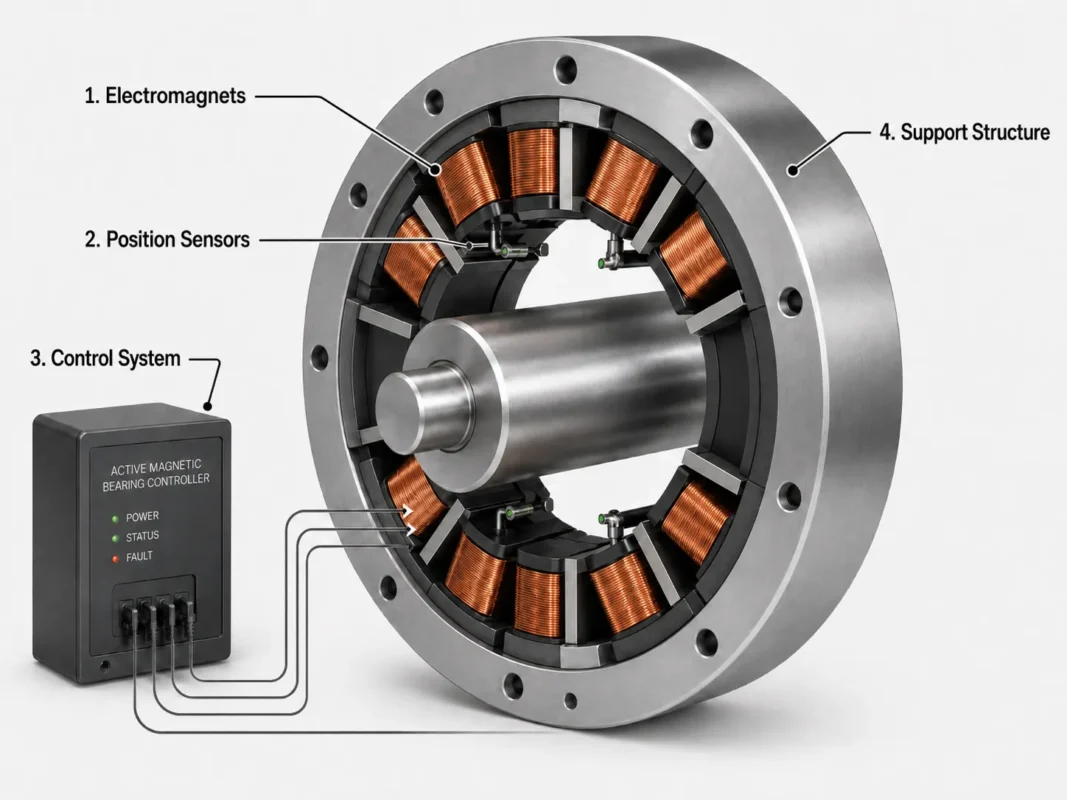
The structure listed above only shows the main parts of the magnetic bearing itself, not the whole magnetic bearing system. Most active magnetic bearing systems also need backup bearings.
Backup bearings are usually installed around the rotor shaft, near the magnetic bearing positions or at the rotor ends. There is usually a small radial clearance between the shaft and the backup bearing inner ring. During normal operation, the backup bearings do not contact the shaft. They only support the rotor when the magnetic bearing is not powered, during startup or shutdown, or if the control system fails.
Now, you may have a simple picture of magnetic bearings. So, what are their advantages and disadvantages? Why do some people choose them, while others do not?
Magnetic Bearing Advantages and Disadvantages
Advantages:
- Low friction
- Low vibration
- Low energy loss in many high-speed applications
- No lubrication required during normal operation
- Less mechanical wear
- High speed capability
- Clean operation, suitable for vacuum, cleanroom, or special environments
- Lower maintenance compared with contact bearings in some applications
Disadvantages:
- Cost is much higher
- Needs continuous power input, especially for active magnetic bearings
- Requires sensors, controllers, and power electronics
- More complicated than traditional ball bearings, roller bearings, or plain bearings
- Needs backup bearings for safety when power is lost or the system stops
- Requires professional design, installation, and control adjustment
Part 2. How Do Magnetic Bearings Work?
After understanding what a magnetic bearing is, you also need to understand its working principle. This helps you know whether it is suitable for your application.
As mentioned before, Magnetic bearings do not support the rotating shaft through physical contact like ball bearings, roller bearings, or plain bearings. Instead, they use magnetic forces to support and control the position of a rotating element, such as a rotor or shaft, relative to the fixed bearing structure.
In many electromagnetic magnetic bearing designs, several electromagnets are arranged around the rotor. These electromagnets generate controlled magnetic forces from different directions. The purpose is not to lock the rotor in place, but to keep it centered while it is rotating.
During operation, position sensors continuously detect the air gap and position of the rotor. If external force, load change, vibration, rotor unbalance, or other movement causes the rotor to move away from its center position, the sensors detect this displacement and send the signal to the electronic control system.
The control system compares the actual rotor position with the required center position. Then, it adjusts the current supplied to different electromagnets. When the current changes, the magnetic force also changes.
By increasing or decreasing the magnetic force from different directions, the control system pulls the rotor back toward the correct position and keeps it stable during operation. This detection, calculation, and adjustment process happens continuously, so the rotor can rotate without direct mechanical contact with the bearing surface.
This is the basic working principle of magnetic bearings.
Part 3. Active Magnetic Bearing vs Passive Magnetic Bearing
When you come across magnetic bearings, you may find that they can be divided into two main types: active magnetic bearings and passive magnetic bearings.
So, what are their differences?
In this part, I will compare them from several aspects, including structure, working principle, advantages, disadvantages, manufacturing difficulty, popularity, and applications. This will help you understand which type may be more suitable for different working conditions.
| Item | Active Magnetic Bearing | Passive Magnetic Bearing |
| Basic Meaning | Uses electromagnets to support and control the rotor. | Uses permanent magnets to support the rotor. |
| Power Requirement | Needs continuous power input. | Does not need continuous power for magnetic force. |
| Main Structure | Electromagnets, sensors, control system, and backup bearings. | Permanent magnets and support structure. |
| Working Principle | Sensors detect rotor position. The controller adjusts current to change magnetic force. | Permanent magnets create fixed magnetic force to support the rotor. |
| Rotor Control | Can actively control rotor position. | Has limited rotor control. |
| Advantages | Precise control, low friction, low wear, high speed, no lubrication during normal operation. | Simple structure, low power use, low friction, low wear, no lubrication for magnetic support. |
| Disadvantages | High cost, complex system, needs power, sensors, and controller. | Limited load, stiffness, and stability. Magnets may be affected by high temperature. |
| Manufacturing Difficulty | More difficult. | Usually simpler, but stable design can still be difficult. |
| Popularity | More common in demanding industrial equipment. | Less common in heavy-duty or high-precision machines. |
| Applications | Compressors, turbines, high-speed motors, vacuum pumps, flywheels. | Low-load devices, small machines, and special magnetic support systems. |
In conclusion, active magnetic bearings use electromagnets to provide better rotor control. They are more suitable for high-speed or high-precision equipment. Passive magnetic bearings use permanent magnets. They have a simpler structure and use less power, but their load capacity and control ability are more limited.
Part 4. Typical Applications of Magnetic Bearings
Because of their low friction, no-contact operation, high-speed capability, and clean running performance, magnetic bearings can be used in many high-speed and special working conditions.
Typical applications include:
- Blowers and High-Speed Blowers
- Compressors
- Pumps
- Gas and Steam Turbines
- Turboexpanders
- Generators
- Motors and High-Speed Electric Motors
- Power Generation SystemsMRI Machines
- Aerospace Equipment
- Maglev Systems
- Rotordynamic Test Equipment
Part 5. Magnetic Bearing vs Other Bearings
Understanding the general information about magnetic bearings is not enough. To have a clearer idea of magnetic bearings, you should also understand how they are different from other bearing types. By comparing magnetic bearings with true bearings, air bearings, and fluid dynamic bearings, you can better know what magnetic bearings really are, where they are useful, and when they are not the right choice.
5.1 Magnetic Bearing vs True Bearing
You may feel confused about what a “true bearing” means here. In this article, “true bearing” refers to traditional contact bearings, such as ball bearings, roller bearings, plain bearings, and journal bearings.
You can also call them traditional bearings or contact bearings because they support the shaft through rolling elements, sliding surfaces, or an oil film. To help you understand the difference, I will compare magnetic bearings and traditional contact bearings side by side in the table below.
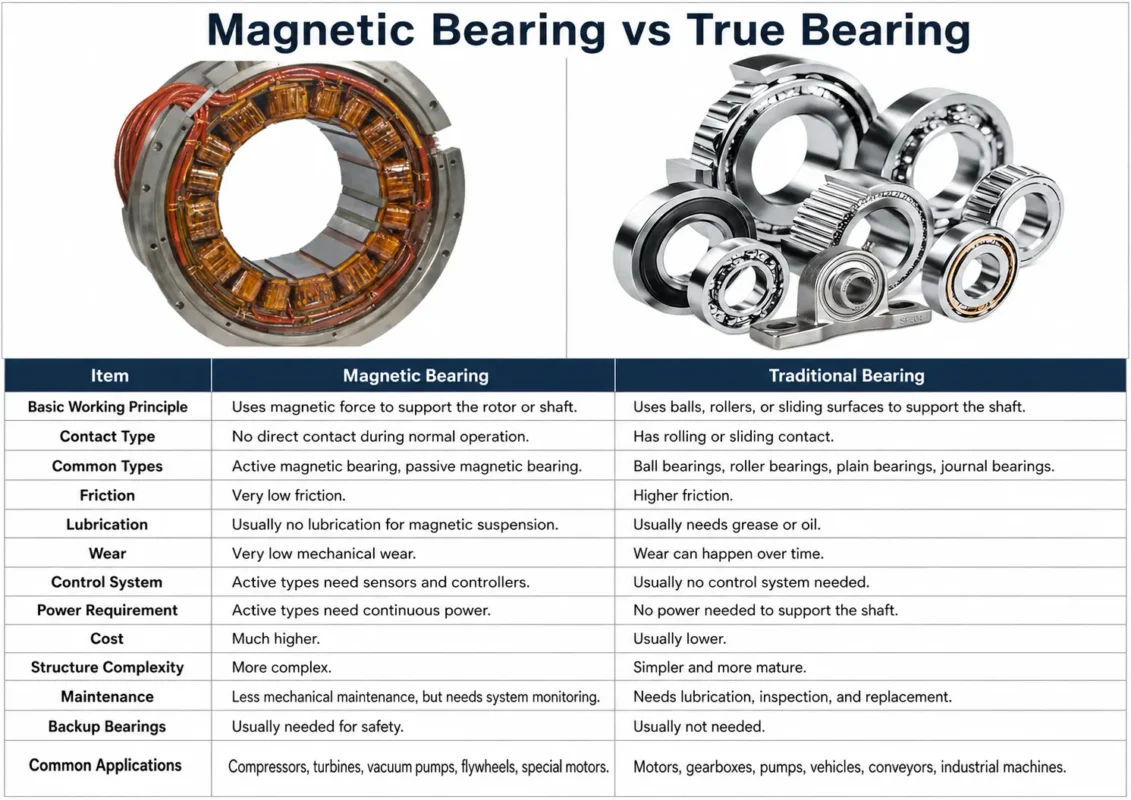
From the table, you can see that the biggest difference between magnetic bearings and traditional contact bearings is their structure and working principle. Magnetic bearings use magnetic force to support the rotor without direct contact, while traditional bearings use rolling elements, sliding surfaces, or an oil film to support the shaft.
5.2 Magnetic Dome Bearing vs Fluid Dynamic Bearing
When you search for magnetic bearings, you may also see the term magnetic dome bearing. So, what is a magnetic dome bearing? Is it a type of industrial magnetic bearing?
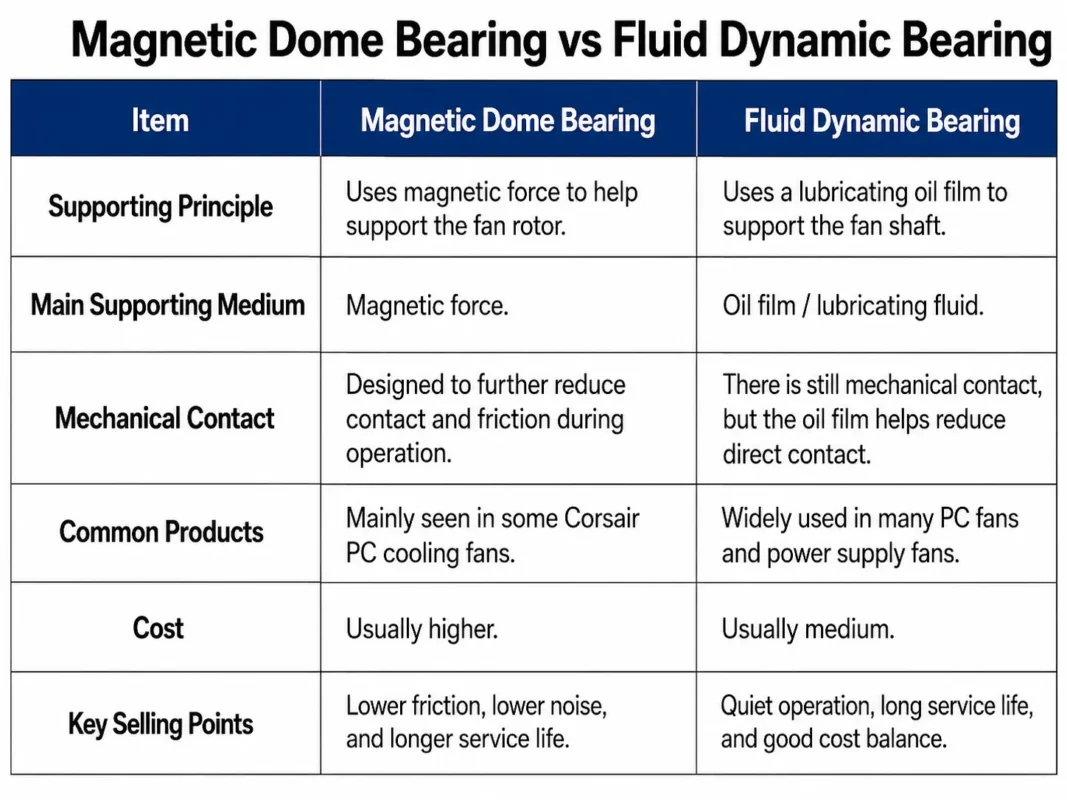
No. A magnetic dome bearing is not the same as the magnetic bearings used in industrial machinery. It is more of a special fan bearing technology used in some PC cooling fans.
When you see magnetic dome bearings, you may also find another common fan bearing type: fluid dynamic bearing. This is because both of them are often used in PC fans, especially in cooling fans that focus on low noise, low friction, and long service life.
So, what is the difference between a magnetic dome bearing and a fluid dynamic bearing? Here is a comparison table to help you understand.
5.3 Air Bearing vs Magnetic Bearing
Air bearing is another bearing type that is often compared with magnetic bearing.
Both air bearings and magnetic bearings can support a shaft with very low friction. But their supporting principles are different.
An air bearing uses a thin air or gas film to support the shaft or moving part. A magnetic bearing uses magnetic force to support and control the rotor or shaft.
Here is a simple comparison table to help you understand the difference.
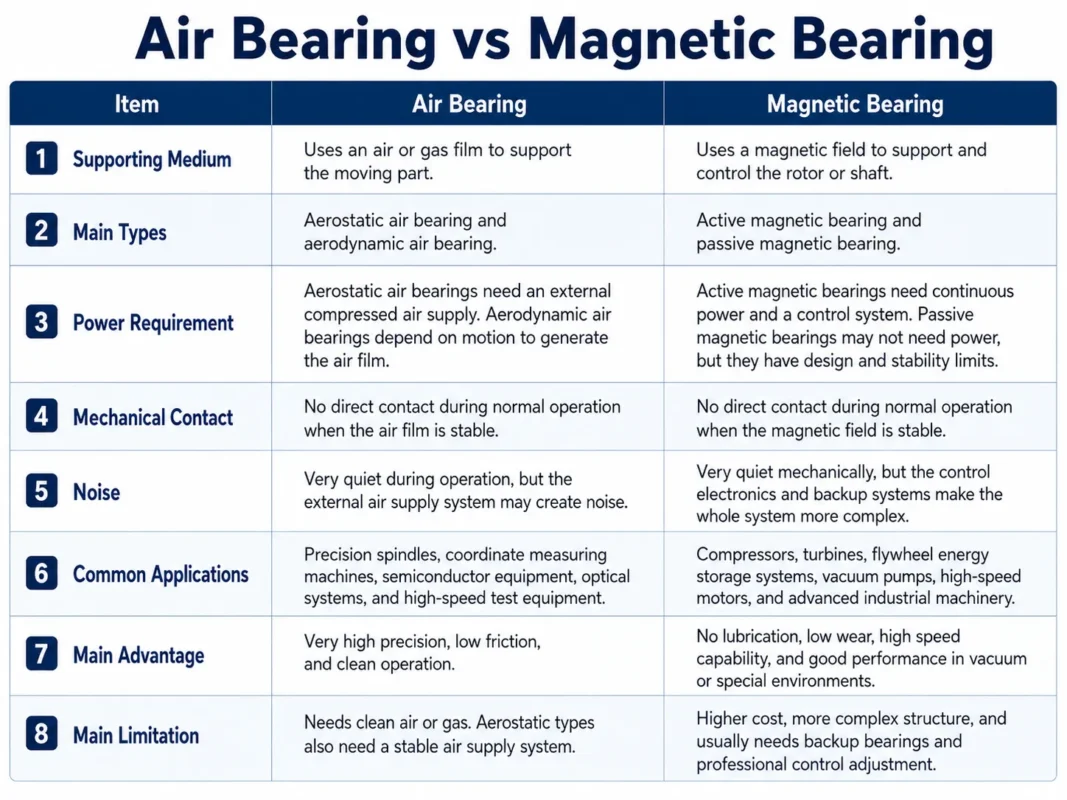
After comparing magnetic bearings with other bearing types, you should now have a clearer understanding of what magnetic bearings are and how they are different from other bearings.
Part 6. FAQS About Magnetic Bearings
Q1. How to Calculate Magnetic Bearing between Two Points?
First, calculate the true bearing between the two points. Then adjust it with the local magnetic declination. The simple rule is: Magnetic Bearing = True Bearing − East Declination or True Bearing + West Declination.
Q2. How to Convert Magnetic Bearing to True Bearing and True Bearing to Magnetic Bearing?
You cannot directly convert an old magnetic bearing into a true bearing, or a true bearing into a magnetic bearing. But in some cases, you can replace one with the other after checking shaft size, housing size, load, speed, lubrication, heat, alignment, sealing, and safety.
Q3. What Are Non-magnetic Ball Bearings?
Non-magnetic ball bearings are ball bearings made from non-magnetic or low-magnetic materials, such as ceramic, plastic, stainless steel, or special alloys. They are different from standard bearing steel ball bearings, which are usually magnetic.
Q4. What Are Non-magnetic Ball Bearings Suppliers?
BKZ Industry is a non-magnetic ball bearing supplier and manufacturer. You can send BKZ Industry the bearing number, drawing, material requirement, application details, and quantity you need. BKZ Industry will check and send you a quotation as soon as possible.
Wrapping Up
Now, after going through what magnetic bearings are, how they work, their main types, typical applications, and their differences from other bearings, you should have a much clearer understanding of magnetic bearings.
You should also know when magnetic bearings may be suitable and when they may not be the best choice.
Magnetic bearings are special bearing systems. They cannot be manufactured by every bearing factory because they need magnetic design, sensors, control systems, power electronics, and professional engineering support. If you need magnetic bearings, there are usually only a limited number of specialized manufacturers to choose from.
But if you need non-magnetic bearings, such as non-magnetic ball bearings, non-magnetic roller bearings, or other special material bearings, you can contact BKZ Industry. BKZ Industry can offer almost all the non-magnetic bearings you need.