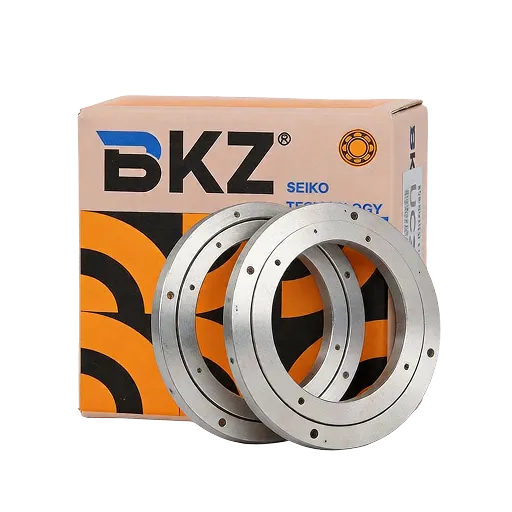
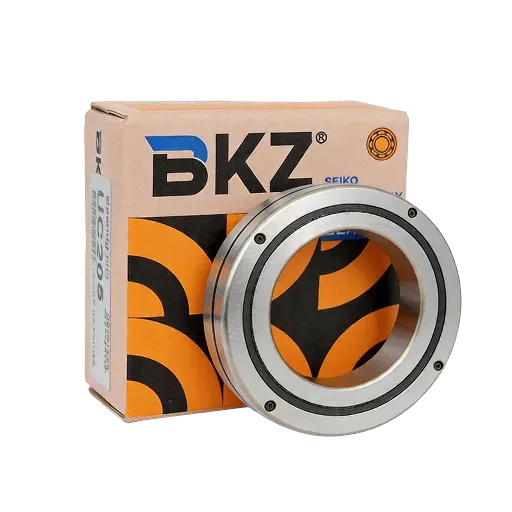
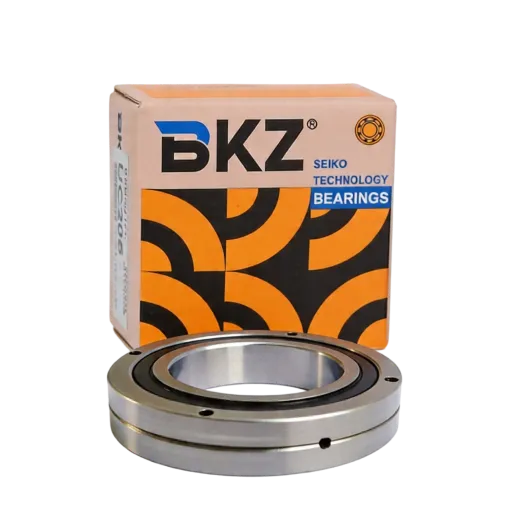
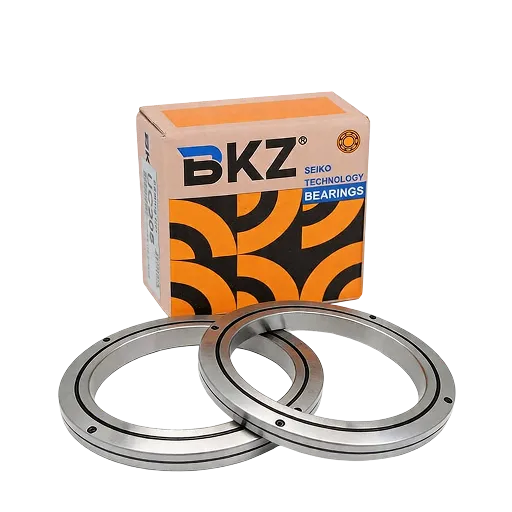
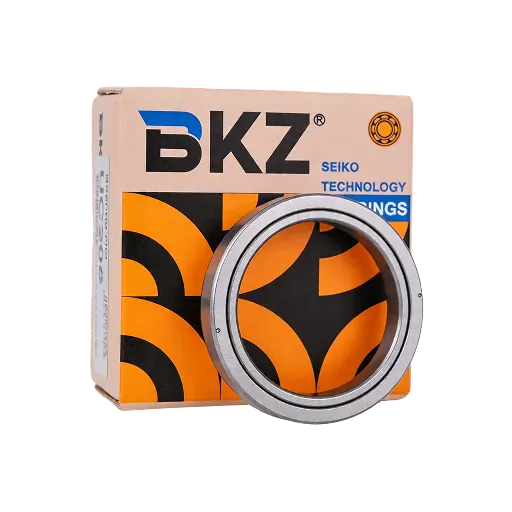
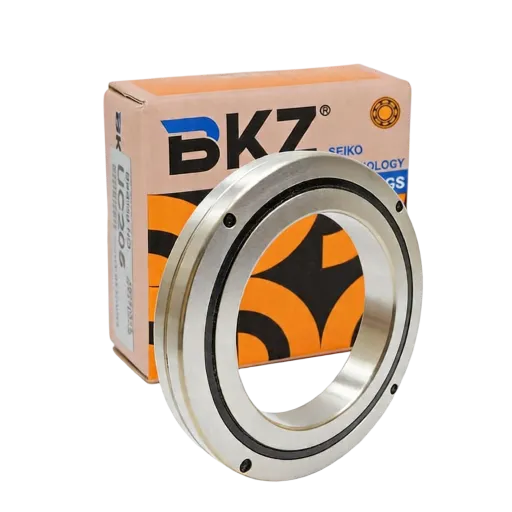
Cross Roller Bearings

Cross roller bearings are specially designed bearings with cylindrical rollers arranged alternately at 90° between the inner ring and outer ring. They are designed to support radial, axial, and moment loads at the same time, while providing high rigidity, compact structure, and high rotational accuracy.

BKZ Industry is a China cross roller bearing manufacturer, offering cross roller bearings with or without mounting holes, as well as different designs such as standard type, slim type, open type, and sealed type based on your application requirements. The cross roller bearings manufactured by BKZ Industry are widely used in robotics, machine tools, medical equipment, and semiconductor equipment.

Why choose BKZ Industry as your factory option? We offer OEM service, 15+ years of bearing manufacturing experience, 2 factories, and strict quality control.

Cross Roller Bearings Are Specially Designed Bearings

Benefits and Advantages of BKZ Industry Cross Roller Bearings

Cross roller bearings manufactured by BKZ Industry are designed to support combined loads while providing high rigidity, high accuracy, space-saving advantages, and various structural types for different applications. With extensive bearing manufacturing experience, BKZ Industry supplies high-quality cross roller bearings worldwide with reliable on-time delivery.

Benefits of Cross Roller Bearings

Support Combined Loads

The alternating 90° arrangement of cylindrical rollers allows the bearing to receive loads from different directions in one compact structure. Combined with the matched raceway geometry, this design enables the bearing to support radial loads, axial loads in both directions, and moment loads simultaneously.

High Rigidity for Precise Motion

The cylindrical rollers provide line contact rather than point contact, which creates a larger effective contact area under load. This helps reduce elastic deformation and gives the bearing higher rigidity, making it suitable for precise motion control and positioning applications.

High Rotational Accuracy

The compact internal structure helps maintain stable running accuracy under combined loading conditions. With proper preload and controlled internal clearance, cross roller bearings can deliver smooth rotation and high rotational accuracy in precision equipment.

Space Saving in Compact Machines

A single cross roller bearing can support radial, axial, and moment loads at the same time, so separate bearing arrangements are often unnecessary. This helps simplify the surrounding structure and reduce installation space in compact machines.

Multiple Structural Types for Different Applications

Cross roller bearings are available in different structural designs, such as standard type, slim type, split outer ring type, split inner ring type, open type, sealed type, with or without mounting holes, as well as high rigidity and preloaded designs. These options help match different mounting methods, installation spaces, rigidity requirements, sealing needs, and operating environments.

Why Choose BKZ Industry

15+ Years of Bearing Manufacturing Experience

BKZ Industry has over 15 years of experience in bearing manufacturing. With mature production technology, advanced equipment, and well-established production lines, we can provide high-quality cross roller bearings tailored to your application requirements.

Stable Production Capacity

With 2 factories, 15+ production lines, and 400+ employees, BKZ Industry has the capacity to produce over 60,000 bearings per day. Our stable production system helps ensure reliable supply and allows us to meet different order volumes and customized requirements efficiently.

Strict Testing and Quality Control

BKZ Industry carries out strict testing and quality control throughout the production process. Our inspection equipment includes raw material testing instruments such as spectrometers for chemical composition analysis, metallographic microscopes for microstructure inspection, hardness testers, and ultrasonic flaw detectors for internal defect detection. We also use dimensional inspection tools such as digital calipers, micrometers, air gauges, bore gauges, and height gauges, as well as raceway profile and surface roughness testing equipment including contour measuring instruments and surface roughness testers. These measures help ensure consistent accuracy, reliable performance, and stable product quality.

OEM Service

BKZ Industry is a bearing manufacturer in China, providing OEM services for cross roller bearings. We can customize products with your logo, label, packaging, and other branding requirements.

Export and Technical Support

BKZ Industry has established long-term cooperation with over 1,000 customers in more than 50 countries. We understand export procedures and documentation requirements for international business and can support smooth order delivery. We also provide technical support to help customers choose suitable bearing solutions based on their application needs.

Types of Cross Roller Bearings

Cross roller bearings are available in different structural types to meet different mounting methods, space limitations, rigidity requirements, and operating conditions. Here are some common cross roller bearing types.

Mounting Holed Cross Roller Bearings

Mounting Holed Cross Roller Bearings

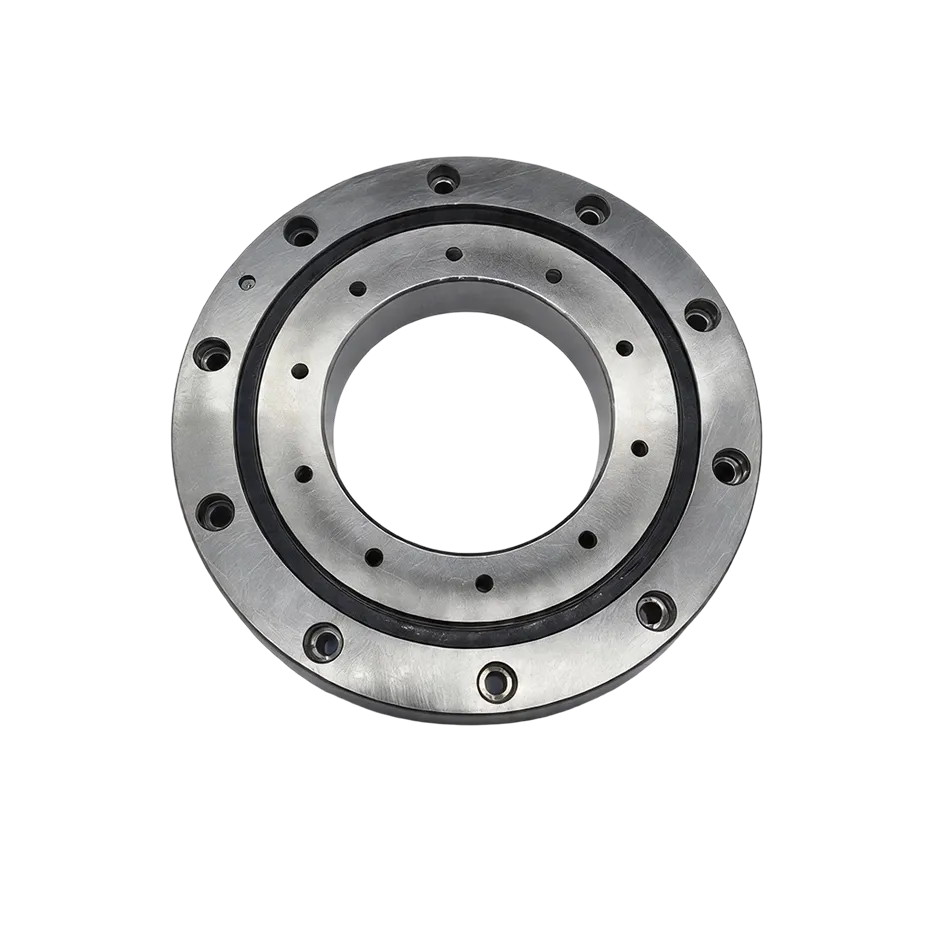
Designed with mounting holes on the inner ring, outer ring, or both rings, this type simplifies installation and eliminates the need for separate housings or clamping parts. Its integrated mounting structure helps improve assembly accuracy and save space. It is commonly used in rotary tables, industrial robots, medical equipment, and compact automation systems.

High Rigidity Cross Roller Bearings

High Rigidity Cross Roller Bearings

Featuring a more rigid ring structure and stronger overall bearing body, this type is designed to reduce elastic deformation under combined loads. Compared with lighter designs, it provides greater stiffness, more stable rotation, and better positioning accuracy. It is widely used in machine tools, precision indexing tables, robotic joints, and inspection equipment.

Standard Cross Roller Bearings

Standard Cross Roller Bearings

This type uses a balanced structural design that combines load capacity, rotational accuracy, and installation versatility. Compared with slim or super slim types, it offers a more general-purpose structure with broader load capability and stable rigidity. It is commonly used in automation equipment, rotary stages, packaging machines, semiconductor devices, and industrial turntables.

Slim Cross Roller Bearings

Slim Cross Roller Bearings

With a thinner ring section and more compact cross-sectional design, slim cross roller bearings help reduce installation space while maintaining the ability to support radial, axial, and moment loads. They are suitable for equipment requiring a compact layout without using larger bearing arrangements. Typical applications include robotic arms, optical devices, medical systems, and compact rotary platforms.

Super Slim Cross Roller Bearings

Super Slim Cross Roller Bearings

This type features an even thinner and lighter ring structure than slim designs, making it ideal for highly compact and lightweight equipment. Its main advantage is extreme space saving in applications where installation space is very limited. Super slim cross roller bearings are commonly used in small robots, precision instruments, miniature rotary units, and advanced medical or laboratory devices.

Sealed Cross Roller Bearings

Sealed Cross Roller Bearings

Equipped with seals on one side or both sides, this type is designed to reduce the entry of dust, debris, and other contaminants while helping retain lubricant inside the bearing. Compared with open types, it is better suited for environments where cleanliness and maintenance control are important. It is often used in medical equipment, automation systems, machine tools, and dusty industrial applications.

*Other types not listed here are also available from BKZ Industry. Please contact us for more details.

Cross Roller Bearing Size Chart

Unlike standard bearings such as deep groove ball bearings, cross roller bearings usually do not follow standard ISO dimensions. The table below shows selected cross roller bearing sizes we previously supplied for customer applications for reference. For your specific requirements, please contact us directly with detailed application information.

Product Type BKZ Identification Number Shaft Diameter (mm) Bore Diameter d (mm) Outside Diameter D (mm) Width B (mm) Minimum Chamfer Dimension rmin (mm) Mounting Shoulder Diameter da (mm) Mounting Shoulder Diameter Da (mm) Reference Weight (kg) Basic Dynamic Load Rating C (N) Basic Static Load Rating C0 (N)
Open Type BKZ-XR 20×36×8 20 20 36 8 0.3 24 31 0.04 2910 2430
Sealed Type BKZ-XRS 20×36×8 20 20 36 8 0.3 24 31 0.04 2910 2430
Open Type BKZ-XR 25×41×8 25 25 41 8 0.3 29 36 0.05 3120 2810
Sealed Type BKZ-XRS 25×41×8 25 25 41 8 0.3 29 36 0.05 3120 2810
Open Type BKZ-XR 30×55×10 30 30 55 10 0.3 36.5 48.5 0.12 7600 8370
Sealed Type BKZ-XRS 30×55×10 30 30 55 10 0.3 36.5 48.5 0.12 7600 8370
Open Type BKZ-XR 35×60×10 35 35 60 10 0.3 41.5 53.5 0.13 7900 9130
Sealed Type BKZ-XRS 35×60×10 35 35 60 10 0.3 41.5 53.5 0.13 7900 9130
Open Type BKZ-XR 40×65×10 40 40 65 10 0.3 46.5 58.5 0.15 8610 10600
Sealed Type BKZ-XRS 40×65×10 40 40 65 10 0.3 46.5 58.5 0.15 8610 10600
Open Type BKZ-XR 45×70×10 45 45 70 10 0.3 51.5 63.5 0.16 8860 11300
Sealed Type BKZ-XRS 45×70×10 45 45 70 10 0.3 51.5 63.5 0.16 8860 11300
Open Type BKZ-XR 50×80×13 50 50 80 13 0.6 56 74 0.29 17300 20900
Sealed Type BKZ-XRS 50×80×13 50 50 80 13 0.6 56 74 0.29 17300 20900
Open Type BKZ-XR 60×90×13 60 60 90 13 0.6 66 84 0.33 18800 24300
Sealed Type BKZ-XRS 60×90×13 60 60 90 13 0.6 66 84 0.33 18800 24300
Open Type BKZ-XR 70×100×13 70 70 100 13 0.6 76 94 0.38 20100 27700
Sealed Type BKZ-XRS 70×100×13 70 70 100 13 0.6 76 94 0.38 20100 27700
Open Type BKZ-XR 80×120×16 80 80 120 16 0.6 88 112 0.74 32100 43400
Sealed Type BKZ-XRS 80×120×16 80 80 120 16 0.6 88 112 0.74 32100 43400
Open Type BKZ-XR 90×130×16 90 90 130 16 0.6 98 122 0.81 33100 46800
Sealed Type BKZ-XRS 90×130×16 90 90 130 16 0.6 98 122 0.81 33100 46800
Open Type BKZ-XR 100×150×20 100 100 150 20 0.6 110 140 1.45 50900 72200
Sealed Type BKZ-XRS 100×150×20 100 100 150 20 0.6 110 140 1.45 50900 72200
Open Type BKZ-XR 110×160×20 110 110 160 20 0.6 120 150 1.56 52400 77400
Sealed Type BKZ-XRS 110×160×20 110 110 160 20 0.6 120 150 1.56 52400 77400
Open Type BKZ-XR 120×180×25 120 120 180 25 1 132 168 2.62 73400 108000
Sealed Type BKZ-XRS 120×180×25 120 120 180 25 1 132 168 2.62 73400 108000
Open Type BKZ-XR 130×190×25 130 130 190 25 1 142 178 2.82 75900 115000
Sealed Type BKZ-XRS 130×190×25 130 130 190 25 1 142 178 2.82 75900 115000
Open Type BKZ-XR 140×200×25 140 140 200 25 1 152 188 2.96 81900 130000
Sealed Type BKZ-XRS 140×200×25 140 140 200 25 1 152 188 2.96 81900 130000
Open Type BKZ-XR 150×210×25 150 150 210 25 1 162 198 3.16 84300 138000
Sealed Type BKZ-XRS 150×210×25 150 150 210 25 1 162 198 3.16 84300 138000
Open Type BKZ-XR 200×260×25 200 200 260 25 1 212 248 4 92300 169000
Sealed Type BKZ-XRS 200×260×25 200 200 260 25 1 212 248 4 92300 169000
Open Type BKZ-XR 250×310×25 250 250 310 25 1.5 262 298 4.97 102000 207000
Sealed Type BKZ-XRS 250×310×25 250 250 310 25 1.5 262 298 4.97 102000 207000

Cross Roller Bearing Applications

Cross roller bearings are one type of special bearing, designed for applications with specific performance requirements.

FAQs About Cross Roller Bearings

Q1. What is Cross Roller Bearing with Gear?

A cross roller bearing with gear is a crossed roller bearing designed with gear teeth on the inner ring or outer ring. It typically consists of an inner ring, outer ring, cylindrical rollers arranged crosswise at 90°, spacers or a retainer, raceways, and optional seals. Compared with a normal cross roller bearing, this type not only supports radial, axial, and moment loads, but also adds a rotary drive function, allowing the bearing to transmit motion directly through gear engagement.

The main difference is in the rolling element design. Cross roller bearings use cylindrical rollers arranged crosswise at 90°, while ball bearings use balls as the rolling elements. Compared with ball bearings, cross roller bearings can support radial loads, axial loads in both directions, and moment loads simultaneously. They also generally provide higher rigidity and higher load-carrying capacity in applications requiring precise rotational accuracy and compact structure.

Cross roller bearings are usually made from high-carbon chromium bearing steel for the inner ring, outer ring, and cylindrical rollers, because this material provides high hardness, good wear resistance, and strong fatigue performance. The spacers or retainers are often made from engineering plastic, brass, or steel, while sealed types use synthetic rubber seals to help protect against dust and contamination. For special environments, stainless steel, corrosion-resistant coatings, or other customized materials can also be used.

No. Sealed bearings do not always outperform open types. The better choice depends on the operating environment and application requirements. Sealed crossed roller bearings provide better protection against dust, dirt, moisture, and grease leakage, so they are often better for contaminated or maintenance-sensitive conditions. Open types, however, may be more suitable for clean environments, higher-speed operation, or applications where external lubrication and sealing systems are already provided.

Both use crossed cylindrical rollers as the rolling elements, but they differ greatly in size, structure, and application. Cross roller bearings are usually compact, high-precision bearings used in robots, machine tools, medical devices, and precision rotary tables. Cross roller slewing bearings are generally larger, heavier-duty, and designed to support higher combined loads and larger overturning moments in cranes, excavators, turntables, and construction machinery. In addition, slewing bearings are more commonly available with gear teeth and mounting holes for direct installation and drive transmission.

Cross roller bearings work by arranging cylindrical rollers alternately at 90° between the inner ring and outer ring raceways. When either the inner ring or outer ring rotates, the rollers rotate on their own axes and roll along the raceways. This rolling motion reduces sliding friction and wear compared with plain sliding contact. Because the rollers are crossed, the bearing can support radial loads, axial loads, and moment loads at the same time. Spacers or retainers keep the rollers properly separated, prevent skewing, and help the bearing maintain smooth rotation, stable torque, and high running accuracy.

They are closely related, but not always exactly the same in naming. Cross roller bearing rings usually refer to the ring-shaped bearing unit itself, especially in catalog or product naming, while cross roller bearings is the more general term for this bearing type. In most industrial usage, both terms often describe the same product: a bearing with crossed cylindrical rollers designed to support radial, axial, and moment loads in one compact structure. However, “ring” is more often used to emphasize the bearing’s compact rotary ring form or a specific product series name.

More Bearing Solutions from BKZ Industry

In addition to cross roller bearings, BKZ Industry supplies a wide range of standard and custom bearing solutions for different loads, speeds, temperatures, and operating environments.

get a quote from bkz industry bearing experts

Get a Fast Quote for Cross Roller Bearings

Share your application requirements, load conditions, dimensions, and operating environment with our team. BKZ Industry will recommend suitable cross roller bearing solutions and provide a competitive quotation based on your project needs.

Get Quotation Now

Complete the form below for a quote, or contact us at sales@bkzindustry.com or +86 18901426056 (WhatsApp/phone).