A journal bearing is one of the most common types of bearings used in industrial machinery. For beginners, the concept may seem unclear at first, as journal bearings are often mentioned alongside sleeve bearings and plain bearings.
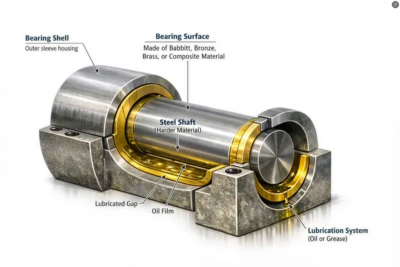
This guide provides a clear overview of journal bearings, covering their basic structure, working principle, load capacity, types, lubrication methods, and typical applications. A simple illustration is also included to help you quickly understand what a journal bearing looks like and how it works.
After reading, you will have a solid understanding of journal bearings and know when they are the right choice for your application.
Part 1. What is a Journal Bearing?
A journal bearing is a type of plain bearing that supports a rotating shaft through sliding contact, without any rolling elements such as balls or rollers. The section of the shaft that runs inside the bearing is known as the journal, which is where the bearing gets its name.
Journal bearings are primarily designed to support radial loads, keeping the shaft properly aligned while allowing smooth rotation.
Structure and Materials
A typical journal bearing consists of:
- A bearing shell or sleeve
- A bearing surface made from materials such as bronze, Babbitt (white metal), brass, or composite materials
- A lubrication system (oil or grease)
The bearing surface is usually softer than the shaft, which helps prevent shaft damage and allows small particles to embed safely.
Working Principle of a Journal Bearing
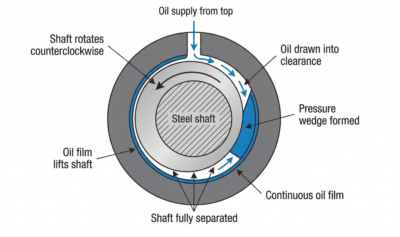
Journal bearings operate based on the principle of hydrodynamic lubrication.
When the shaft begins to rotate:
- Lubricant is drawn into the clearance between the shaft and the bearing.
- Shaft rotation creates a pressure wedge of lubricant.
- This pressure lifts the shaft slightly, forming a continuous oil film.
- The shaft is fully separated from the bearing surface during normal operation.
As a result:
- Metal-to-metal contact is avoided
- Friction is significantly reduced
- Wear is minimized
At start-up and shutdown, brief boundary or mixed lubrication may occur, which is why proper lubricant selection is critical.
Load Capacity
Journal bearings are mainly used to:
- Carry high radial loads
- Operate reliably under heavy-duty conditions
Some designs may also accommodate limited axial loads when combined with thrust bearing features.
Advantages of Journal Bearings
- High load-carrying capacity
- Simple and robust construction
- Quiet operation (no rolling noise)
- Long service life with proper lubrication
- Lower cost for large shaft diameters
- Good shock and vibration damping
Tip:
If you are looking for a reliable journal bearing manufacturer, feel free to contact BKZ Industry. Simply send us your requirements, and our professional team will provide the most suitable bearing solution for your application.
Part 2. What Does a Journal Bearing Look Like?
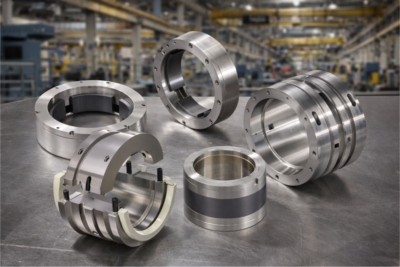
After understanding what a journal bearing is, you may be curious about its physical appearance. So, what does a journal bearing actually look like? Here is one image to show what the journal bearing looks like.
Part 3. Journal Bearing vs Sleeve Bearing vs Plain Bearing: Are They the Same?
By now, you should have a basic understanding of what a journal bearing is and how it functions. However, when searching for journal bearings, you may also encounter the terms sleeve bearing and plain bearing. This often leads to the assumption that these bearings are identical. In reality, they are closely related but not exactly the same.
A plain bearing is the broad category. It refers to any bearing that supports relative motion between surfaces through sliding contact, rather than rolling elements such as balls or rollers. Plain bearings are also commonly known as sliding bearings or bush bearings.
A sleeve bearing is a specific type of plain bearing. It has a simple cylindrical shape and is installed between the shaft and the housing. Sleeve bearings are widely used due to their compact design, ease of installation, and ability to operate with grease, oil, or self-lubricating materials.
A journal bearing is also a type of plain bearing, specifically designed to support radial loads on a rotating shaft journal. It typically operates with hydrodynamic or hydrostatic oil film lubrication, where a pressurized oil film completely separates the shaft from the bearing surface during operation. This lubrication method enables journal bearings to handle high speeds and heavy loads with low friction and long service life.
In summary, all journal bearings and sleeve bearings are plain bearings, but not all plain bearings are journal or sleeve bearings.
Here is the table to compare journal bearing with sleeve bearing, and plain bearing to help you have a better understanding of them.
| Item | Plain Bearing | Sleeve Bearing | Journal Bearing |
| Category | Bearing type | Plain bearing subtype | Plain bearing subtype |
| Structure | Sliding contact surface | Cylindrical sleeve (bushing) | Bearing shell with hydrodynamic oil film |
| Load type | Radial or axial (depending on design) | Mainly radial | Radial |
| Lubrication | Dry or lubricated | Grease, oil, or self-lubricating | Oil film (hydrodynamic or hydrostatic) |
| Typical use | General sliding applications | Compact housings, light to medium loads | High-speed, heavy-load rotating shafts |
Also Read: What is Spherical Plain Bearing?
Part 4. Journal Bearing vs Ball Bearing vs Roller Bearing: What Are the Differences?
To understand journal bearings better, it is essential to compare them with ball bearings and roller bearings, which are the most common rolling-element bearings. Although all three are used to support rotating shafts, their working principles, load characteristics, lubrication methods, and applications are fundamentally different.
The most significant difference is that a journal bearing does not use rolling elements. Instead, it supports the shaft through sliding contact separated by a lubricating film, usually oil. In contrast, ball bearings and roller bearings use rolling elements, such as balls or rollers, positioned between the inner and outer rings to reduce friction during rotation.
Journal bearings rely heavily on hydrodynamic or hydrostatic lubrication to form an oil film that prevents direct metal-to-metal contact. When properly lubricated, this oil film allows journal bearings to operate smoothly under high speeds and heavy loads with low wear. Rolling bearings, on the other hand, can operate with grease or oil lubrication and are easier to install and maintain in many general-purpose applications.
Each bearing type has its own advantages and is selected based on load capacity, speed, accuracy, operating conditions, maintenance requirements, and cost.
| Item | Journal Bearing | Ball Bearing | Roller Bearing |
| Bearing type | Plain bearing | Rolling bearing | Rolling bearing |
| Rolling elements | None | Balls | Cylindrical, tapered, or spherical rollers |
| Friction mechanism | Sliding with oil film | Rolling contact | Rolling contact |
| Load capacity | Very high | Moderate | High to very high |
| Load direction | Mainly radial | Radial and axial | Mainly radial (some types support axial) |
| Lubrication | Oil (hydrodynamic or hydrostatic) | Grease or oil | Grease or oil |
| Structure | Shaft journal + bearing shell | Inner ring, outer ring, balls, cage | Inner ring, outer ring, rollers, cage |
| Operating clearance | Designed radial clearance | Fixed internal clearance | Fixed internal clearance |
| Speed capability | Very high | High | Medium to high |
| Shock resistance | Excellent | Moderate | Very good |
| Noise and vibration | Very low | Low | Moderate |
| Maintenance | Requires continuous lubrication | Low maintenance | Low to moderate maintenance |
| Installation | More complex | Easy | Moderate |
| Service life | Very long with proper lubrication | Limited by fatigue | Longer than ball bearings |
| Price | Low bearing cost, higher system cost | Moderate | Higher than ball bearings |
| Typical applications | Turbines, compressors, pumps, generators | Electric motors, fans, household appliances | Gearboxes, conveyors, heavy machinery |
Also Read: Ball Bearing Size Chart: The Ultimate Guide
Part 5. What Are the Two Types of Journal Bearings?
Journal bearings can be classified in different ways depending on installation structure and lubrication method. The two most common and practical classification approaches are explained below.
1. Classification Based on Installation Structure
Based on how the bearing is installed and assembled, journal bearings can be divided into integral (solid) journal bearings and split journal bearings.
Integral journal bearings, also known as solid journal bearings, are manufactured as a single, non-split piece. They cannot be separated into halves and must be installed by sliding the bearing onto the shaft or inserting the shaft through the bearing bore. This type of journal bearing is typically used in applications where the shaft can be easily assembled or disassembled.
Split journal bearings consist of two separate halves: an upper half and a lower half. The lower half is fixed to the machine housing, while the upper half can be removed for inspection, maintenance, or replacement without dismantling the shaft. This design makes split journal bearings especially suitable for large machinery, heavy-duty equipment, and applications requiring frequent maintenance.
2. Classification Based on Lubrication Method
Based on the lubrication system used, journal bearings can also be classified into oil-lubricated and grease-lubricated full fluid film journal bearings.
Oil-lubricated journal bearings operate with hydrodynamic or hydrostatic lubrication. During operation, a continuous oil supply forms a full fluid film between the shaft journal and the bearing surface, completely separating the metal surfaces. This type is widely used in high-speed, high-load, and continuous-operation machinery, such as turbines, compressors, and large pumps.
Grease-lubricated journal bearings use grease as the lubricating medium instead of circulating oil. While grease lubrication is simpler and requires less auxiliary equipment, it is generally suitable for lower speeds and lighter loads compared to oil-lubricated designs.
Part 6. Lubrication in Journal Bearings
Lubrication plays a critical role in the performance and service life of journal bearings. It reduces friction and wear, removes heat, and protects bearing surfaces from damage. Journal bearings are commonly lubricated using oil or grease, and depending on operating conditions, they may function under different lubrication regimes.
Oil Lubrication
Oil lubrication is mainly used in high-speed and heavy-load journal bearing applications. A continuous oil supply forms a stable lubricating film between the shaft journal and the bearing surface. In addition to reducing friction, oil lubrication provides effective cooling and helps flush away debris and contaminants, making it suitable for continuous and demanding operating conditions.
Grease Lubrication
Grease lubrication is typically applied in low-speed or intermittent operating conditions. Since grease does not circulate like oil, no external cooling system is required, resulting in a simpler and more compact bearing design. Grease-lubricated journal bearings perform well in frequent start–stop operations and can help absorb shock loads and vibration.
Lubrication Regimes in Journal Bearings
Regardless of whether oil or grease is used, journal bearings may operate under different lubrication regimes depending on speed, load, and lubrication supply:
- Hydrodynamic lubrication – a full fluid film is generated by shaft rotation, completely separating the sliding surfaces during normal operation.
- Hydrostatic lubrication – lubricant is supplied under external pressure, providing surface separation even at zero or very low speeds.
- Boundary lubrication – a very thin lubricant film exists, with partial contact between surface asperities, typically during start-up or low-speed operation.
- Solid-film lubrication – self-lubricating materials such as graphite or PTFE are used when liquid lubricants are not suitable.
Part 7. What’s the Application of Journal Bearing?
Journal bearings are widely used in heavy-duty industrial equipment to support rotating shafts under high loads and continuous operation. Typical applications include:
- Steam turbines – applied to turbine rotor shaft supports
- Compressors – used in main shaft and rotor journal positions
- Large pumps and heavy-duty pumps – installed on pump shafts and impeller shafts
- Generators and large motors – applied to rotor shafts and bearing pedestals
- Gearboxes and speed reducers – used on gear shafts and intermediate shafts
- Industrial fans and blowers – applied to fan shafts and main rotating shafts
Also Read: What is a Babbitt Bearing? Everything You Need to Know
FAQS About Journal Bearings
A full journal bearing is a type of plain bearing in which the bearing surface surrounds the shaft journal through a full 360° arc. This design provides continuous support around the shaft and is commonly used in applications with stable operating conditions and high radial loads.
Journal bearing clearance refers to the intentional gap between the shaft journal and the bearing surface during operation. This clearance allows space for lubricant to enter and form an oil film, enabling smooth rotation and preventing direct metal-to-metal contact.
The radial clearance of a journal bearing is the difference between the bearing bore radius and the shaft journal radius. It is a critical design parameter that influences oil film formation, operating temperature, load capacity, and bearing service life.
Conclusion
After reading this journal bearing guide, you should now have a complete understanding of journal bearings. You have learned what a journal bearing is, how it works, and what it looks like. You also understand the key differences between journal bearings, sleeve bearings, plain bearings, ball bearings, and roller bearings, as well as the main types of journal bearings, their lubrication methods, and typical applications.
If you are looking for a reliable bearing manufacturer to supply the bearings you need, feel free to contact BZK Industry by clicking here.