Before We Begin:
If you are looking for a ball bearing size chart, it means you are trying to find the correct bearing for your application. Selecting the wrong bearing can lead to premature failure, overheating, vibration, and unnecessary downtime. If you are unsure about your selection, you can Contact BKZ Industry sales with your application details. Our team can recommend the most suitable and cost-effective solution for you, saving both time and money.
Among all types of bearings, ball bearings are the most widely used. From deep groove ball bearings to thrust ball bearings and angular contact ball bearings, each model has its own structure, characteristics, and application range. Because different operating environments require different performance, selecting the correct bearing model and size is extremely important.
If you are searching for a ball bearing size chart, it means you are in the process of selecting or replacing a bearing. Understanding the size chart is the first and most critical step to ensure correct selection. Here, I will explain all you want to know about ball bearing size chart.
Part 1.What is Ball Bearing Size Chart?
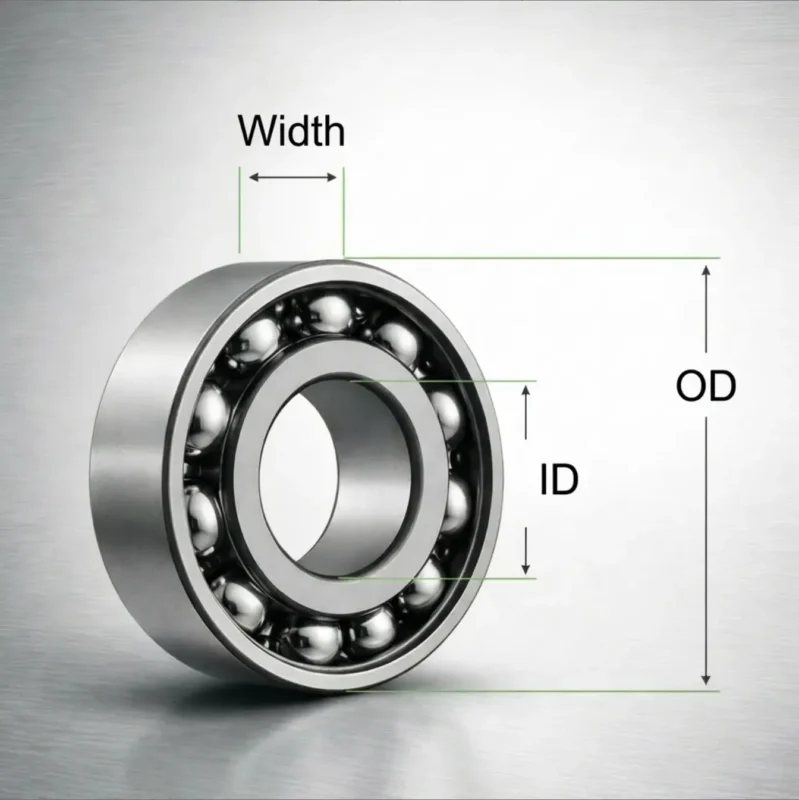
First of all, what is ball bearing size chart? A ball bearing size chart is a standardized reference table that lists the key dimensions and technical data of ball bearings. Most ball bearing size chart includes below information:
- Bearing Series
- Inner Diameter (ID / Bore)
- Outer Diameter (OD)
- Width (B)
And some tables also include the below information like:
- Dynamic Load Rating (C)
- Static Load Rating (C0)
- Limiting Speed
- Weight
- Tolerance Class
- Sealing / Shielding Type
- Material
- Operating Temperature Range
Since most ball bearings follow international ISO standards, their dimensions are globally standardized. This allows buyers to:
- Cross-reference bearing numbers across different brands to ensure dimensional compatibility
- Replace branded bearings with cost-effective compatible alternatives based on ISO standardized dimensions
The size chart is the foundation for correct bearing selection.
Part 2. Ball Bearing Dimension Charts
After understanding what a ball bearing size chart is, I will now show you some of the most popular ball bearing size charts. You may wonder why the full list is not included. The reason is simple: there are too many ball bearing types and series, and it is impossible to display all of them in one single article. If you cannot find the ball bearing you need here, you can contact BKZ Industry sales to obtain the exact model required, as BKZ Industry offers a full range of ball bearings.
Before reviewing the ball bearing size charts below, please note that load ratings and limiting speeds are reference values and may vary depending on the manufacturer, material quality, heat treatment, cage design, internal clearance, sealing type (open/ZZ/2RS), grease type, operating temperature, and installation conditions. For accurate selection and final confirmation, please consult with BKZ Industry.
And before checking all the tables, you need to understand the header meaning of the table:

- Model: The bearing designation that identifies the bearing type/series and bore size (different series may share the same bore but have different OD and width).
- ID (mm): The inner diameter of the bearing, which matches the shaft diameter.
- OD (mm): The outer diameter of the bearing, which matches the housing bore diameter.
- Width (mm): The bearing width (axial thickness), which affects the installation space and load capacity.
- Tolerance: The precision grade of the bearing (P0 is normal accuracy; higher grades like P6/P5 are used for higher speed or higher runout control).
- Weight (kg): The approximate bearing weight for reference in logistics and design.
- Dynamic Load C (kN): The basic dynamic load rating used for bearing life calculation under rotating load conditions.
- Static Load C₀ (kN): The basic static load rating showing the bearing’s resistance to permanent deformation under stationary or shock loads.
- Limiting Speed (r/min, Grease): The maximum recommended speed under grease lubrication; actual allowable speed depends strongly on grease type, clearance, sealing, load, and temperature.
Now, let’s check some size charts for deep groove ball bearings, thrust ball bearings, miniature ball bearings, self-aligning ball bearings, and angular contact ball bearings.
Deep Groove Ball Bearings (6000. 6200, 6400, 6800, 6900)
6000 Series (Light Series)
| Model | ID (mm) | OD (mm) | Width (mm) | Tolerance | Weight (kg) | Dynamic Load C (kN) | Static Load C0 (kN) | Limiting Speed (r/min, Grease) |
| 6000 | 10 | 26 | 8 | P0 | 0.019 | 4.5 | 1.95 | 26000 |
| 6001 | 12 | 28 | 8 | P0 | 0.022 | 5.1 | 2.4 | 24000 |
| 6002 | 15 | 32 | 9 | P0 | 0.030 | 5.6 | 2.8 | 22000 |
| 6003 | 17 | 35 | 10 | P0 | 0.039 | 6.8 | 3.35 | 20000 |
| 6004 | 20 | 42 | 12 | P0 | 0.069 | 9.4 | 5.0 | 18000 |
| 6005 | 25 | 47 | 12 | P0 | 0.080 | 10.1 | 5.9 | 16000 |
| 6006 | 30 | 55 | 13 | P0 | 0.116 | 13.2 | 8.0 | 14000 |
| 6007 | 35 | 62 | 14 | P0 | 0.155 | 16.8 | 10.3 | 13000 |
| 6008 | 40 | 68 | 15 | P0 | 0.190 | 19.5 | 12.0 | 12000 |
| 6009 | 45 | 75 | 16 | P0 | 0.245 | 22.5 | 14.5 | 11000 |
| 6010 | 50 | 80 | 16 | P0 | 0.260 | 23.5 | 15.8 | 10000 |
| 6011 | 55 | 90 | 18 | P0 | 0.362 | 29.5 | 19.0 | 9500 |
| 6012 | 60 | 95 | 18 | P0 | 0.380 | 31.0 | 20.0 | 9000 |
| 6013 | 65 | 100 | 18 | P0 | 0.420 | 33.0 | 22.0 | 8500 |
| 6014 | 70 | 110 | 20 | P0 | 0.550 | 38.0 | 26.0 | 8000 |
| 6015 | 75 | 115 | 20 | P0 | 0.590 | 41.0 | 28.0 | 7500 |
| 6016 | 80 | 125 | 22 | P0 | 0.780 | 48.0 | 33.0 | 7000 |
| 6017 | 85 | 130 | 22 | P0 | 0.820 | 50.0 | 36.0 | 6800 |
| 6018 | 90 | 140 | 24 | P0 | 1.05 | 57.0 | 40.0 | 6500 |
| 6019 | 95 | 145 | 24 | P0 | 1.10 | 60.0 | 43.0 | 6200 |
6200 Series (Medium Series)
| Model | ID (mm) | OD (mm) | Width (mm) | Tolerance | Weight (kg) | Dynamic Load C (kN) | Static Load C0 (kN) | Limiting Speed (r/min, Grease) |
| 6200 | 10 | 30 | 9 | P0 | 0.032 | 6.8 | 3.05 | 22000 |
| 6201 | 12 | 32 | 10 | P0 | 0.037 | 7.3 | 3.5 | 20000 |
| 6202 | 15 | 35 | 11 | P0 | 0.045 | 7.8 | 3.75 | 19000 |
| 6203 | 17 | 40 | 12 | P0 | 0.065 | 9.6 | 4.8 | 17000 |
| 6204 | 20 | 47 | 14 | P0 | 0.106 | 12.8 | 6.65 | 15000 |
| 6205 | 25 | 52 | 15 | P0 | 0.129 | 14.8 | 7.8 | 14000 |
| 6206 | 30 | 62 | 16 | P0 | 0.199 | 19.5 | 11.2 | 12000 |
| 6207 | 35 | 72 | 17 | P0 | 0.287 | 25.7 | 15.3 | 11000 |
| 6208 | 40 | 80 | 18 | P0 | 0.366 | 29.5 | 18.0 | 10000 |
| 6209 | 45 | 85 | 19 | P0 | 0.410 | 31.5 | 19.5 | 9500 |
| 6210 | 50 | 90 | 20 | P0 | 0.455 | 35.0 | 23.0 | 9000 |
| 6211 | 55 | 100 | 21 | P0 | 0.600 | 43.5 | 29.0 | 8500 |
| 6212 | 60 | 110 | 22 | P0 | 0.790 | 52.0 | 36.0 | 8000 |
| 6213 | 65 | 120 | 23 | P0 | 1.00 | 57.0 | 40.0 | 7500 |
| 6214 | 70 | 125 | 24 | P0 | 1.05 | 60.0 | 44.0 | 7200 |
| 6215 | 75 | 130 | 25 | P0 | 1.20 | 66.0 | 50.0 | 6800 |
| 6216 | 80 | 140 | 26 | P0 | 1.50 | 72.0 | 54.0 | 6500 |
| 6217 | 85 | 150 | 28 | P0 | 1.85 | 83.0 | 63.0 | 6000 |
| 6218 | 90 | 160 | 30 | P0 | 2.30 | 95.0 | 72.0 | 5600 |
| 6219 | 95 | 170 | 32 | P0 | 2.90 | 108 | 81.0 | 5200 |
6400 Series (Heavy Series)
| Model | ID (mm) | OD (mm) | Width (mm) | Tolerance | Weight (kg) | Dynamic Load C (kN) | Static Load C0 (kN) | Limiting Speed (r/min, Grease) |
| 6403 | 17 | 62 | 17 | P0 | 0.26 | 22.5 | 11.5 | 11000 |
| 6404 | 20 | 72 | 19 | P0 | 0.40 | 30.7 | 15.8 | 9500 |
| 6405 | 25 | 80 | 21 | P0 | 0.54 | 38.5 | 20.5 | 8500 |
| 6406 | 30 | 90 | 23 | P0 | 0.75 | 48.0 | 27.5 | 7500 |
| 6407 | 35 | 100 | 25 | P0 | 1.05 | 60.0 | 36.0 | 7000 |
| 6408 | 40 | 110 | 27 | P0 | 1.45 | 72.0 | 44.0 | 6500 |
| 6409 | 45 | 120 | 29 | P0 | 1.95 | 83.0 | 52.0 | 6000 |
| 6410 | 50 | 130 | 31 | P0 | 2.55 | 98.0 | 65.0 | 5600 |
| 6411 | 55 | 140 | 33 | P0 | 3.20 | 110 | 75.0 | 5200 |
| 6412 | 60 | 150 | 35 | P0 | 3.95 | 125 | 88.0 | 4800 |
| 6413 | 65 | 160 | 37 | P0 | 4.80 | 138 | 100 | 4500 |
| 6414 | 70 | 180 | 42 | P0 | 6.50 | 165 | 125 | 4000 |
| 6415 | 75 | 190 | 45 | P0 | 7.50 | 180 | 140 | 3800 |
| 6416 | 80 | 200 | 48 | P0 | 8.80 | 195 | 160 | 3600 |
| 6417 | 85 | 210 | 52 | P0 | 10.5 | 210 | 180 | 3400 |
| 6418 | 90 | 225 | 54 | P0 | 13.0 | 235 | 205 | 3200 |
| 6419 | 95 | 240 | 55 | P0 | 15.0 | 260 | 230 | 3000 |
| 6420 | 100 | 250 | 58 | P0 | 18.0 | 280 | 255 | 2800 |
| 6422 | 110 | 280 | 65 | P0 | 25.0 | 330 | 310 | 2500 |
| 6424 | 120 | 310 | 72 | P0 | 35.0 | 380 | 360 | 2200 |
6800 Series (Thin Section)
| Model | ID (mm) | OD (mm) | Width (mm) | Tolerance | Weight (kg) | Dynamic Load C (kN) | Static Load C0 (kN) | Limiting Speed (r/min, Grease) |
| 6800 | 10 | 19 | 5 | P0 | 0.006 | 1.9 | 0.9 | 32000 |
| 6801 | 12 | 21 | 5 | P0 | 0.007 | 2.2 | 1.05 | 30000 |
| 6802 | 15 | 24 | 5 | P0 | 0.009 | 2.6 | 1.25 | 28000 |
| 6803 | 17 | 26 | 5 | P0 | 0.011 | 3.0 | 1.45 | 26000 |
| 6804 | 20 | 32 | 7 | P0 | 0.020 | 5.0 | 2.7 | 22000 |
| 6805 | 25 | 37 | 7 | P0 | 0.025 | 5.9 | 3.4 | 20000 |
| 6806 | 30 | 42 | 7 | P0 | 0.030 | 6.7 | 4.1 | 18000 |
| 6807 | 35 | 47 | 7 | P0 | 0.040 | 7.8 | 4.8 | 17000 |
| 6808 | 40 | 52 | 7 | P0 | 0.045 | 8.5 | 5.2 | 16000 |
| 6809 | 45 | 58 | 7 | P0 | 0.055 | 9.5 | 6.0 | 15000 |
| 6810 | 50 | 65 | 7 | P0 | 0.065 | 10.5 | 6.8 | 14000 |
| 6811 | 55 | 72 | 9 | P0 | 0.095 | 13.0 | 8.5 | 13000 |
| 6812 | 60 | 78 | 10 | P0 | 0.120 | 15.0 | 10.0 | 12000 |
| 6813 | 65 | 85 | 10 | P0 | 0.150 | 17.0 | 11.5 | 11000 |
| 6814 | 70 | 90 | 10 | P0 | 0.170 | 18.5 | 13.0 | 10500 |
| 6815 | 75 | 95 | 10 | P0 | 0.180 | 19.5 | 14.0 | 10000 |
| 6816 | 80 | 100 | 10 | P0 | 0.190 | 21.0 | 15.5 | 9500 |
| 6817 | 85 | 110 | 13 | P0 | 0.300 | 26.0 | 20.0 | 9000 |
| 6818 | 90 | 115 | 13 | P0 | 0.320 | 28.0 | 22.0 | 8500 |
| 6819 | 95 | 120 | 13 | P0 | 0.350 | 30.0 | 24.0 | 8000 |
6900 Series (Slim Series)
| Model | ID (mm) | OD (mm) | Width (mm) | Tolerance | Weight (kg) | Dynamic Load C (kN) | Static Load C0 (kN) | Limiting Speed (r/min, Grease) |
| 6900 | 10 | 22 | 6 | P0 | 0.010 | 2.7 | 1.25 | 30000 |
| 6901 | 12 | 24 | 6 | P0 | 0.012 | 3.1 | 1.55 | 28000 |
| 6902 | 15 | 28 | 7 | P0 | 0.016 | 4.0 | 2.0 | 24000 |
| 6903 | 17 | 30 | 7 | P0 | 0.018 | 4.3 | 2.15 | 22000 |
| 6904 | 20 | 37 | 9 | P0 | 0.036 | 7.2 | 3.8 | 18000 |
| 6905 | 25 | 42 | 9 | P0 | 0.042 | 8.0 | 4.5 | 16000 |
| 6906 | 30 | 47 | 9 | P0 | 0.050 | 9.0 | 5.2 | 15000 |
| 6907 | 35 | 55 | 10 | P0 | 0.080 | 12.0 | 7.0 | 14000 |
| 6908 | 40 | 62 | 12 | P0 | 0.120 | 15.5 | 9.5 | 12000 |
| 6909 | 45 | 68 | 12 | P0 | 0.140 | 17.0 | 10.5 | 11000 |
| 6910 | 50 | 72 | 12 | P0 | 0.150 | 18.5 | 11.5 | 10500 |
| 6911 | 55 | 80 | 13 | P0 | 0.220 | 22.0 | 14.0 | 9500 |
| 6912 | 60 | 85 | 13 | P0 | 0.240 | 24.0 | 15.5 | 9000 |
| 6913 | 65 | 90 | 13 | P0 | 0.260 | 26.0 | 17.0 | 8500 |
| 6914 | 70 | 100 | 16 | P0 | 0.420 | 33.0 | 23.0 | 8000 |
| 6915 | 75 | 105 | 16 | P0 | 0.450 | 35.0 | 25.0 | 7600 |
| 6916 | 80 | 110 | 16 | P0 | 0.480 | 37.0 | 27.0 | 7200 |
| 6917 | 85 | 120 | 18 | P0 | 0.650 | 42.0 | 32.0 | 6800 |
| 6918 | 90 | 125 | 18 | P0 | 0.700 | 45.0 | 34.0 | 6500 |
| 6919 | 95 | 130 | 18 | P0 | 0.750 | 47.0 | 36.0 | 6200 |
Thrust Ball Bearings(511, 512 series)
511 Series – Thrust Ball Bearings (Light Thrust Series)
| Model | Bore d (mm) | Outside D (mm) | Height H (mm) | Tolerance | Weight (kg) | Dynamic Load C (kN) | Static Load C0 (kN) | Limiting Speed (r/min, Grease) |
| 51100 | 10 | 24 | 9 | P0 | 0.018 | 5.1 | 9.5 | 12000 |
| 51101 | 12 | 26 | 9 | P0 | 0.020 | 5.8 | 11.0 | 11000 |
| 51102 | 15 | 28 | 9 | P0 | 0.022 | 6.4 | 12.8 | 10000 |
| 51103 | 17 | 30 | 9 | P0 | 0.025 | 7.0 | 14.5 | 9500 |
| 51104 | 20 | 35 | 10 | P0 | 0.040 | 8.9 | 20.0 | 8500 |
| 51105 | 25 | 42 | 11 | P0 | 0.060 | 12.5 | 28.0 | 7500 |
| 51106 | 30 | 47 | 11 | P0 | 0.080 | 15.0 | 35.5 | 7000 |
| 51107 | 35 | 52 | 12 | P0 | 0.110 | 18.2 | 44.0 | 6500 |
| 51108 | 40 | 60 | 13 | P0 | 0.160 | 22.0 | 55.0 | 6000 |
| 51109 | 45 | 65 | 14 | P0 | 0.200 | 25.5 | 65.0 | 5500 |
| 51110 | 50 | 70 | 14 | P0 | 0.230 | 29.0 | 76.0 | 5000 |
| 51111 | 55 | 78 | 16 | P0 | 0.330 | 35.0 | 92.0 | 4500 |
| 51112 | 60 | 85 | 17 | P0 | 0.420 | 41.0 | 110 | 4200 |
| 51113 | 65 | 90 | 18 | P0 | 0.480 | 45.0 | 125 | 4000 |
| 51114 | 70 | 95 | 18 | P0 | 0.520 | 49.0 | 140 | 3800 |
512 Series – Thrust Ball Bearings (Medium Thrust Series)
| Model | Bore d (mm) | Outside D (mm) | Height H (mm) | Tolerance | Weight (kg) | Dynamic Load C (kN) | Static Load C0 (kN) | Limiting Speed (r/min, Grease) |
| 51200 | 10 | 26 | 11 | P0 | 0.030 | 7.5 | 15.0 | 10000 |
| 51201 | 12 | 28 | 11 | P0 | 0.032 | 8.3 | 17.5 | 9500 |
| 51202 | 15 | 32 | 12 | P0 | 0.045 | 10.2 | 23.0 | 9000 |
| 51203 | 17 | 35 | 12 | P0 | 0.050 | 11.5 | 26.0 | 8500 |
| 51204 | 20 | 40 | 14 | P0 | 0.080 | 15.0 | 36.0 | 7500 |
| 51205 | 25 | 47 | 15 | P0 | 0.120 | 21.0 | 50.0 | 7000 |
| 51206 | 30 | 52 | 16 | P0 | 0.160 | 24.5 | 62.0 | 6500 |
| 51207 | 35 | 62 | 18 | P0 | 0.260 | 32.0 | 80.0 | 6000 |
| 51208 | 40 | 68 | 19 | P0 | 0.320 | 38.0 | 98.0 | 5500 |
| 51209 | 45 | 73 | 20 | P0 | 0.380 | 42.0 | 110 | 5200 |
| 51210 | 50 | 78 | 22 | P0 | 0.450 | 48.0 | 125 | 5000 |
| 51211 | 55 | 90 | 25 | P0 | 0.700 | 60.0 | 160 | 4500 |
| 51212 | 60 | 95 | 26 | P0 | 0.800 | 65.0 | 175 | 4200 |
| 51213 | 65 | 100 | 27 | P0 | 0.900 | 70.0 | 190 | 4000 |
| 51214 | 70 | 105 | 27 | P0 | 0.950 | 75.0 | 205 | 3800 |
Miniature Ball Bearings(604-698 series)
| Model | Bore d (mm) | Outside D (mm) | Width B (mm) | Weight (kg) | Dynamic Load C (kN) | Static Load C0 (kN) | Limiting Speed (r/min, Grease) |
| 604 | 4 | 12 | 4 | 0.002 | 0.95 | 0.36 | 45000 |
| 605 | 5 | 14 | 5 | 0.004 | 1.30 | 0.51 | 42000 |
| 606 | 6 | 17 | 6 | 0.007 | 2.05 | 0.78 | 38000 |
| 607 | 7 | 19 | 6 | 0.008 | 2.40 | 0.95 | 36000 |
| 608 | 8 | 22 | 7 | 0.012 | 3.35 | 1.37 | 34000 |
| 609 | 9 | 24 | 7 | 0.014 | 3.60 | 1.55 | 32000 |
| 623 | 3 | 10 | 4 | 0.001 | 0.63 | 0.24 | 48000 |
| 624 | 4 | 13 | 5 | 0.003 | 1.05 | 0.40 | 44000 |
| 625 | 5 | 16 | 5 | 0.005 | 1.70 | 0.68 | 40000 |
| 626 | 6 | 19 | 6 | 0.008 | 2.45 | 0.98 | 36000 |
| 627 | 7 | 22 | 7 | 0.013 | 3.30 | 1.37 | 34000 |
| 628 | 8 | 24 | 8 | 0.017 | 3.90 | 1.75 | 32000 |
| 629 | 9 | 26 | 8 | 0.019 | 4.55 | 2.05 | 30000 |
| 684 | 4 | 9 | 4 | 0.001 | 0.62 | 0.22 | 50000 |
| 685 | 5 | 11 | 5 | 0.002 | 0.90 | 0.33 | 48000 |
| 686 | 6 | 13 | 5 | 0.003 | 1.20 | 0.46 | 45000 |
| 687 | 7 | 14 | 5 | 0.004 | 1.35 | 0.52 | 42000 |
| 688 | 8 | 16 | 5 | 0.006 | 1.70 | 0.70 | 40000 |
| 689 | 9 | 17 | 5 | 0.007 | 1.85 | 0.78 | 38000 |
| 694 | 4 | 11 | 4 | 0.0015 | 0.85 | 0.32 | 48000 |
| 695 | 5 | 13 | 4 | 0.002 | 1.10 | 0.42 | 45000 |
| 696 | 6 | 15 | 5 | 0.003 | 1.55 | 0.60 | 42000 |
| 697 | 7 | 17 | 5 | 0.004 | 1.95 | 0.78 | 40000 |
| 698 | 8 | 19 | 6 | 0.007 | 2.60 | 1.08 | 38000 |
Self-aligning Ball Bearings (1200 / 2200 /2300 Series)
1200 Series – Self-Aligning Ball Bearings
| Model | Bore d (mm) | Outside D (mm) | Width B (mm) | Weight (kg) | Dynamic C (kN) | Static C0 (kN) | Speed (r/min, Grease) |
| 1200 | 10 | 30 | 9 | 0.030 | 7.2 | 1.8 | 22000 |
| 1201 | 12 | 32 | 10 | 0.040 | 7.8 | 2.0 | 20000 |
| 1202 | 15 | 35 | 11 | 0.050 | 8.9 | 2.4 | 19000 |
| 1203 | 17 | 40 | 12 | 0.080 | 9.6 | 2.8 | 17000 |
| 1204 | 20 | 47 | 14 | 0.120 | 12.5 | 3.6 | 15000 |
| 1205 | 25 | 52 | 15 | 0.150 | 14.8 | 4.5 | 14000 |
| 1206 | 30 | 62 | 16 | 0.230 | 19.5 | 6.2 | 12000 |
| 1207 | 35 | 72 | 17 | 0.350 | 25.5 | 8.5 | 11000 |
| 1208 | 40 | 80 | 18 | 0.420 | 29.0 | 10.0 | 10000 |
| 1209 | 45 | 85 | 19 | 0.480 | 31.5 | 11.5 | 9500 |
| 1210 | 50 | 90 | 20 | 0.550 | 35.0 | 13.0 | 9000 |
| 1211 | 55 | 100 | 21 | 0.700 | 43.0 | 16.5 | 8500 |
| 1212 | 60 | 110 | 22 | 0.900 | 52.0 | 21.0 | 8000 |
| 1213 | 65 | 120 | 23 | 1.100 | 57.0 | 24.0 | 7500 |
| 1214 | 70 | 125 | 24 | 1.200 | 60.0 | 26.0 | 7200 |
| 1215 | 75 | 130 | 25 | 1.350 | 66.0 | 30.0 | 6800 |
2200 Series – Self-Aligning Ball Bearings
| Model | Bore d (mm) | Outside D (mm) | Width B (mm) | Weight (kg) | Dynamic C (kN) | Static C0 (kN) | Speed (r/min, Grease) |
| 2200 | 10 | 30 | 14 | 0.050 | 9.5 | 2.8 | 20000 |
| 2201 | 12 | 32 | 14 | 0.060 | 10.2 | 3.1 | 19000 |
| 2202 | 15 | 35 | 14 | 0.070 | 11.0 | 3.6 | 18000 |
| 2203 | 17 | 40 | 16 | 0.120 | 14.5 | 5.0 | 16000 |
| 2204 | 20 | 47 | 18 | 0.200 | 19.8 | 7.2 | 14000 |
| 2205 | 25 | 52 | 18 | 0.230 | 21.5 | 8.2 | 13000 |
| 2206 | 30 | 62 | 20 | 0.360 | 28.0 | 11.5 | 11000 |
| 2207 | 35 | 72 | 23 | 0.550 | 35.5 | 15.0 | 10000 |
| 2208 | 40 | 80 | 23 | 0.620 | 39.0 | 17.5 | 9500 |
| 2209 | 45 | 85 | 23 | 0.680 | 42.0 | 19.0 | 9000 |
| 2210 | 50 | 90 | 23 | 0.750 | 45.0 | 21.0 | 8500 |
| 2211 | 55 | 100 | 25 | 1.000 | 57.0 | 26.0 | 8000 |
| 2212 | 60 | 110 | 28 | 1.400 | 70.0 | 33.0 | 7500 |
| 2213 | 65 | 120 | 31 | 1.900 | 83.0 | 40.0 | 7000 |
| 2214 | 70 | 125 | 31 | 2.000 | 90.0 | 45.0 | 6800 |
| 2215 | 75 | 130 | 31 | 2.100 | 95.0 | 50.0 | 6500 |
| 2216 | 80 | 140 | 33 | 2.600 | 110 | 60.0 | 6200 |
| 2217 | 85 | 150 | 36 | 3.300 | 125 | 72.0 | 5800 |
| 2218 | 90 | 160 | 40 | 4.200 | 150 | 85.0 | 5400 |
2300 Series – Self-Aligning Ball Bearings
| Model | Bore d (mm) | Outside D (mm) | Width B (mm) | Weight (kg) | Dynamic C (kN) | Static C0 (kN) | Speed (r/min, Grease) |
| 2305 | 25 | 62 | 24 | 0.450 | 32.0 | 12.5 | 9500 |
| 2306 | 30 | 72 | 27 | 0.700 | 42.0 | 17.0 | 8500 |
| 2307 | 35 | 80 | 31 | 1.000 | 52.0 | 22.0 | 7500 |
| 2308 | 40 | 90 | 33 | 1.400 | 64.0 | 27.0 | 6800 |
| 2309 | 45 | 100 | 36 | 1.900 | 78.0 | 33.0 | 6200 |
| 2310 | 50 | 110 | 40 | 2.500 | 92.0 | 40.0 | 5800 |
| 2311 | 55 | 120 | 43 | 3.200 | 110 | 50.0 | 5200 |
| 2312 | 60 | 130 | 46 | 4.000 | 125 | 60.0 | 4800 |
| 2313 | 65 | 140 | 48 | 5.000 | 140 | 72.0 | 4500 |
| 2314 | 70 | 150 | 51 | 6.200 | 160 | 85.0 | 4200 |
| 2315 | 75 | 160 | 55 | 7.800 | 180 | 100 | 4000 |
| 2316 | 80 | 170 | 58 | 9.500 | 205 | 115 | 3800 |
| 2317 | 85 | 180 | 60 | 11.0 | 220 | 130 | 3600 |
| 2318 | 90 | 190 | 64 | 13.0 | 250 | 150 | 3400 |
| 2319 | 95 | 200 | 67 | 15.5 | 280 | 170 | 3200 |
| 2320 | 100 | 215 | 73 | 19.0 | 310 | 195 | 3000 |
| 2322 | 110 | 240 | 80 | 26.0 | 380 | 250 | 2700 |
| 2324 | 120 | 260 | 86 | 33.0 | 440 | 300 | 2500 |
Angular Contact Ball Bearings(Single Row/Double Row)
Single Row Angular Contact Ball Bearings (7000 Series)
| Model | Bore d (mm) | Outside D (mm) | Width B (mm) | Contact Angle | Weight (kg) | Dynamic Load C (kN) | Static Load C0 (kN) | Limiting Speed (r/min, Grease) |
| 7000 | 10 | 26 | 8 | 15°/40° | 0.018 | 5.0 | 2.2 | 26000 |
| 7001 | 12 | 28 | 8 | 15°/40° | 0.020 | 5.5 | 2.5 | 24000 |
| 7002 | 15 | 32 | 9 | 15°/40° | 0.030 | 6.8 | 3.4 | 22000 |
| 7003 | 17 | 35 | 10 | 15°/40° | 0.040 | 7.5 | 3.8 | 20000 |
| 7004 | 20 | 42 | 12 | 15°/40° | 0.070 | 9.8 | 5.2 | 18000 |
| 7005 | 25 | 47 | 12 | 15°/40° | 0.080 | 10.5 | 5.8 | 16000 |
| 7006 | 30 | 55 | 13 | 15°/40° | 0.120 | 14.5 | 8.5 | 14000 |
| 7007 | 35 | 62 | 14 | 15°/40° | 0.160 | 18.0 | 11.0 | 13000 |
| 7008 | 40 | 68 | 15 | 15°/40° | 0.200 | 20.0 | 13.0 | 12000 |
| 7009 | 45 | 75 | 16 | 15°/40° | 0.260 | 23.0 | 15.5 | 11000 |
| 7010 | 50 | 80 | 16 | 15°/40° | 0.280 | 24.5 | 17.0 | 10000 |
| 7011 | 55 | 90 | 18 | 15°/40° | 0.380 | 30.0 | 21.0 | 9500 |
| 7012 | 60 | 95 | 18 | 15°/40° | 0.400 | 32.0 | 23.0 | 9000 |
| 7013 | 65 | 100 | 18 | 15°/40° | 0.420 | 34.0 | 25.0 | 8500 |
| 7014 | 70 | 110 | 20 | 15°/40° | 0.600 | 40.0 | 30.0 | 8000 |
| 7015 | 75 | 115 | 20 | 15°/40° | 0.650 | 43.0 | 33.0 | 7500 |
| 7016 | 80 | 125 | 22 | 15°/40° | 0.900 | 50.0 | 40.0 | 7000 |
| 7017 | 85 | 130 | 22 | 15°/40° | 0.950 | 52.0 | 42.0 | 6800 |
| 7018 | 90 | 140 | 24 | 15°/40° | 1.200 | 60.0 | 50.0 | 6500 |
| 7019 | 95 | 145 | 24 | 15°/40° | 1.300 | 63.0 | 53.0 | 6200 |
Double Row Angular Contact Ball Bearings (3200 / 3300 Series)
| Model | Bore d (mm) | Outside D (mm) | Width B (mm) | Contact Angle | Weight (kg) | Dynamic Load C (kN) | Static Load C0 (kN) | Limiting Speed (r/min, Grease) |
| 3200 | 10 | 30 | 14 | 30° | 0.050 | 9.5 | 4.8 | 18000 |
| 3201 | 12 | 32 | 15 | 30° | 0.060 | 10.5 | 5.5 | 17000 |
| 3202 | 15 | 35 | 15 | 30° | 0.070 | 12.0 | 6.5 | 16000 |
| 3203 | 17 | 40 | 17 | 30° | 0.120 | 15.5 | 8.5 | 15000 |
| 3204 | 20 | 47 | 20 | 30° | 0.200 | 21.0 | 12.5 | 13000 |
| 3205 | 25 | 52 | 20 | 30° | 0.230 | 23.0 | 14.0 | 12000 |
| 3206 | 30 | 62 | 23 | 30° | 0.360 | 30.0 | 19.0 | 11000 |
| 3207 | 35 | 72 | 27 | 30° | 0.600 | 40.0 | 26.0 | 10000 |
| 3208 | 40 | 80 | 30 | 30° | 0.800 | 50.0 | 34.0 | 9000 |
| 3209 | 45 | 85 | 30 | 30° | 0.900 | 55.0 | 38.0 | 8500 |
| 3210 | 50 | 90 | 30 | 30° | 1.000 | 60.0 | 42.0 | 8000 |
| 3305 | 25 | 62 | 25 | 30° | 0.350 | 30.5 | 19.5 | 11000 |
| 3306 | 30 | 72 | 30 | 30° | 0.600 | 41.0 | 28.0 | 9500 |
| 3307 | 35 | 80 | 34 | 30° | 0.900 | 52.0 | 37.0 | 8500 |
| 3308 | 40 | 90 | 36 | 30° | 1.200 | 64.0 | 46.0 | 7800 |
| 3309 | 45 | 100 | 39 | 30° | 1.600 | 75.0 | 55.0 | 7000 |
| 3310 | 50 | 110 | 44 | 30° | 2.100 | 92.0 | 70.0 | 6500 |
| 3311 | 55 | 120 | 49 | 30° | 2.700 | 110 | 85.0 | 6000 |
| 3312 | 60 | 130 | 54 | 30° | 3.400 | 125 | 100 | 5600 |
| 3313 | 65 | 140 | 58 | 30° | 4.200 | 145 | 120 | 5200 |
Part 3. Problems of Choosing Wrong Ball Bearings
Now that you have reviewed the ball bearing size charts, you may be ready to select the required model. However, before making a final decision, you must clearly understand the serious consequences of choosing the wrong ball bearing.
If the bearing selection is incorrect, the impact can be significant. Even when the installation dimensions (ID, OD, and width) match, improper load rating, internal clearance, precision grade, or bearing type selection can still lead to performance and reliability problems.
- Increased Friction, Overheating and Reduced Life Service
If the bearing load rating is too low, or the internal clearance is not suitable, friction will increase during operation.
Higher friction generates excessive heat, which accelerates grease deterioration and surface wear. As a result, the bearing service life will be much shorter than expected, and the shaft may also be damaged.

- Reduced Efficiency with Frequent Stops
Wrong ball bearings may not support the required radial or axial load properly. This can cause unstable rotation, increased resistance, and frequent shutdowns. In industrial applications, this directly reduces production efficiency and increases maintenance costs.
- Vibration and Noise
Improper precision grade, poor fit tolerance, or incorrect bearing type can lead to abnormal vibration and noise. This is especially critical in electric motors, office equipment, and household appliances where quiet operation is required.
- Safety Problems
In heavy-duty machinery, bearing failure may cause shaft seizure, sudden machine stoppage, or even mechanical damage. In some cases, it can create serious safety risks for operators and equipment.
With so many potential problems, choosing the correct ball bearing is extremely important. If you are unsure which model is suitable for your application, we highly recommend contacting BKZ Industry sales for professional selection advice and technical support.
Part 4. How to Choose the Ball Bearing?
If you are confident that you can select the ball bearing by yourself, you can follow the steps below to make a proper and professional selection.
Step 1. Understand Your Application
First, clearly define your working conditions:
- Radial or axial load
- Load magnitude
- Speed (RPM)
- Working temperature
- Working environment (dust, water, vibration, etc.)
- Installation space
Understanding these factors is critical because bearing type, clearance, precision grade, and sealing structure are all determined by real operating conditions — not only by size.
Step 2. Measure the Required Size and Specifications
Accurately measure:
- Shaft diameter (bearing inner diameter requirement)
- Housing bore size (outer diameter requirement)
- Available installation width
- Fit tolerance between shaft and housing
- Required service life (if calculation is needed)
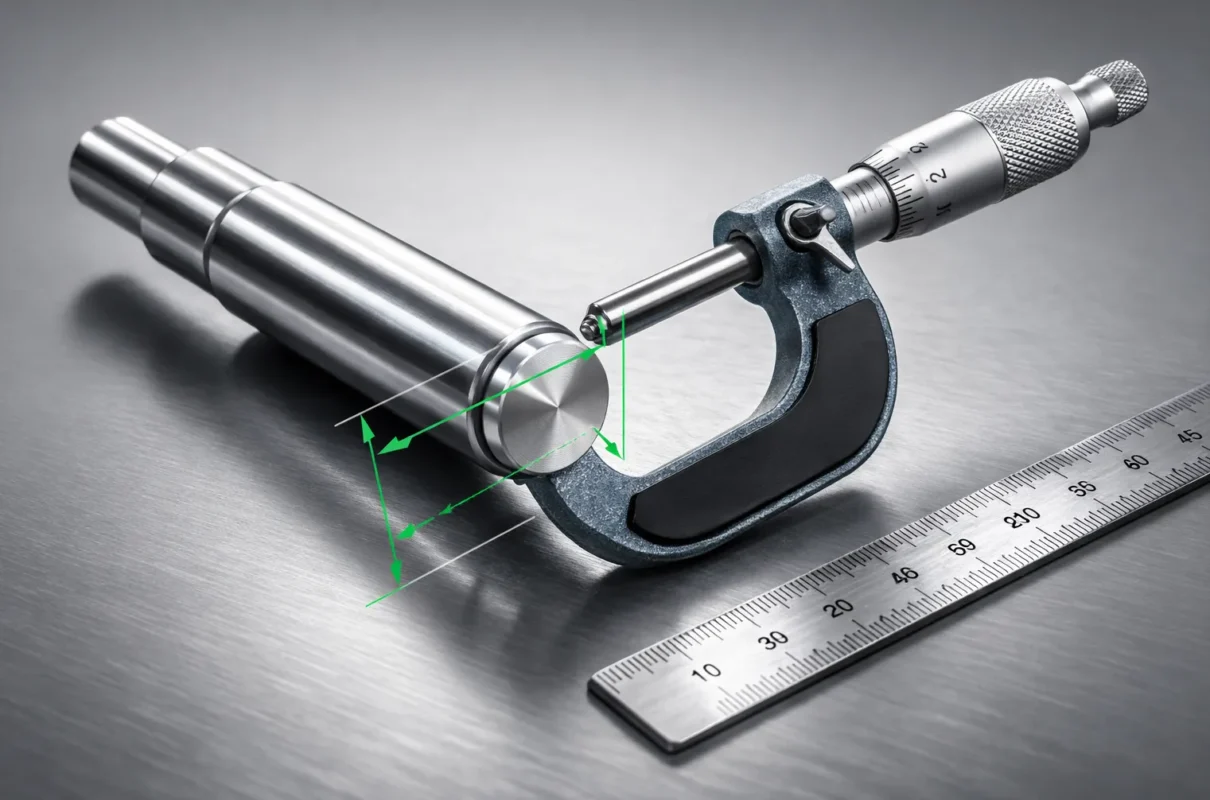
Correct measurement is the foundation of proper bearing selection.
Step 3. Check the Ball Bearing Size Chart
Based on shaft diameter, housing size, and width limitation, find the suitable model in the ball bearing size chart.
If you are not sure, you can send your application information to BKZ Industry sales for professional selection support.
Step 4. Confirm with the Manufacturer
Confirm important technical details such as:
- Internal clearance (C0, C3, etc.)
- Precision class (P0, P6, P5)
- Sealing type (ZZ, 2RS, open)
- Lubrication type
This ensures the bearing matches your real working conditions.
Step 4. Test Samples
Buy some samples for testing before bulk order.
Step 5. Place Bulk Order
After verification, proceed with bulk purchasing.
Correct selection can reduce failure risk, improve efficiency, and extend service life.
Part 5. How Do I Measure Ball Bearing?
From the steps of choosing ball bearings, you can see that measurement is one of the most important steps.
If you want to find the correct bearing from the ball bearing size chart, the first and most critical step is obtaining accurate dimensions. Even a small measurement error may lead to wrong selection, improper fit, abnormal heat generation, vibration, or early bearing failure.
There are different situations depending on whether you have the old bearing.
If You Have the Old Bearing
The easiest and most reliable way is to measure the existing bearing directly.
There are three critical dimensions for any standard ball bearing:
- Inner Diameter (ID)
- Outer Diameter (OD)
- Width (B)
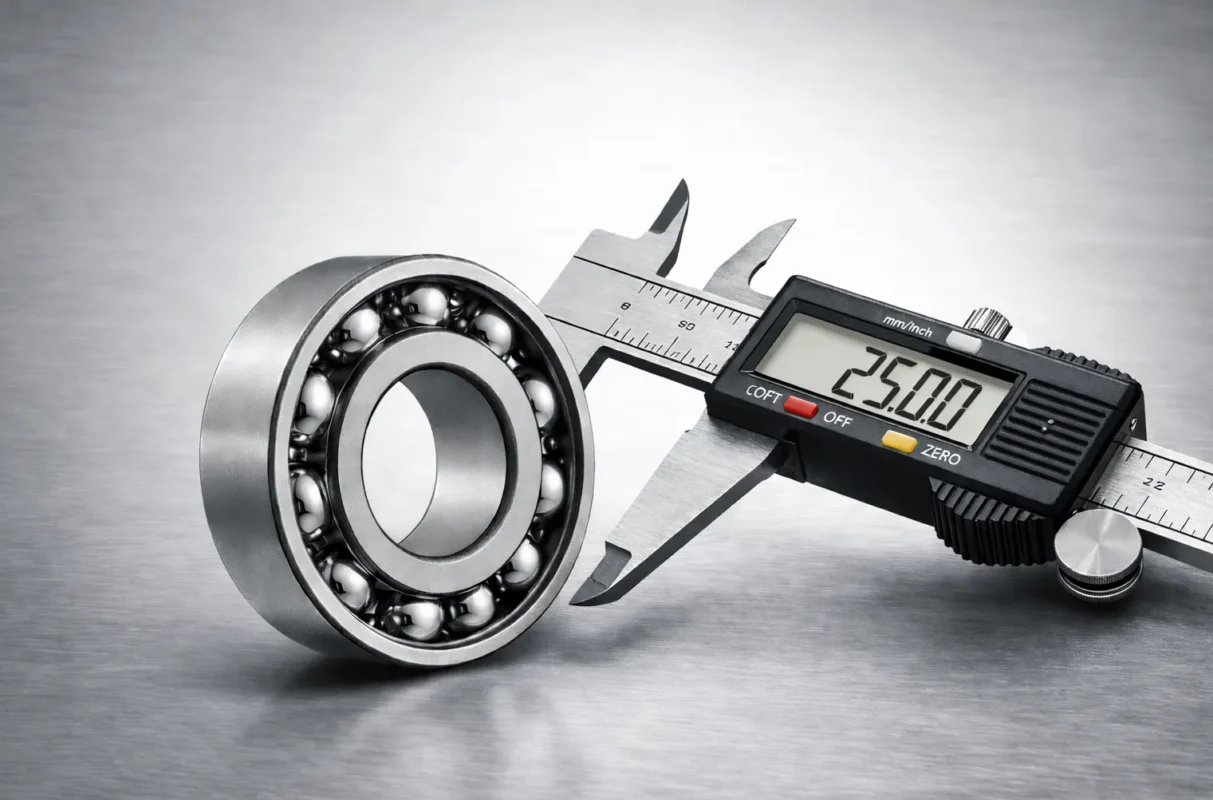
Step 1: Measure Inner Diameter (ID)
Measure the bore (inside hole) of the bearing using:
- Vernier caliper (recommended)
- Micrometer (for higher precision requirement)
Do NOT use a ruler. Even a small error will result in choosing the wrong model.
Step 2: Measure Outer Diameter (OD)
Measure the external diameter carefully. Make sure the caliper is straight and fully in contact with the outer ring.
Step 3: Measure the Width (B)
Measure the total thickness of the bearing. Different bearing series may share the same bore size but have different widths.
Once you have the three dimensions (ID × OD × Width), you can search the ball bearing size chart to identify the correct bearing number.
Example:
25 × 52 × 15 mm → 6205 bearing.
This is the most common method for bearing replacement.
If You Know the Bearing Series
If the bearing number is still visible, such as 6204-2RS, the process is much easier.
You can directly search the model number in the ball bearing size chart to confirm:
- Dimensions
- Dynamic load rating (C)
- Static load rating (C0)
- Limiting speed
- Seal or shield type
This avoids measurement errors and ensures fast and accurate confirmation.
If You Do NOT Have the Old Bearing
If the old bearing is missing, damaged, or you are designing a new project, you must measure the machine components instead of the bearing itself.
In this case, you need to measure the installation positions:
Step 1: Measure the Shaft Diameter
Use a vernier caliper or micrometer to measure the shaft where the bearing inner ring will be installed. This dimension determines the bearing inner diameter (ID).
Step 2: Measure the Housing Bore Diameter
Measure the internal diameter of the housing where the outer ring will fit. This dimension determines the bearing outer diameter (OD).
Step 3: Measure the Available Installation Width
Measure the axial space available for the bearing. This determines the maximum allowable bearing width (B).
After confirming the installation dimensions, you must also determine:
- Radial load
- Axial (thrust) load
- Rotating speed (RPM)
- Working temperature
- Working environment (dust, water, chemicals, vibration, etc.)
These parameters are critical because bearing selection is not only based on dimension, but also on load capacity, speed capability, clearance class, and sealing design.
With this complete information, a professional bearing manufacturer can calculate and recommend the correct model. For example, you can contact BKZ Industry sales for technical recommendation to ensure the bearing is correctly selected for your application.
Part 6. Applications for Ball Bearings
Ball bearings are widely used in various industries because of their low friction, high speed capability, and simple structure. According to different load and working conditions, they can be applied in light-duty, medium-duty, and heavy-duty industries.
Low-Duty Industry
In light-load and high-speed applications, ball bearings are commonly used in:
- Household appliances
- Electric fans
- Office equipment
These applications usually require low noise, smooth rotation, and stable performance.
Medium-Duty Industry
For moderate load and continuous operation conditions, ball bearings are widely used in:
- Electric motors
- Pumps
- Agricultural equipment
In these environments, bearings must provide stable load capacity, reliable sealing, and long service life.
Heavy-Duty Industry
In higher load and more demanding working environments, ball bearings are applied in:
- Gearboxes
- Steel industry machinery
- Mining equipment
- Construction machinery
These applications require proper load rating selection, suitable clearance, and strong sealing performance to ensure reliability under harsh conditions.
Part 7. FAQS about Ball Bearing Size Chart
Q1. How to Download Ball Bearing Size Chart in PDF?
The complete ball bearing size chart PDF is usually very large and includes many bearing series and technical data. Most companies do not publish the full version online.
If you cannot find the ball bearing you need from the downloaded PDF ball bearing size chart, you can contact a manufacturer like BKZ Industry to request the specific series you need.
Q2. How to Get Ball Bearing Size Chart for SKF?
You can visit SKF official website here to get the ball bearing size chart. If you want to find the ball bearing that meets your requirement with the same quality and lower price, you can contact BKZ Industry to get the ball bearing you need directly.
Final Words
A ball bearing size chart is not just a table of dimensions. It is a technical selection tool that directly affects machine reliability, efficiency, and service life.
Always confirm dimensions, load ratings, speed limits, and working conditions before purchasing. If you are not fully confident in your selection, BKZ Industry is ready to support you with professional bearing solutions.